How Cars Work · Suck, Squeeze, Bang, Blow
Four cylinders, taking turns
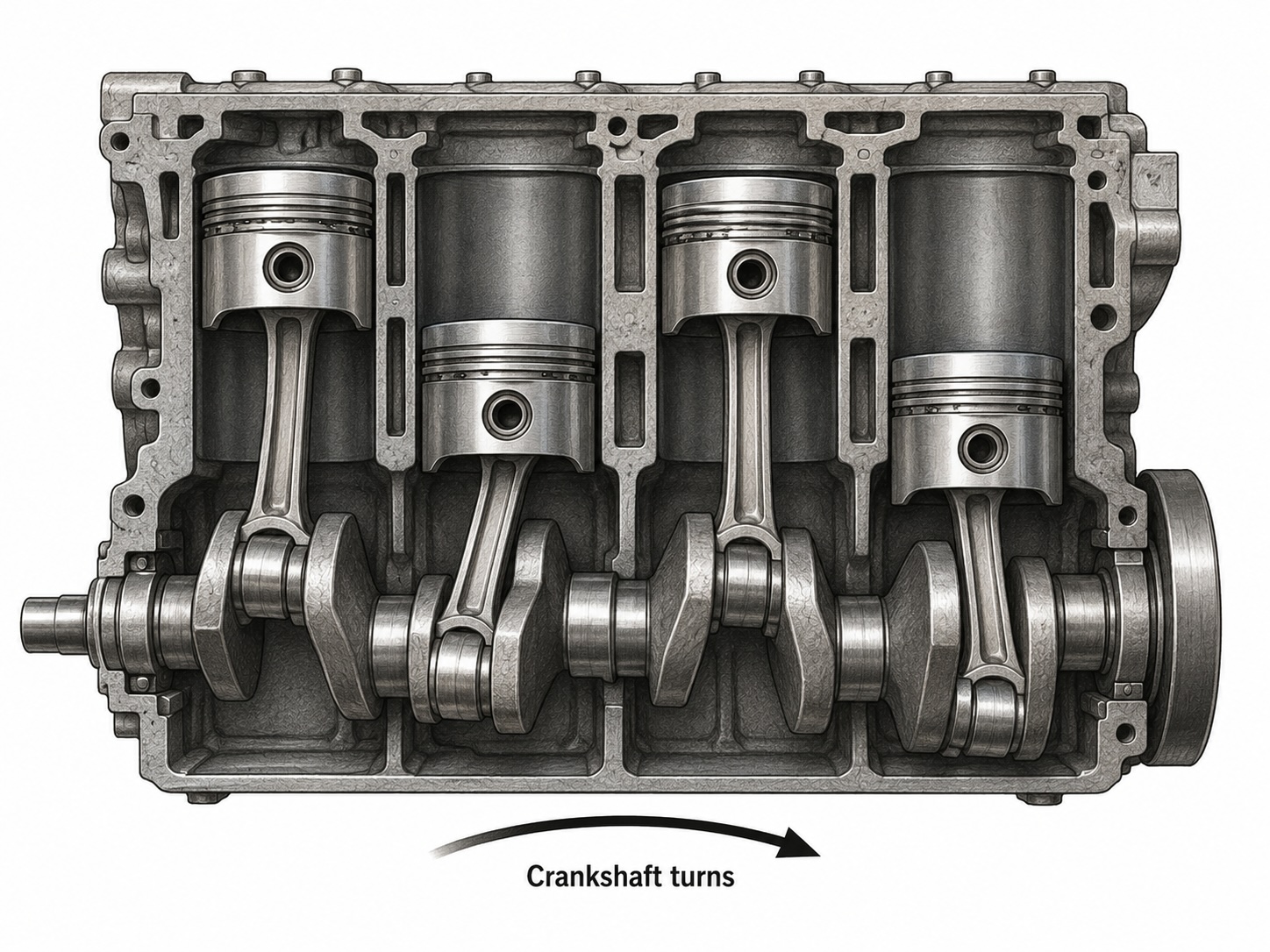
A regular car doesn’t have one cylinder. It has four, or six, or eight, all running this same dance, but timed so they take turns. While cylinder 1 is on BANG, cylinder 2 might be on SQUEEZE, cylinder 3 on BLOW, and cylinder 4 on SUCK. They are staggered so that there is always at least one cylinder making power at any given moment.
Think of a Lego model where four little arms all push down on the same gear, but never at the same time. Each arm does its job in turn, and the gear keeps spinning smoothly. That is an engine.
All the pistons push down on the same long metal rod called a crankshaft. The crankshaft has the shape of a few zigzags — bent in the right places so that when a piston pushes straight down, the crankshaft has to turn sideways to make room. Up-and-down motion at the top becomes round-and-round motion at the bottom.
Just like your legs on a bicycle. Your knees go up and down, but the pedals turn in circles. The connecting bar between your knee and the pedal makes the conversion. The crankshaft does the same thing in a car, except with metal arms and explosions instead of your legs and a peanut butter sandwich.
That’s the heartbeat
When you hear a car start, what you are hearing is the four-stroke cycle beginning. A small motor (called the starter) turns the engine over a few times to get the cycle going, and then the explosions take over and the engine runs itself, banging along at thousands of cycles a minute.
When the car is sitting at a red light and you can hear it idling — that low, even rumble under the hood — that is the four-stroke running slowly, just enough to keep itself going. When your mom presses the gas pedal, more fuel and more air flow in, the bangs come faster and harder, and the wheels turn faster.
The whole rest of an old-fashioned car is built around this single trick: the heartbeat in the middle, where small, controlled explosions happen thousands of times a minute, and somehow — except it isn’t somehow, it is the next four chapters — that heartbeat ends up turning the wheels under your seat.
Questions to talk about
No answer key. These are for arguing over, with someone who read the same chapter.
- Only one of the four strokes — BANG — actually makes power. The other three set it up. Does that seem wasteful to you, or is it the price of making the trick repeatable? What else works this way, where most of the effort is preparation?
- The candle goes out under the jar even though there is plenty of wax left. Before you read the explanation, what would you have guessed was happening? What made the real answer surprising?
- Nicolaus Otto was a grocer, not a trained engineer, and his cycle is still in almost every petrol car 150 years later. What might an outsider notice that a trained expert would miss?