How Cars Work
Suck, Squeeze, Bang, Blow
PART ONE — How an Old Car Works
CHAPTER ONE
A car is heavy. Heavier than you, heavier than your mom, heavier than your mom and you and a full week of groceries combined. A normal car weighs about three thousand pounds. That is roughly the same as a small horse, except a horse can move itself and a car cannot, not on its own.
Something has to push it.
When you ride a bicycle, you know what is pushing it: you are. Your legs push the pedals, the pedals turn the chain, the chain turns the back wheel, and the bike rolls forward. If you stop pushing, the bike slows down and stops. The connection between your legs and the wheels is direct. You can feel it.
A car has no pedals you push. (It has pedals your mom pushes with her foot, but those don’t push the wheels — they just tell the car what to do. We will get to those later.) So what is pushing a car?
The answer is small explosions. Hundreds of them, every second. Every car like the one your grandmother drove, and most cars on the road today, runs on a controlled, repeating series of tiny explosions inside the engine. The explosions push metal pieces. The metal pieces turn other metal pieces. Eventually the wheels turn, and the car moves.
That is the whole story. The rest of this chapter is the details.
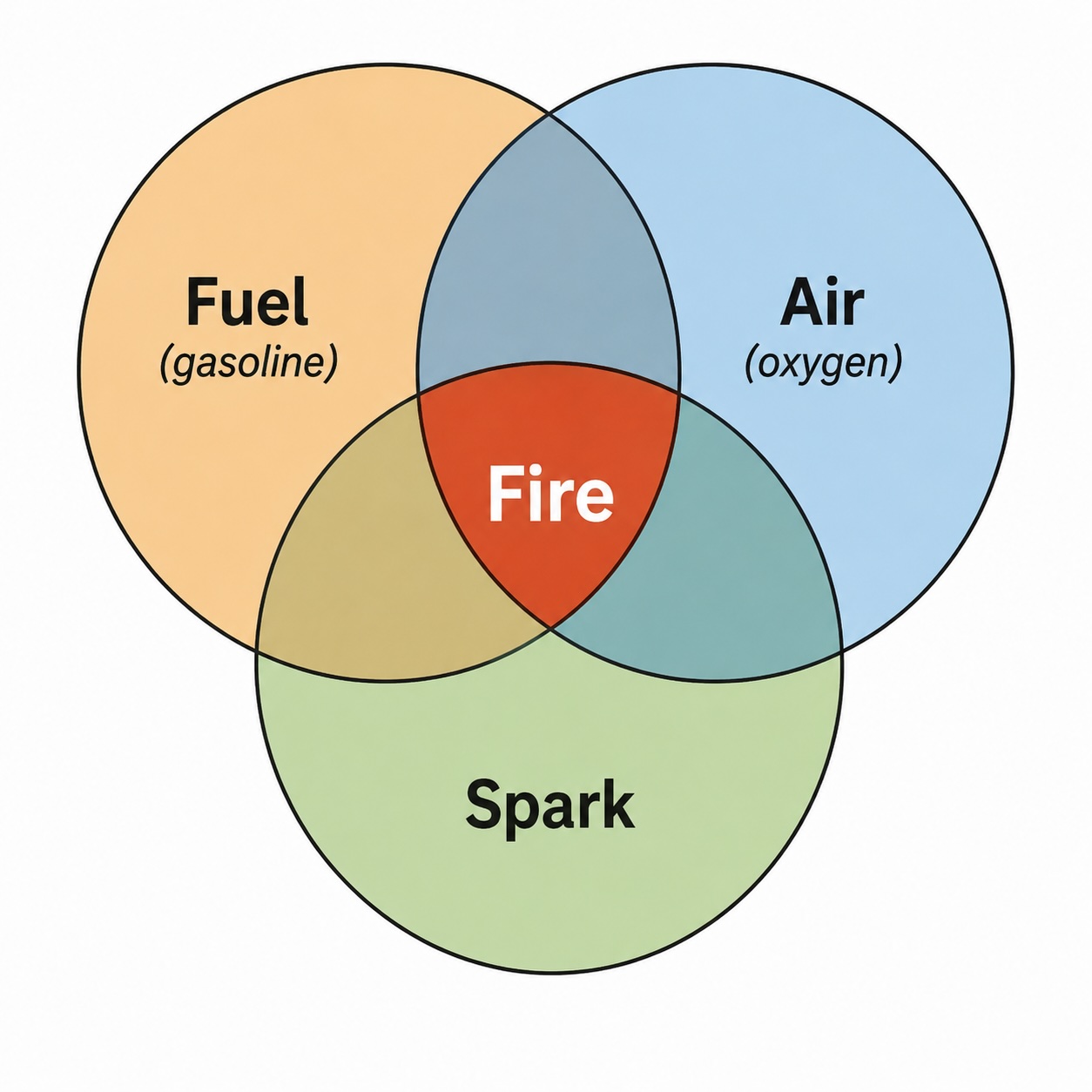
Fire needs three things
To have an explosion, you need fire. To have fire, you need three things: something to burn, something to burn it with, and something to start it.
Something to burn is gasoline. Gasoline is a liquid made from oil that comes out of the ground, and it burns very, very well. If you have ever stood near a pump at a gas station, you have smelled it.
Something to burn it with is air. Specifically, the oxygen in air. About one-fifth of the air around you is oxygen, and oxygen is what makes things burn. Without oxygen, fire cannot exist.
Something to start it is a spark. Gasoline and air sitting together don’t do anything. Mix them in a jar and ignore them and they will just sit there. You have to give them a kick. A small electric spark is enough.
Try It: The Candle and the Jar
You will need:
A small candle (a tea light works perfectly)
A glass jar that is bigger than the candle (a clean pasta-sauce jar is great)
A grown-up to help with the lighting
Put the candle on a plate. Light it with the grown-up’s help and let it burn for a few seconds. Then turn the jar upside down and lower it over the candle, so the mouth of the jar sits flat on the plate and the candle is sealed inside.
Watch what happens. The flame keeps burning for a few seconds. Then it gets smaller. Then it gets very small. Then it goes out. There is still candle left. There is nothing wrong with the wick. The candle did not run out of fuel.
What ran out is the oxygen. Once the flame burned through all the oxygen sealed inside the jar, the fire could not continue. Take the jar off, light the candle again, and it burns happily, because now the air can get to it.
This is exactly what is happening inside a car engine, except instead of a candle you have gasoline, and instead of an open flame you have a controlled explosion. No oxygen, no boom. The whole engine is built around making sure the right amount of fuel meets the right amount of air at exactly the right time.