How Cars Work · Suck, Squeeze, Bang, Blow
A metal cup in a metal tube
Now we need something for the explosion to push.
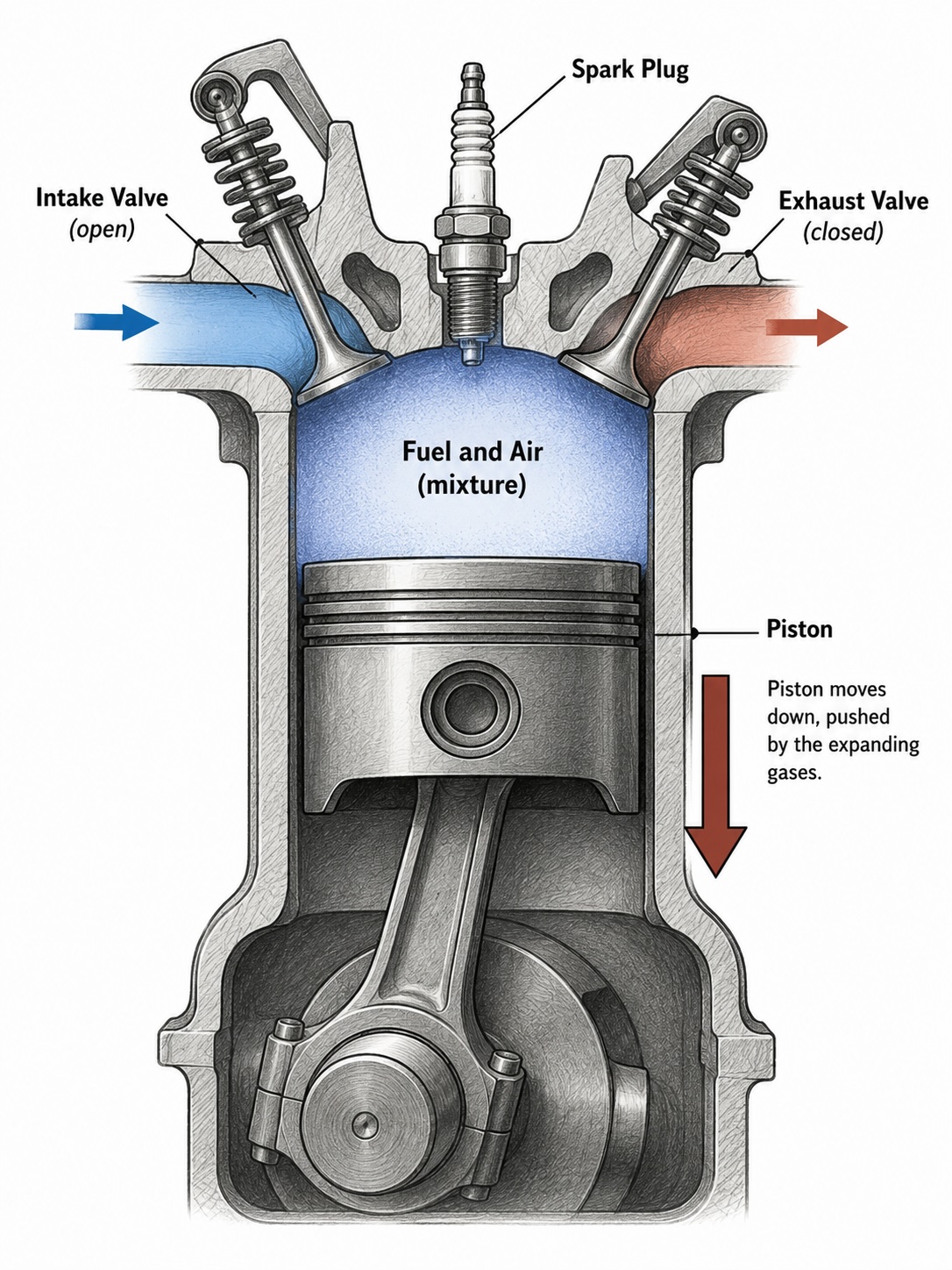
Picture a metal cup that fits snugly inside a metal tube — close enough that nothing leaks past the edges, but loose enough that the cup can slide up and down freely. The cup is called a piston. The tube is called a cylinder.
If you light a small amount of gasoline-and-air mixture in the closed top of the cylinder, the explosion shoves the piston down. Hard. Faster than you can blink.
That is the only thing the explosion has to do. Push the piston down. Everything else in the engine is just a clever way to set up the next explosion and turn that downward push into something useful.
The four strokes
You can’t have one explosion and call it done. Cars need to keep going for hours. So the engine has to repeat this same trick — explosion, push, explosion, push — over and over.
To do that, every cylinder repeats the same four-step cycle, called the four-stroke cycle. Each stroke is one movement of the piston, either up or down. The four strokes have nicknames, and the nicknames are accurate and a little funny:
1. SUCK. The piston moves down. A little door at the top of the cylinder (called an intake valve) opens, and the falling piston pulls in a fresh mixture of air and gasoline. Like pulling on the plunger of a syringe.
2. SQUEEZE. The little door slams shut. The piston moves back up, squishing the air-and-gasoline mixture into a tiny space at the top. Squeezing a gas makes it hot and ready to burn.
3. BANG. A spark plug — a small device that can shoot an electric spark on demand — fires. The squished mixture explodes. The piston gets shoved down hard. This is the only stroke where the engine is making power. The other three are just setting it up.
4. BLOW. The piston comes back up. A different little door (the exhaust valve) opens, and the piston pushes the burned, used-up gas out of the cylinder. Then that door slams shut, the intake door opens again, and we are back at SUCK.
Down, up, down, up. Suck, squeeze, bang, blow. Two full trips up and back down for the piston, and the engine has produced one push.
A typical car engine does this somewhere between ten and a hundred times every second, in each cylinder. When you hear a car running, what you are hearing is hundreds of these little cycles per second, blurred into one steady sound.
Did You Know? The four-stroke cycle was invented by a German engineer named Nicolaus Otto in 1876. Engineers still call it the Otto cycle in his honor, almost 150 years later. Otto wasn’t even a trained engineer — he started out as a grocer who got obsessed with engines in his spare time and eventually built one that worked better than anyone else’s. Almost every gasoline car ever made uses a version of his idea.