Designing & Revising a Collision Protector — Print · Grade 8 Science
Chapter: MotionDesigning & Revising a Collision Protector
Learning goals
- I can define a protector’s criteria and constraints and evaluate repeated test records.
- I can propose a mechanism-based revision and plan a controlled retest.
Readings for this unit
Before this unit
Review the earlier collisions/deformation unit. The visible language notes explain this unit’s quantities; then connect them to its concrete records and figure.
Use three teaching sessions of about 40–45 minutes: first observe the phenomenon, draft a model and study Parts 1–2; next explain Parts 3–4 with the figures and evidence; then work the application, examples, practice, model revision and exit check. Divide any difficult part into smaller steps and revisit after feedback. Investigations, review and quizzes have separate sessions. Study the four visual parts across the scheduled sessions, then use the illustrated worked case and independent transfer questions. Extend or revisit a session when the learner cannot explain the figure; completion time is a proposed allocation, not a mastery guarantee.
Start with something to explain
What would explain the observations in designing & revising a collision protector?
Illustrative evidence case. Illustrative designs have A: mean peak 13 N, thickness 4 cm; B: mean peak 9 N, thickness 7 cm. Maximum permitted thickness is 5 cm.
Notice and wonder
Which is a qualifying starting design under the stated limit? Write two observations from the supplied record without guessing their cause. Include a quantity and its unit when given. An observation is what was recorded; an inference is what you think explains it.
Write one question about why the pattern occurs and one question about a comparison that could distinguish competing explanations. A testable question identifies what could be observed or measured.
Your first model
Before reading the model answer, sketch the named objects or particles and label what you think changes. Choose a qualifying starting design and propose an evidence-based revision. Keep this first version so you can compare it with your later explanation.
Build the language from the idea
- criterion
- Feature used to evaluate success.
- constraint
- Limit a design must meet.
- stakeholder
- Person or group affected by the design.
- operational definition
- Stated rule for measuring or judging a property.
- iteration
- Another test-and-revision cycle informed by evidence.
- model
- A representation that explains selected features and makes predictions; it leaves other details out.
- evidence
- Relevant observations or records used to support or challenge a claim.
- system boundary
- The chosen limit separating the objects being studied from their surroundings.
- assumption
- A condition taken as true for a model or calculation and needing to be checked against the case.
Engineering uses scientific evidence to solve a defined problem. A criterion is a feature used to judge success, such as keeping a model payload undamaged.
A constraint is a limit, such as maximum size or cost. A stakeholder is someone affected by a design.
A good protector must satisfy the actual task, not merely contain the most padding. Use a soft toy model and supplied records; do not use people, animals, real electronics, fragile glass or certification claims about safety equipment.
The design cycle is iterative: testing informs a revision, and the revised solution must be tested again.
An observation is what a person or instrument records. An inference is a proposed interpretation of those records. Keep the two separate: a graph can show a pattern while more than one mechanism might explain it. State the chosen system, or part of the world being studied, and its boundary before accounting for material or energy transfers.
Use each figure as a reasoning tool. Read its caption and labels, describe the pattern, then explain a cause. If the picture is schematic, use the stated numbers rather than measuring its printed size. Check whether its simplified conditions match the problem before applying a formula.
Build your understanding
Where this fits
This unit helps answer the chapter question: What evidence lets us describe and predict motion? Keep a notebook table with the question, evidence, explanation and one unresolved issue. Revise a previous model only when you can name the new evidence or idea that changes it.
Use three teaching sessions of about 40–45 minutes: first observe the phenomenon, draft a model and study Parts 1–2; next explain Parts 3–4 with the figures and evidence; then work the application, examples, practice, model revision and exit check. Divide any difficult part into smaller steps and revisit after feedback. Investigations, review and quizzes have separate sessions.
Part 1 · Define success and the limits before testing
Specify the protected object, collision conditions, damage measure and permitted resources. Operational definition means exactly how a property will be judged in the test. A visible mark on a paper target can be a model damage indicator, but it is not a measurement of real injury.
Read the visual model
Why define the dent measure before seeing results?
Visual reasoning — after your attempt
A fixed rule allows consistent judgments and avoids changing success criteria to favor a preferred design.
A toy protector may need to leave no permanent target dent, fit within 5 cm thickness and use at most 20 g of padding. A design that exceeds a hard limit does not qualify even if its force reading is lower.
Pause and explain
Why define the dent measure before seeing results?
Check your reasoning after answering
A fixed rule allows consistent judgments and avoids changing success criteria to favor a preferred design.
Part 2 · Predict how a feature could work
An initial design model should connect a physical feature to a mechanism. Compressible padding can increase stopping distance; a broad face can distribute contact over greater area. These are different mechanisms and need different observations. More padding can add mass or run out of compression space.
Read the visual model
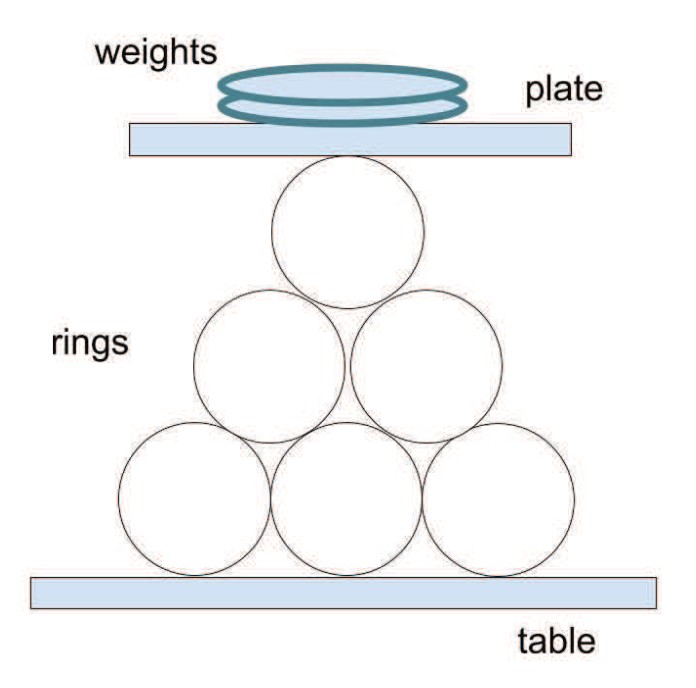
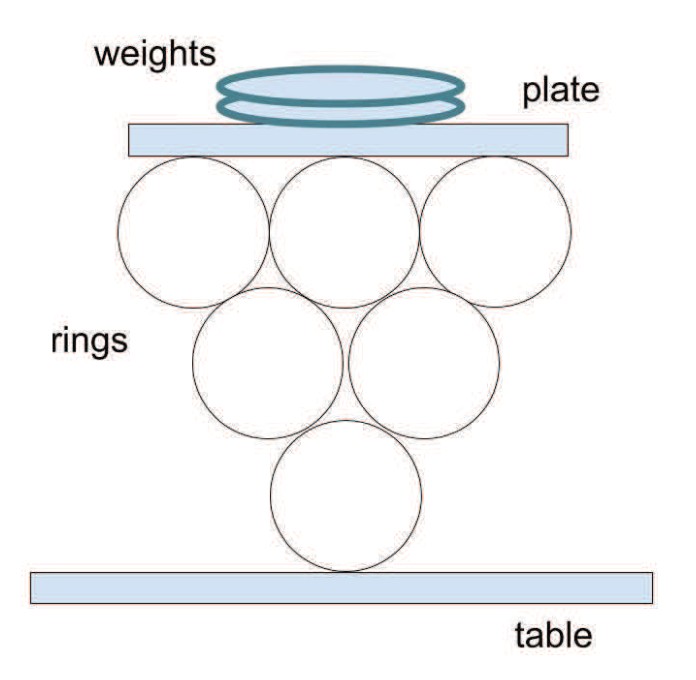
A mechanism explains how the feature changes the interaction. OpenSciEd’s ring sketches below give concrete shapes to compare, but an unloaded drawing cannot establish their performance. Predict, test, revise and retest.
Which measurement could distinguish “more travel” from “a prettier design”?
Visual reasoning — after your attempt
Measure deformation or stopping distance/time under matched loads and then evaluate peak-force/damage criteria using an appropriate safe test or supplied records.
Sketch two designs with the same total padding amount but different arrangements. Predict the shape changes during contact and identify the measurement that could distinguish the ideas. Drawing a thick case alone is not an explanation.
Pause and explain
Does a larger contact face automatically mean a smaller total force?
Check your reasoning after answering
No. It can lower pressure for the same force by spreading contact area, but total force depends on the stopping interaction.
Part 3 · Compare repeated tests under matched conditions
Hold starting speed, payload mass, collision direction, surface and measuring procedure comparable. Repeat with fresh or restored samples when previous deformation affects results. Keep all planned measurements, including inconvenient failures. A mean is the sum divided by the number of readings; a range is maximum minus minimum.
Read the visual model
State whether a requirement concerns a mean, a maximum or every trial. Different definitions lead to different decisions. Graphing both the mean and trials helps a parent or reviewer see the evidence instead of relying on one favorable result.
Which design meets the stated force limit in all three trials? Why must C’s 48 N reading remain in the report?
Visual reasoning — after your attempt
Only B does. C fails one trial even though two are below the limit; omitting the 48 N record would misrepresent reliability and the actual criterion.
Illustrative peaks for A are 12, 14, 13 N and for B 10, 11, 15 N. A averages 13 N with range 2 N; B averages 12 N with range 5 N. B has a lower mean but greater variability.
Pause and explain
Why is B’s single 10 N reading an incomplete comparison?
Check your reasoning after answering
It omits its other readings and variability. Evaluate all planned trials along with constraints and damage observations.
Part 4 · Revise and transfer the explanation
Choose a revision from evidence, then predict what should change and retest. A design can be strongest for one criterion and weaker for another. A transfer assessment asks whether the mechanism still applies in a new setting, rather than whether the student remembers a brand or drawing.
Read the visual model
Transfer means applying an explanation to a new situation. Keep the mechanism explicit: which part should deform, what motion change should occur, and which constraint might fail? A prediction is not an already completed retest.
Does passing three horizontal tests guarantee a successful corner impact? Name one changed condition to test.
Visual reasoning — after your attempt
No. Orientation/contact area or the stopping path changes. Define a safe comparable corner-impact test or analyze supplied records and evaluate the same stated criteria.
Combine A’s stable arrangement with B’s more compressible layer if the size and mass limits allow it. Predict reduced typical peak while retaining consistency, then collect new data. The combination is a proposal until tested.
Pause and explain
Does combining useful features prove the new protector is better?
Check your reasoning after answering
No. Features can interact and violate limits. The revised design requires new tests under the same evaluation rules.
Apply the whole unit · A design decision with a hard constraint
Illustrative case for analysis, not measurements collected by the learner. Illustrative designs have A: mean peak 13 N, thickness 4 cm; B: mean peak 9 N, thickness 7 cm. Maximum permitted thickness is 5 cm.
Your task
Choose a qualifying starting design and propose an evidence-based revision. Use the supplied conditions, show intermediate reasoning and distinguish the supported conclusion from a broader claim.
What your response should show
- Use the specified quantities and units.
- Explain an intermediate step or comparison.
- Connect the pattern to the physical mechanism.
- State an assumption or limitation.
Response guidance — after your attempt
Read the hard thickness limit before ranking peak force.
A at 4 cm satisfies the 5 cm limit; B at 7 cm does not.
Choose A as a qualifying starting design, not as proof of universally best protection.
Propose a changed padding arrangement within 5 cm and retest with matched motion, repeated peaks and deformation records.
A qualifies under the thickness rule; B does not despite its lower mean peak. Start with A and investigate whether a more compressible arrangement within 5 cm lowers the peak. Repeat matched tests, record all results and evaluate permanent deformation as well as force. Lower mean peak alone is not universal protection.
Scientific references and adapted teaching resources
- OpenSciEd 8.1 Contact Forces — public unit overview
- OpenSciEd instructional model — storyline routines
- Creative Commons Attribution 4.0 — middle-school material license
- OpenSciEd 8.1 Lesson 13 — Exploring shape of a cushioning material (public handout)
Parent / teacher teaching notes
Ask the learner to describe the phenomenon before naming a formula. Discuss each checkpoint after an attempt. Use the supplied records when equipment is unavailable and label them illustrative rather than actual measurements. The final explanation should identify a mechanism and a limit, with different defensible wording accepted. Adaptation credit: OpenSciEd middle-school teaching routines and public task structures by OpenSciEd, CC BY 4.0. This independent version adds original explanatory text, data and figures, terminology support and a home-study schedule. It does not reproduce the complete teacher editions or their classroom validation.
The key idea
Judge repeated evidence, variability, damage measures and hard constraints, rather than one selected reading. A qualifies under the thickness rule; B does not despite its lower mean peak.
Worked examples
Example 1 · Build the first reasoning step
- Identify what the question asks and what the stated observation establishes.
- A fixed rule allows consistent judgments and avoids changing success criteria to favor a preferred design.
Example 2 · A design decision with a hard constraint
- Read the hard thickness limit before ranking peak force.
- A at 4 cm satisfies the 5 cm limit; B at 7 cm does not.
- Choose A as a qualifying starting design, not as proof of universally best protection.
- Propose a changed padding arrangement within 5 cm and retest with matched motion, repeated peaks and deformation records.
Explain why each stated condition matters.
Example 3 · Transfer to a different condition
- Identify the changed condition.
- No. All planned trials matter. Report the failures, investigate their causes, and revise the design or the limited claim rather than selecting only the success.
Example 4 · Find and fix the mistake
- Distinguish what is observed from what is inferred.
- Judge repeated evidence, variability, damage measures and hard constraints, rather than one selected reading.
Compare the claim with the stated observations and model assumptions.
Example 5 · Interpret the visual model
- Identify the represented objects, axes, labeled quantities and stated conditions before choosing a rule.
- A mechanism explains how the feature changes the interaction. OpenSciEd’s ring sketches below give concrete shapes to compare, but an unloaded drawing cannot establish their performance. Predict, test, revise and retest.
- Measure deformation or stopping distance/time under matched loads and then evaluate peak-force/damage criteria using an appropriate safe test or supplied records.
Keep the model’s stated limits explicit: The comparison proposes that a compressible ring arrangement provides more deformation travel than a very thin pad under a matched test load. Geometry is shown schematically, and no measured force reduction is supplied by this drawing. A protector must still be checked for stability, maximum compression, size and repeat performance; adding material without a mechanism is not enough.
Avoid these mistakes
- Judge repeated evidence, variability, damage measures and hard constraints, rather than one selected reading.
- Do not treat a schematic drawing as a scale measurement or a universal guarantee.
- Keep the stated comparison conditions and measurement boundary explicit.
- A correct numerical result needs units and an explanation of its meaning.
Check your understanding
Why define the dent measure before seeing results?
Discuss the answer
A fixed rule allows consistent judgments and avoids changing success criteria to favor a preferred design.
Does a larger contact face automatically mean a smaller total force?
Discuss the answer
No. It can lower pressure for the same force by spreading contact area, but total force depends on the stopping interaction.
Why is B’s single 10 N reading an incomplete comparison?
Discuss the answer
It omits its other readings and variability. Evaluate all planned trials along with constraints and damage observations.
Does combining useful features prove the new protector is better?
Discuss the answer
No. Features can interact and violate limits. The revised design requires new tests under the same evaluation rules.
Return to the phenomenon
Illustrative designs have A: mean peak 13 N, thickness 4 cm; B: mean peak 9 N, thickness 7 cm. Maximum permitted thickness is 5 cm. Choose a qualifying starting design and propose an evidence-based revision. Revise your first explanation using a named idea from the lesson. Mark the changed part and the evidence that supports it.
Compare explanations after your attempt
A qualifies under the thickness rule; B does not despite its lower mean peak. Start with A and investigate whether a more compressible arrangement within 5 cm lowers the peak. Repeat matched tests, record all results and evaluate permanent deformation as well as force. Lower mean peak alone is not universal protection.
What should we investigate next?
Which condition could be changed to test a remaining uncertainty in this explanation? State the predicted observation and what result would challenge your model.
Investigate, explain and revise
Use these tasks after the three teaching sessions as needed. Discuss an attempted explanation before opening response guidance; a matching sentence is less important than a supported mechanism.
Activity 1 · Explain the new evidence case
Use the visible scenario above, Parts 1–4 and your first notebook model. No outside reading or equipment is required.
Your task
Illustrative designs have A: mean peak 13 N, thickness 4 cm; B: mean peak 9 N, thickness 7 cm. Maximum permitted thickness is 5 cm. Choose a qualifying starting design and propose an evidence-based revision. Write 100–150 words or give a labeled drawing with an equivalent oral explanation.
Success criteria
- Use two relevant stated records or conditions.
- Explain the mechanism rather than only repeat a definition.
- Label observation and inference.
- Name a changed model feature or a remaining uncertainty.
Hint
Read the stated boundary and conditions before selecting a relationship. The unit’s worked examples show intermediate steps.
Response guidance — discuss after your attempt
A qualifies under the thickness rule; B does not despite its lower mean peak. Start with A and investigate whether a more compressible arrangement within 5 cm lowers the peak. Repeat matched tests, record all results and evaluate permanent deformation as well as force. Lower mean peak alone is not universal protection.
Activity 2 · Read and extend the figure
Study the new labeled figure and its caption, then compare it with the associated teaching part.
Your task
Which is a qualifying starting design under the stated limit? Explain what each important label represents. Add one missing feature that would be needed for a different question, and explain why the original figure leaves it out.
Success criteria
- Answer the figure question with its stated labels.
- Connect the visual representation to the scientific idea.
- Identify a specific limitation from the caption.
- Propose a useful change without misrepresenting supplied evidence.
Hint
The bar comparison favors B for lower mean peak in the supplied tests, but B fails the hard size constraint. A decision needs both criteria and constraints and should check repeated variability and damage outcomes. These are illustrative model-protector records, not safety certification.
Response guidance — discuss after your attempt
A qualifies at 4 cm. B at 7 cm does not, despite its lower recorded mean peak. A revision needs retesting. The bar comparison favors B for lower mean peak in the supplied tests, but B fails the hard size constraint. A decision needs both criteria and constraints and should check repeated variability and damage outcomes. These are illustrative model-protector records, not safety certification.
Words to know
- criterion
- Feature used to evaluate success.
- constraint
- Limit a design must meet.
- stakeholder
- Person or group affected by the design.
- operational definition
- Stated rule for measuring or judging a property.
- iteration
- Another test-and-revision cycle informed by evidence.
- model
- A representation that explains selected features and makes predictions; it leaves other details out.
- evidence
- Relevant observations or records used to support or challenge a claim.
- system boundary
- The chosen limit separating the objects being studied from their surroundings.
- assumption
- A condition taken as true for a model or calculation and needing to be checked against the case.
In the real world
Illustrative designs have A: mean peak 13 N, thickness 4 cm; B: mean peak 9 N, thickness 7 cm. Maximum permitted thickness is 5 cm.
Exit check
Which is a qualifying starting design under the stated limit? Explain the relevant mechanism and one model limitation.
Check your explanation after answering
A qualifies at 4 cm. B at 7 cm does not, despite its lower recorded mean peak. A revision needs retesting. The bar comparison favors B for lower mean peak in the supplied tests, but B fails the hard size constraint. A decision needs both criteria and constraints and should check repeated variability and damage outcomes. These are illustrative model-protector records, not safety certification.
Explain your reasoning without notes. If a key idea is missing, revisit the lesson and try again.
Problem 1
Answer and explanation
A fixed rule allows consistent judgments and avoids changing success criteria to favor a preferred design.
A fixed rule allows consistent judgments and avoids changing success criteria to favor a preferred design.
Response criteria
- Use the supplied conditions and relevant evidence.
- Explain the scientific mechanism or calculation.
- State a meaningful limitation or testable next step.
Problem 2
Answer and explanation
No. It can lower pressure for the same force by spreading contact area, but total force depends on the stopping interaction.
No. It can lower pressure for the same force by spreading contact area, but total force depends on the stopping interaction.
Response criteria
- Use the supplied conditions and relevant evidence.
- Explain the scientific mechanism or calculation.
- State a meaningful limitation or testable next step.
Problem 3
Answer and explanation
It omits its other readings and variability. Evaluate all planned trials along with constraints and damage observations.
It omits its other readings and variability. Evaluate all planned trials along with constraints and damage observations.
Response criteria
- Use the supplied conditions and relevant evidence.
- Explain the scientific mechanism or calculation.
- State a meaningful limitation or testable next step.
Problem 4
Answer and explanation
No. Features can interact and violate limits. The revised design requires new tests under the same evaluation rules.
No. Features can interact and violate limits. The revised design requires new tests under the same evaluation rules.
Response criteria
- Use the supplied conditions and relevant evidence.
- Explain the scientific mechanism or calculation.
- State a meaningful limitation or testable next step.
Problem 5
Answer and explanation
A qualifies under the thickness rule; B does not despite its lower mean peak. Start with A and investigate whether a more compressible arrangement within 5 cm lowers the peak. Repeat matched tests, record all results and evaluate permanent deformation as well as force. Lower mean peak alone is not universal protection.
A qualifies under the thickness rule; B does not despite its lower mean peak. Start with A and investigate whether a more compressible arrangement within 5 cm lowers the peak. Repeat matched tests, record all results and evaluate permanent deformation as well as force. Lower mean peak alone is not universal protection.
Response criteria
- Use the supplied conditions and relevant evidence.
- Explain the scientific mechanism or calculation.
- State a meaningful limitation or testable next step.
Problem 6
Answer and explanation
No. All planned trials matter. Report the failures, investigate their causes, and revise the design or the limited claim rather than selecting only the success.
No. All planned trials matter. Report the failures, investigate their causes, and revise the design or the limited claim rather than selecting only the success.
Response criteria
- Use the supplied conditions and relevant evidence.
- Explain the scientific mechanism or calculation.
- State a meaningful limitation or testable next step.
Problem 7
Answer and explanation
Judge repeated evidence, variability, damage measures and hard constraints, rather than one selected reading.
Judge repeated evidence, variability, damage measures and hard constraints, rather than one selected reading.
Response criteria
- Use the supplied conditions and relevant evidence.
- Explain the scientific mechanism or calculation.
- State a meaningful limitation or testable next step.
Problem 8
Answer and explanation
Combine A’s stable arrangement with B’s more compressible layer if the size and mass limits allow it. Predict reduced typical peak while retaining consistency, then collect new data. The combination is a proposal until tested. No. Features can interact and violate limits. The revised design requires new tests under the same evaluation rules.
Combine A’s stable arrangement with B’s more compressible layer if the size and mass limits allow it. Predict reduced typical peak while retaining consistency, then collect new data. The combination is a proposal until tested. No. Features can interact and violate limits. The revised design requires new tests under the same evaluation rules.
Response criteria
- Use the supplied conditions and relevant evidence.
- Explain the scientific mechanism or calculation.
- State a meaningful limitation or testable next step.
Problem 9
Hints
Distinguish the observed quantities, the proposed mechanism and its conditions.
Answer and explanation
Mean is 14 N and range 6 N. The 11 N minimum omits the other trials and understates variability. Compare all planned results with criteria, constraints and damage observations before choosing or revising.
Mean is 14 N and range 6 N. The 11 N minimum omits the other trials and understates variability. Compare all planned results with criteria, constraints and damage observations before choosing or revising.
Problem 10
Hints
Distinguish the observed quantities, the proposed mechanism and its conditions.
Answer and explanation
No. All planned trials matter. Report the failures, investigate their causes, and revise the design or the limited claim rather than selecting only the success.
No. All planned trials matter. Report the failures, investigate their causes, and revise the design or the limited claim rather than selecting only the success.
Problem 11
Answer and explanation
Measure deformation or stopping distance/time under matched loads and then evaluate peak-force/damage criteria using an appropriate safe test or supplied records.
A mechanism explains how the feature changes the interaction. OpenSciEd’s ring sketches below give concrete shapes to compare, but an unloaded drawing cannot establish their performance. Predict, test, revise and retest.
Measure deformation or stopping distance/time under matched loads and then evaluate peak-force/damage criteria using an appropriate safe test or supplied records.
Response criteria
- Use the named labels, directions or supplied quantities accurately.
- Connect the visual evidence to the scientific mechanism or calculation.
- State the relevant model conditions or limitation.
Problem 12
Answer and explanation
No. The 35 N trial fails the every-trial limit even though the mean is 27 N. Preserve the result, investigate variation, revise a mechanism and retest under matched conditions.
Read the criterion as every trial, not the mean.
Use all records before recommending a tested revision.
No. The 35 N trial fails the every-trial limit even though the mean is 27 N. Preserve the result, investigate variation, revise a mechanism and retest under matched conditions.
Response criteria
- Use the named labels, directions or supplied quantities accurately.
- Connect the visual evidence to the scientific mechanism or calculation.
- State the relevant model conditions or limitation.