Magnetism & Electromagnetism — Print · Grade 12 Science
Chapter: Electricity, Magnetism & CircuitsMagnetism & Electromagnetism
Learning goals
- I can describe magnetic fields, poles, and the force between magnets.
- I can explain how an electric current creates a magnetic field and calculate the force on a wire with F = BIL.
- I can explain electromagnetic induction and how motors and generators convert energy.
Readings for this unit
Before this unit
Fields, moving charge, and changing magnetic flux.
Use the detailed parent plan: two core 50–60-minute sessions per focused unit, with a third assigned for selected calculation/modeling topics. First study the core explanation and Parts 1–2 with their figures/checks; next study Parts 3–4, the whole-unit application, worked cases, varied practice and exit check. Attempt reasoning before opening guidance. Extend time when actual understanding requires it; investigations and chapter assessments have separate sessions.
Start with something to explain
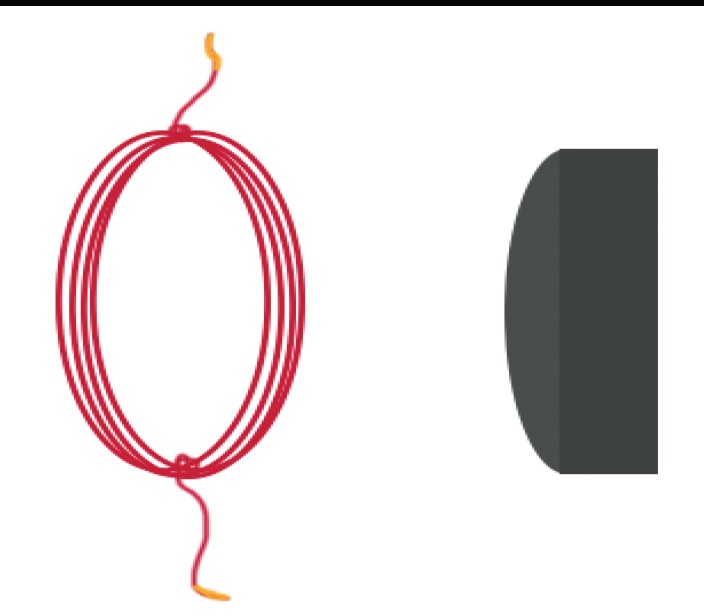
Why does moving a magnet relative to a coil matter?
Illustrative evidence case. An unchanged magnetic arrangement differs from one with changing linked flux.
Notice and wonder
Record two observations using the stated quantities or relationships. Keep observations separate from possible causes. Write one question that a new measurement could help answer.
Why does moving a magnet relative to a coil matter?
Your first model
Draw the loop orientation and name what changes with time.
Build the language from the idea
- magnetic field
- The region around a magnet or current where magnetic forces act, measured in tesla (T) and drawn with field lines from north to south.
- electromagnet
- A magnet created by running electric current through a coil of wire, often around an iron core, that can be switched on and off.
- electromagnetic induction
- The production of a voltage (and current) in a conductor by a changing magnetic field.
- electric motor
- A device that uses the force on a current-carrying wire in a magnetic field to convert electrical energy into motion.
- generator
- A device that uses electromagnetic induction to convert mechanical motion into electrical energy — essentially a motor run in reverse.
Magnets are familiar, but their behavior sets the stage for the deepest idea in the unit. Every magnet has two poles, north and south, and the rule mirrors electric charge: like poles repel, opposite poles attract. Around every magnet stretches a magnetic field, an invisible region of influence we draw with field lines running out of the north pole and into the south. Unlike electric charges, you can never isolate a single pole — snap a bar magnet in half and each piece instantly has its own north and south. Earth itself is one giant magnet, and its field is what swings a compass needle to point north.
For centuries electricity and magnetism looked like separate subjects, until 1820, when Hans Christian Oersted noticed a compass needle twitch every time he switched on a nearby electric current. That tiny deflection was a revelation: an electric current produces a magnetic field. Coil that current-carrying wire into a loop, or many loops, and the magnetic fields reinforce into a strong, controllable magnet — an electromagnet. Because it works only while current flows, an electromagnet can be switched on and off and made stronger simply by adding more turns or more current, which is exactly why scrapyard cranes, doorbells, and hard drives rely on them instead of permanent magnets.
A straight current-carrying wire segment in a uniform field has magnetic-force magnitude BIL sinθ, where θ is the angle between current direction and field. The simpler BIL applies when they are perpendicular. Direction follows the appropriate vector rule, and force can be zero for a parallel segment. Magnetic interactions can exert torque on a coil in a motor, with electrical input, motion, and losses included in the energy account.
Faraday’s law relates induced emf to the rate of change of magnetic flux linked with a circuit. Flux can change through field strength, loop area, or orientation. A stationary loop in a steady field has no induction from that unchanged flux. Sustained induced current additionally requires a conducting path and appropriate circuit behavior; an open loop can have emf without a closed-path current. Lenz’s law relates the response direction to the flux change.
A generator can convert mechanical input into electrical transfer by changing linked magnetic flux. Rotation in a field can change flux through a coil even when the external field is steady. Turbine-driven generators are used in many thermal, wind, and hydro systems; photovoltaics produce electricity by a different mechanism. Track actual energy inputs and outputs instead of describing every electrical source as induction or imagining newly created electrons delivered from the generator.
Electric and magnetic effects are parts of electromagnetism. Electric currents and changing fields can produce magnetic fields; changing magnetic flux linked with a circuit produces emf under the stated conditions. Current additionally requires the relevant conducting path and circuit response. Maxwell’s field framework also supports electromagnetic waves. This connected account does not mean every static field automatically generates a current or provides a new energy source.
Model check: A static magnet beside a stationary coil does not continuously generate emf. A changing magnetic flux, through changing field, area, or orientation; a moving magnet can supply that change.
Build your understanding
Use the detailed parent plan: two core 50–60-minute sessions per focused unit, with a third assigned for selected calculation/modeling topics. First study the core explanation and Parts 1–2 with their figures/checks; next study Parts 3–4, the whole-unit application, worked cases, varied practice and exit check. Attempt reasoning before opening guidance. Extend time when actual understanding requires it; investigations and chapter assessments have separate sessions.
Part 1 · Distinguish magnetic interactions from charge signs
A bar magnet has north and south magnetic poles, not a separated pair of ordinary positive and negative electric charges. External field directions run from north toward south, while complete magnetic field lines continue through the magnet as closed loops. Cutting an ordinary magnet produces smaller dipoles rather than an isolated electric charge at each cut. A field-line drawing summarizes direction and relative pattern, not a set of material threads.
Read the visual model
Identify the labeled structures and units, then trace the arrows or compare values under the caption’s stated conditions. Separate the displayed evidence from a further inference. Write your reasoning before opening the guidance.
Does a north pole mean a positively charged end?
Visual reasoning — after your attempt
No. Magnetic pole labels and net electric charge are different properties.
Magnetic poles and electric charge signs are different organizing concepts. Ordinary bar magnets have north and south poles; breaking one does not isolate an ordinary single pole. Magnetic field lines describe field direction, and their pattern is not a set of physical threads.
A compass aligns approximately with the local field subject to other interactions. Nearby current and magnetic materials can alter the pattern.
Pause and explain
Does a north magnetic pole mean positive electric charge?
Check your reasoning after answering
No. Magnetic poles and electric charges describe different properties and must not be substituted for each other.
Part 2 · Use magnetic force direction and magnitude
For a moving charge, magnetic force is F=q(v×B), with magnitude |q|vBsinθ. The cross product gives a perpendicular direction by the right-hand rule for positive q; a negative charge reverses it. Here velocity is right and field is out of the page, so positive-charge force is down. A stationary charge has no magnetic force in this simple expression, although an electric field can still act on it.
Read the visual model
Identify the labeled structures and units, then trace the arrows or compare values under the caption’s stated conditions. Separate the displayed evidence from a further inference. Write your reasoning before opening the guidance.
If the moving charge is negative, which way is its magnetic force in this diagram?
Visual reasoning — after your attempt
Up. Reversing q reverses the force from the positive-charge right-hand result.
For a moving charge, magnetic force magnitude is |q|vB sinθ and direction is perpendicular to velocity and field, with charge sign included. The magnetic force alone does no work on a point charge because it is perpendicular to instantaneous velocity. Electric forces can still transfer energy.
A charge moving parallel to a uniform magnetic field has zero magnetic force even though the field is present.
Pause and explain
Can a magnetic field alone speed up a point charge through this force?
Check your reasoning after answering
Not through the qv×B force alone; it can change direction but its perpendicular force does no work in this model.
Part 3 · Separate flux from field magnitude
Magnetic flux measures the field passing through an oriented surface. For a uniform field and flat area, ΦB=BAcosθ, where θ is between B and the area normal, not the surface itself. A loop can have nonzero field but zero net flux when its plane is parallel to B. Flux is measured in webers and differs from field strength in teslas. Changing field, loop area or orientation can change flux.
Read the visual model
Identify the labeled structures and units, then trace the arrows or compare values under the caption’s stated conditions. Separate the displayed evidence from a further inference. Write your reasoning before opening the guidance.
What flux results if B lies parallel to the loop plane?
Visual reasoning — after your attempt
Zero for a uniform field and flat loop, because θ=90° from the area normal.
Magnetic flux through a flat area is BA cosθ for a uniform field, with θ between field and the area’s normal. Flux changes if field, area, or orientation changes. A strong field does not necessarily give large flux through a surface oriented parallel to it.
Rotating a loop changes its area orientation and can change flux even with fixed B. A drawing should label the normal rather than the surface angle.
Pause and explain
Why can nonzero B give zero flux through a flat loop?
Check your reasoning after answering
If the field is perpendicular to the area normal, cosθ=0; the field lies along the surface rather than crossing it.
Part 4 · Use induction as a change and energy account
Electromagnetic induction produces an emf associated with changing magnetic flux: ε=−NΔΦB/Δt for the stated coil model. Emf is energy supplied per charge around a circuit; a current also needs a closed conducting path. Lenz’s law expresses the opposing sign: the induced response resists the flux change. Mechanical work or another external energy input supplies the electrical output, so a stationary magnet beside an unchanged coil does not provide endless electrical power.
Read the visual model
Identify the labeled structures and units, then trace the arrows or compare values under the caption’s stated conditions. Separate the displayed evidence from a further inference. Write your reasoning before opening the guidance.
A 100-turn coil changes flux per turn by 0.002 Wb in 0.10 s. Find average emf magnitude.
Visual reasoning — after your attempt
|ε|=100×0.002/0.10=2 V; its direction needs the geometry and sign convention.
Faraday’s law relates induced emf to flux-change rate, and Lenz’s law gives a direction opposing the change that produces it. An induced current requires a conducting path and depends on resistance and other circuit behavior. Induction does not supply unlimited energy without a source.
A changing-field or moving-loop arrangement needs an energy input account. The opposition implied by Lenz’s law is consistent with energy conservation.
Pause and explain
Does induced emf alone determine induced current?
Check your reasoning after answering
No. Current also depends on the circuit path, resistance, and dynamic behavior; an open loop can have emf without sustained closed-path current.
Apply the whole unit · Calculate an ideal induced emf
Illustrative 200-turn coil has flux per turn decrease uniformly from 0.00500 Wb to 0.00100 Wb in 0.100 s. Total closed-circuit resistance is 4.00 Ω; neglect inductive transients.
Your task
Find emf magnitude and approximate current, explain the Lenz-law direction qualitatively, and identify why a flux decrease alone does not specify clockwise versus counterclockwise.
What your response should show
- Define the system, quantities, units, and relevant conditions before selecting a model.
- Show intermediate calculations or a labeled evidence account, including signs or denominators.
- Explain how the supplied evidence supports the conclusion rather than reporting only an answer.
- Identify a meaningful uncertainty, model limit, or measurement needed to test the conclusion.
Response guidance — after your attempt
Flux change per turn is −0.00400 Wb over 0.100 s.
Emf magnitude=N|ΔΦ|/Δt=200×0.00400/0.100=8.00 V.
Approximate current magnitude=8.00/4.00=2.00 A.
The induced magnetic response tends to oppose the decrease in flux. A clockwise or counterclockwise label additionally needs the field direction, viewing side, and coil orientation. Current uses the stated resistance and negligible-transient approximation; an actual coil can need a fuller time-dependent account.
Scientific references and source-model foundations
- OpenStax — series and parallel circuits
- OpenSciEd 8.3 — forces at a distance
- OpenSciEd public middle-school figure license — CC BY 4.0
Parent / teacher teaching notes
Ask for the direction of the flux change before the current direction. Require a viewing convention and distinguish induced emf from a guaranteed current. Ask the learner to explain each symbol, axis, unit and arrow before calculating. Calculated examples, supplied illustrative records and actual historical observations are labeled separately. Selected public OpenSciEd middle-school source figures are foundation examples, not complete high-school editions or an endorsement; all advanced explanations are supplied locally.
The key idea
Currents produce magnetic fields; forces depend on vector geometry. Changing linked flux induces emf, while a current also requires an appropriate conducting path and energy input.
Force on a Current-Carrying Wire
F = BIL
F is force in newtons (N); B is magnetic field strength in tesla (T); I is current in amps (A); L is the length of wire in the field in meters (m).
Worked examples
Example 1
- For perpendicular current and field, F=BIL sin 90°=BIL.
- F = 0.4 × 5 × 0.2.
- = 0.4.
Example 2 · Worked application
- Parallel means θ=0°.
- sin 0=0, so the magnetic force is zero.
- Changing the direction to perpendicular would give maximum magnitude for the same q, v and B.
Zero force here does not mean no magnetic field.
Example 3
- A current is induced only when the magnetic field through the coil is *changing*, which happens while the magnet is moving in.
- Holding the magnet still means the field through the coil is no longer changing.
- With no change in the field, no voltage is induced, so the current — and the needle — falls back to zero.
Example 4 · Find and fix the mistake
- Test the claim against the stated conditions: Zero force here does not mean no magnetic field.
- The angle matters; use the vector cross-product direction and sinθ magnitude.
Zero force here does not mean no magnetic field.
Example 5 · Reason from the visual model
- Magnetic flux measures the field passing through an oriented surface. For a uniform field and flat area, ΦB=BAcosθ, where θ is between B and the area normal, not the surface itself. A loop can have nonzero field but zero net flux when its plane is parallel to B. Flux is measured in webers and differs from field strength in teslas. Changing field, loop area or orientation can change flux.
- Zero for a uniform field and flat loop, because θ=90° from the area normal.
Original tilted-area and normal schematic; arrow directions clarify angle definition rather than a numerical geometry.
Avoid these mistakes
- A static magnet beside a stationary coil does not continuously generate emf.
Check your understanding
What induces emf in a stationary coil?
Discuss the answer
A changing magnetic flux, through changing field, area, or orientation; a moving magnet can supply that change.
Return to the phenomenon
Return to the initial case. Why does moving a magnet relative to a coil matter? Revise your drawing or explanation using two named ideas and one stated limitation.
Compare explanations after your attempt
Changing flux induces emf; current requires closure and energy comes from the external change.
What should we investigate next?
Which comparison would test a remaining uncertainty? State what you would change, keep comparable and measure.
Investigate, calculate and revise
Keep a first model and an evidence-supported revision. Attempt each task before opening guidance; all required explanations and supplied-data routes are available locally.
Activity 1 · Return to the opening case
Use the opening phenomenon, unit definitions and explained Parts 1–4.
Your task
Return to the initial case. Why does moving a magnet relative to a coil matter? Revise your drawing or explanation using two named ideas and one stated limitation.
Success criteria
- Use the stated observations and appropriate units.
- Connect a labeled model with the physical/environmental mechanism.
- State assumptions and an evidence limitation.
- Explain a substantive revision or next test.
Hint
Keep object/material identity, material transfer and energy account distinct.
Response guidance — discuss after your attempt
Changing flux induces emf; current requires closure and energy comes from the external change.
Activity 2 · Transfer to a changed case
Cover the worked answer and use the explained models, relationships and notebook.
Your task
A charge+2 μC moves at 3.0×10⁴ m/s perpendicular to a 0.20 T field. Find magnetic force magnitude. What happens if velocity becomes parallel to the field?
Success criteria
- Use the stated measurements or conditions, with correct units.
- Connect the result to the physical or environmental mechanism or evidence relationship.
- Identify the assumption, model limit or further evidence requested.
Hint
Name known quantities and conditions, show intermediate steps and check conservation.
Response guidance — discuss after your attempt
F=|q|vB=0.012 N. Parallel motion gives sin 0=0 and zero magnetic-force magnitude in this model; electric forces would need a separate account.
Words to know
- magnetic field
- The region around a magnet or current where magnetic forces act, measured in tesla (T) and drawn with field lines from north to south.
- electromagnet
- A magnet created by running electric current through a coil of wire, often around an iron core, that can be switched on and off.
- electromagnetic induction
- The production of a voltage (and current) in a conductor by a changing magnetic field.
- electric motor
- A device that uses the force on a current-carrying wire in a magnetic field to convert electrical energy into motion.
- generator
- A device that uses electromagnetic induction to convert mechanical motion into electrical energy — essentially a motor run in reverse.
A twitching compass and an iron ring: the unification begins
In April 1820, Danish physicist Hans Christian Oersted was lecturing when he noticed a compass needle deflect every time he switched on a nearby electric current — the first hard evidence that electricity and magnetism are connected. Eleven years later, England's Michael Faraday wound two coils on opposite sides of an iron ring and found that switching current on or off in one coil induced a momentary current in the other, with nothing but the changing magnetic field connecting them. Oersted showed current makes magnetism; Faraday showed changing magnetism makes current. Together, these two discoveries opened the door to the electric age.
Magnetism is electricity seen in motion
Here is one of the strangest and most beautiful ideas in physics: electric and magnetic fields are not two separate things but two views of a single electromagnetic field, and which one you see depends on your motion. A stationary charge produces only an electric field; set it moving and a magnetic field appears alongside it. In fact, the magnetic force between two current-carrying wires can be re-described, from a frame moving with the charges, as an ordinary electric force — the two are linked by Einstein's special relativity. It's no accident that his landmark 1905 paper was titled 'On the Electrodynamics of Moving Bodies'; the deep unity of electricity and magnetism was one of the puzzles that led him straight to relativity.
Almost all the world's electricity is Faraday's induction
Step back and the scale of Faraday's 1831 discovery is staggering: the overwhelming majority of electrical energy generated on Earth comes from electromagnetic induction — spinning coils or magnets to induce a current. A coal or gas plant burns fuel only to boil water into steam whose single purpose is to spin a turbine; a nuclear plant uses fission heat to do the very same thing; hydroelectric dams and wind farms spin the turbines directly with moving water or air. In every case, the final step that actually makes the electricity is a magnet and a coil in relative motion. The notable exception is the solar panel, which makes current directly from light with no moving parts at all — but even it feeds into a grid built entirely around induction.
Motors, maglev, MRI, and the data on your hard drive
Once you can turn electricity into magnetism and back, electromagnetism quietly runs modern life. Electric motors — using the F = BIL force on a current-carrying coil — spin everything from kitchen blenders and washing machines to the wheels of electric cars. Maglev trains float and glide on carefully controlled electromagnets, eliminating wheel friction entirely. MRI scanners use enormous superconducting electromagnets to image the inside of your body without any radiation. And for decades, computer hard drives stored every file as microscopic patterns of magnetization, written and read by tiny electromagnetic heads. Behind each of these is the same two-way street Oersted and Faraday discovered: current makes magnetism, and changing magnetism makes current.
In the real world
Nearly all the world's electricity comes from generators: power plants spin turbines — with steam, wind, or falling water — to turn coils inside magnetic fields, using Faraday's induction to push current to your home.
Exit check
What induces emf in a stationary coil?
Check your explanation after answering
A changing magnetic flux, through changing field, area, or orientation; a moving magnet can supply that change.
Explain your reasoning without notes. If a key idea is missing, revisit the lesson and try again.
Problem 1
- stick together
- repel each other
- lose their magnetism
- attract strongly
Answer and explanation
repel each other
Like magnetic poles repel, just as like charges do, so two north poles push apart.
Problem 2
- rubbing a balloon to charge it
- rubbing a magnet on a piece of iron
- passing an electric current through a coil of wire
- cooling a wire until it is very cold
Answer and explanation
passing an electric current through a coil of wire
A current flowing through a coil produces a magnetic field, forming an electromagnet that can be switched on and off.
Problem 3
- the wire is warm
- the coil is made of copper
- a magnet is held motionless inside it
- the magnetic field through it is changing
Answer and explanation
the magnetic field through it is changing
Electromagnetic induction requires a changing magnetic field; a stationary field induces no current.
Problem 4
Answer and explanation
0.4 N
F = BIL = 0.2 × 4 × 0.5 = 0.4 N. The BIL form applies because current and field are perpendicular; otherwise include sinθ.
Problem 5
- electrical energy into mechanical (motion) energy
- mechanical energy into electrical energy
- heat energy into light energy
- sound energy into motion
Answer and explanation
electrical energy into mechanical (motion) energy
A motor uses the force on a current-carrying coil in a magnetic field to turn electrical energy into rotational motion.
Problem 6
Answer and explanation
A generator spins a coil of wire inside a magnetic field (or spins a magnet near a coil). The constantly changing magnetic field through the coil induces a voltage by electromagnetic induction, driving a current. It is a motor in reverse because a motor takes in electricity to produce motion, while a generator takes in motion to produce electricity — the same parts, run the opposite way.
Problem 7
Hints
Zero force here does not mean no magnetic field.
Answer and explanation
F=2×3×0.5=3 N.
Problem 8
Hints
State what the supplied observations or conditions establish, and separate that from any assumption.
Answer and explanation
A changing flux produces an induced emf; current depends on the circuit being closed and its impedance.
Problem 9
Answer and explanation
Zero for a uniform field and flat loop, because θ=90° from the area normal.
Magnetic flux measures the field passing through an oriented surface. For a uniform field and flat area, ΦB=BAcosθ, where θ is between B and the area normal, not the surface itself. A loop can have nonzero field but zero net flux when its plane is parallel to B. Flux is measured in webers and differs from field strength in teslas. Changing field, loop area or orientation can change flux.
Zero for a uniform field and flat loop, because θ=90° from the area normal.
Response criteria
- Interpret labels, structures, axes, units and directions correctly.
- Explain the physical or environmental relationship or mechanism.
- Respect stated assumptions and distinguish observation from inference.
Problem 10
Answer and explanation
F=|q|vB=0.012 N. Parallel motion gives sin 0=0 and zero magnetic-force magnitude in this model; electric forces would need a separate account.
F=|q|vB=0.012 N.
Parallel motion gives sin 0=0 and zero magnetic-force magnitude in this model; electric forces would need a separate account.
Response criteria
- Use the stated measurements or conditions, with correct units.
- Connect the result to the physical or environmental mechanism or evidence relationship.
- Identify the assumption, model limit or further evidence requested.
Problem 11
Answer and explanation
Force on the coil points toward the magnet; force on the magnet points toward the coil. They are equal/opposite and act on different bodies. Attraction was supplied as an assumption, not inferred from absent pole/current labels. An unchanged linked flux does not continuously induce emf; current also needs the appropriate conducting path and energy account.
Read source labels, scope, axes and intentional omissions.
Use the complete local explanation to draw a justified mechanism or calculate a supported quantity.
State what is observed, what is assumed and what evidence remains needed.
Response criteria
- Interpret the source labels, units and scope accurately.
- Explain the relevant mechanism with a labeled model or supported calculation.
- Identify a meaningful assumption, uncertainty or missing comparison.