Magnetism & Electromagnetism — Practice · Grade 12 Science
Chapter: Electricity, Magnetism & CircuitsWhat this practice covers
By the end of Magnetism & Electromagnetism you should be able to:
- I can describe magnetic fields, poles, and the force between magnets.
- I can explain how an electric current creates a magnetic field and calculate the force on a wire with F = BIL.
- I can explain electromagnetic induction and how motors and generators convert energy.
11 questions, multiple choice, numeric and written answer, each with a worked explanation.
Vocabulary used: magnetic field, electromagnet, electromagnetic induction, electric motor, generator.
Problem 1
- stick together
- repel each other
- lose their magnetism
- attract strongly
Answer and explanation
repel each other
Like magnetic poles repel, just as like charges do, so two north poles push apart.
Problem 2
- rubbing a balloon to charge it
- rubbing a magnet on a piece of iron
- passing an electric current through a coil of wire
- cooling a wire until it is very cold
Answer and explanation
passing an electric current through a coil of wire
A current flowing through a coil produces a magnetic field, forming an electromagnet that can be switched on and off.
Problem 3
- the wire is warm
- the coil is made of copper
- a magnet is held motionless inside it
- the magnetic field through it is changing
Answer and explanation
the magnetic field through it is changing
Electromagnetic induction requires a changing magnetic field; a stationary field induces no current.
Problem 4
Answer and explanation
0.4 N
F = BIL = 0.2 × 4 × 0.5 = 0.4 N. The BIL form applies because current and field are perpendicular; otherwise include sinθ.
Problem 5
- electrical energy into mechanical (motion) energy
- mechanical energy into electrical energy
- heat energy into light energy
- sound energy into motion
Answer and explanation
electrical energy into mechanical (motion) energy
A motor uses the force on a current-carrying coil in a magnetic field to turn electrical energy into rotational motion.
Problem 6
Answer and explanation
A generator spins a coil of wire inside a magnetic field (or spins a magnet near a coil). The constantly changing magnetic field through the coil induces a voltage by electromagnetic induction, driving a current. It is a motor in reverse because a motor takes in electricity to produce motion, while a generator takes in motion to produce electricity — the same parts, run the opposite way.
Problem 7
Hints
Zero force here does not mean no magnetic field.
Answer and explanation
F=2×3×0.5=3 N.
Problem 8
Hints
State what the supplied observations or conditions establish, and separate that from any assumption.
Answer and explanation
A changing flux produces an induced emf; current depends on the circuit being closed and its impedance.
Problem 9
Answer and explanation
Zero for a uniform field and flat loop, because θ=90° from the area normal.
Magnetic flux measures the field passing through an oriented surface. For a uniform field and flat area, ΦB=BAcosθ, where θ is between B and the area normal, not the surface itself. A loop can have nonzero field but zero net flux when its plane is parallel to B. Flux is measured in webers and differs from field strength in teslas. Changing field, loop area or orientation can change flux.
Zero for a uniform field and flat loop, because θ=90° from the area normal.
Response criteria
- Interpret labels, structures, axes, units and directions correctly.
- Explain the physical or environmental relationship or mechanism.
- Respect stated assumptions and distinguish observation from inference.
Problem 10
Answer and explanation
F=|q|vB=0.012 N. Parallel motion gives sin 0=0 and zero magnetic-force magnitude in this model; electric forces would need a separate account.
F=|q|vB=0.012 N.
Parallel motion gives sin 0=0 and zero magnetic-force magnitude in this model; electric forces would need a separate account.
Response criteria
- Use the stated measurements or conditions, with correct units.
- Connect the result to the physical or environmental mechanism or evidence relationship.
- Identify the assumption, model limit or further evidence requested.
Problem 11
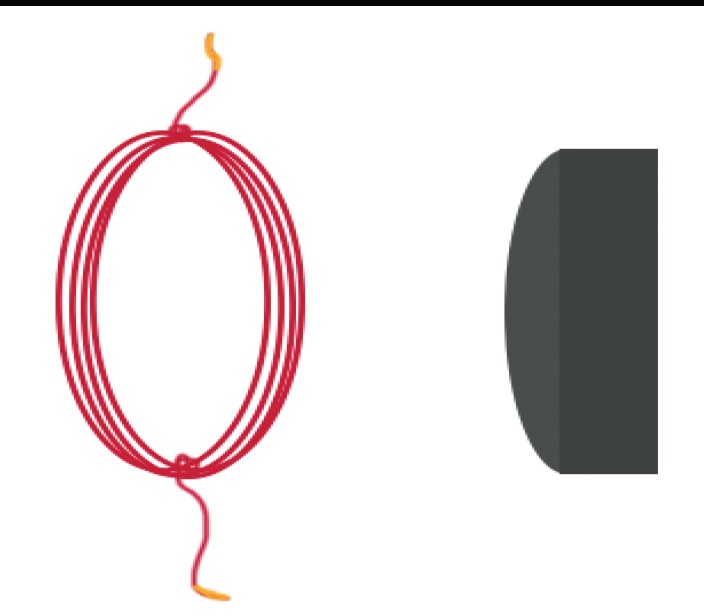
Answer and explanation
Force on the coil points toward the magnet; force on the magnet points toward the coil. They are equal/opposite and act on different bodies. Attraction was supplied as an assumption, not inferred from absent pole/current labels. An unchanged linked flux does not continuously induce emf; current also needs the appropriate conducting path and energy account.
Read source labels, scope, axes and intentional omissions.
Use the complete local explanation to draw a justified mechanism or calculate a supported quantity.
State what is observed, what is assumed and what evidence remains needed.
Response criteria
- Interpret the source labels, units and scope accurately.
- Explain the relevant mechanism with a labeled model or supported calculation.
- Identify a meaningful assumption, uncertainty or missing comparison.