Will you live to 120? · The Hunger Switch
Rapamycin: the one that travels
Rapamycin: the one that travels
If you want to know which longevity intervention to take most seriously, the honest answer is the one that keeps working no matter who runs the experiment — and that is rapamycin.
The molecule has a wonderful origin. In the 1960s, a soil sample from Rapa Nui — Easter Island, the one with the giant stone heads — yielded a compound made by a soil bacterium, an antifungal that was named rapamycin after the island. It turned out to be a potent immunosuppressant (it’s used to keep transplant patients from rejecting organs), and the reason it works is that it shuts down mTOR — indeed, mTOR is named after rapamycin, the drug having been discovered before the protein it hits.
Then came the result that anchors the whole field. The U.S. National Institute on Aging runs an Interventions Testing Program designed to be hype-proof: candidate longevity drugs are tested in genetically diverse mice, simultaneously, at three independent laboratories, so that no single lab’s quirks or wishful thinking can produce a false positive. In 2009 it reported that rapamycin extended the lifespan of these mice — and, astonishingly, it worked even when started late in life, at an age equivalent to a human in their sixties. A drug, begun in old age, reliably lengthened mammalian lifespan, in both sexes, reproduced across three labs. Nothing else in aging biology has a result that clean. Rapamycin is the closest thing the field has to a sure thing, and everything else gets measured against it.
That said — and this is the discipline the book runs on, applied symmetrically, not just to the things we want to dismiss — rapamycin is still not a proven human longevity drug. It is the best animal result we have, which is not the same thing. At the doses used in transplant patients it suppresses the immune system and can worsen blood-sugar control, which are real liabilities for a drug you’d give to healthy older people for decades. The field’s current bet is that intermittent, lower-dose regimens, or close chemical cousins, can capture the longevity benefit while shedding the immunosuppression — and there are encouraging early human studies in which brief courses of rapamycin-like drugs actually improved immune function in the elderly. We are also, right now, running the experiment in companion dogs (whose aging resembles ours far more than a lab mouse’s does), which is exactly the right move: take the best mouse result and test it in a longer-lived, more human-like animal before believing it for people. Rapamycin clears a higher evidentiary bar than anything else in this chapter. It has not yet cleared the highest one.
Eat less, live longer — but compared to what?
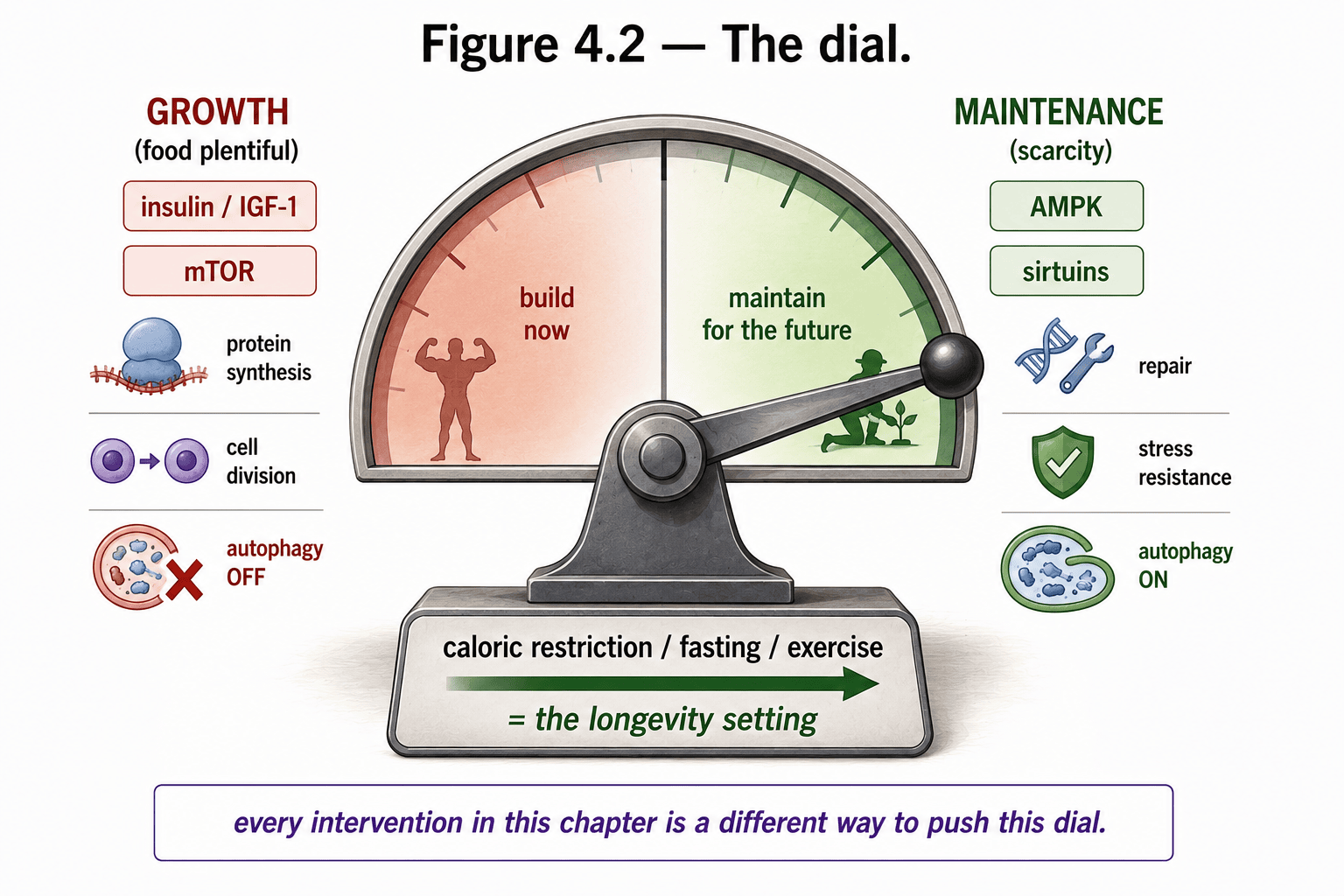
Behind rapamycin sits the oldest longevity intervention of all, the one rapamycin partly mimics: simply eating less. Caloric restriction — reducing food intake (typically 20–40%) while keeping nutrition adequate — has extended lifespan in essentially every model organism it’s been carefully tried in, from yeast to worms to flies to mice, where it can add 30–50% to lifespan. It was first shown in rats in 1935, and it remains the most robust environmental lever on aging known. Mechanistically it is no mystery: CR tips the whole nutrient-sensing network toward maintenance.
But the moment you ask whether it works in primates — in animals like us — you walk into the single best lesson in this book about why honest science is hard, and why “a study showed X” is never enough.
Two research teams set out, in the late 1980s, to test caloric restriction in rhesus monkeys — long-lived animals, decades-long studies, enormous expense and patience. One was at the University of Wisconsin; the other at the National Institute on Aging. And when their results came in, they appeared to flatly contradict each other. Wisconsin (reporting in 2009) found that its calorie-restricted monkeys had less age-related disease and better survival — CR worked. The NIA (reporting in 2012) found that its calorie-restricted monkeys did not live significantly longer than controls — CR didn’t, at least for survival. Same intervention. Same animal. Two rigorous, careful, decades-long studies. Opposite headlines. If you wanted a reason to distrust longevity science, here it was.
Except the contradiction was not a contradiction. When the two teams sat down together and reconciled their studies, the answer turned out to be almost entirely about a single, easily overlooked variable: what the control monkeys ate. At the NIA, the “control” monkeys were not gorging freely — they were fed a healthy, portion-controlled diet of natural ingredients, so they were already lean and already mildly restricted. At Wisconsin, the control monkeys ate as much as they wanted of a sugary, purified diet, and got fat. So the two studies were not asking the same question at all. Wisconsin compared restricted monkeys to overfed monkeys and found a big benefit. The NIA compared restricted monkeys to already-sensibly-fed monkeys and found a small one. The studies also differed in the age restriction started and in diet composition. Once you align them, the apparent war dissolves into a coherent and rather mundane conclusion: caloric restriction does benefit primate health, but how much benefit you see depends enormously on what you’re comparing against — and on a junk-food control diet, even modest restriction looks miraculous.
That is the lesson to carry out of this section and into every health claim you ever read: “compared to what?” is the question that breaks or makes a study. The monkey “contradiction” was not fraud, not sloppiness, not a failure of science. It was two excellent studies with different control groups, and the entire field had to learn to read them together. Most of the confusing, whiplash-inducing nutrition and longevity news you encounter has exactly this shape underneath it.
All 10 chapters of Will you live to 120? · Foundations · All courses