Will you live to 120?
Chapter 4 · The Hunger Switch
Sensing scarcity flips a cell from growth to repair — the most reliable longevity lever we have, and the corner of the field most drowned in hype.
Companion notebook · Chapter 4. The Goldilocks Dose: hormesis and the mTOR dial — open it in Google Colab and build it yourself: Open in Colab →
The worm that doubled
For most of the twentieth century, serious biologists did not study aging, because aging was not thought to be a thing you could study. It looked like entropy — the slow, unprogrammed wearing-down of a complicated machine, no more controllable than rust. There were no genes “for” aging any more than there were genes for a car rusting. To propose otherwise was to mark yourself as not quite respectable.
Then, in 1993, Cynthia Kenyon broke the field open with a worm.
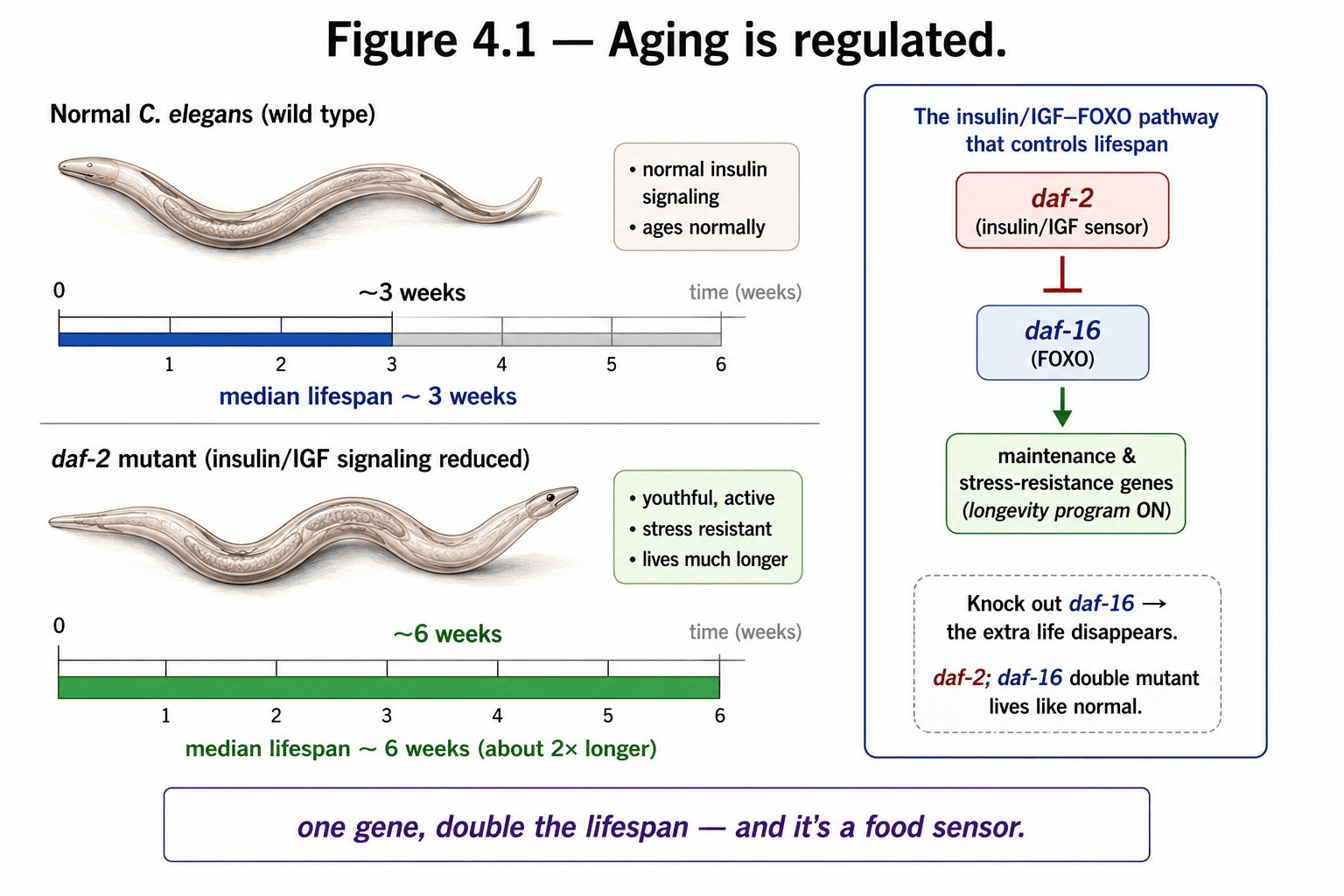
Working with C. elegans — a millimeter-long roundworm that lives a few weeks and has exactly 959 cells — Kenyon’s lab found that mutating a single gene, called daf-2, doubled the animal’s lifespan. Not by a few percent. Double. And the long-lived worms were not frail invalids dragging out a miserable extra span; they stayed youthful and vigorous, moving and feeding like much younger animals, simply for twice as long. A single gene. One switch.
It got better, and more revealing. The doubling was not automatic — it required a second gene, daf-16, working downstream. Knock out daf-16, and the daf-2 longevity evaporated entirely; the worms aged and died on schedule. So this was not damage being passively avoided. It was an active program: daf-2 normally holds daf-16 in check, and when you release daf-16, it switches on a whole suite of protective, maintenance, and stress-resistance genes that keep the animal young. Aging, Kenyon had shown, is regulated. There are genetic controls that set how long an animal lives, and flipping a single one can rewrite the lifespan.
This is, without much competition, the most important single experiment in the molecular biology of aging, because it converted aging from an inevitability into a mechanism — and a mechanism can be studied, and perhaps adjusted. (Kenyon was not entirely first; in the 1980s Michael Klass and Tom Johnson had found worm mutants that lived longer. But the magnitude of the daf-2 effect, and the clean demonstration that a regulated genetic pathway controlled it, is what changed the field’s mind.) And the moment anyone asked what daf-2 actually was, the whole story snapped into focus around a single theme that organizes this chapter. daf-2 is the worm’s receptor for an insulin-and-IGF-like signal — a nutrient sensor. The switch that doubles a worm’s life is the switch that tells its cells how much food is around.
The growth-versus-maintenance switch
Here is the deep idea the worm handed us, and it runs through every intervention in this chapter.
A cell, and an organism, must constantly make a choice about how to spend limited resources: pour them into growth and reproduction, or into maintenance and repair. When food is plentiful, the sensible bet is to grow and breed now. When food is scarce, the sensible bet is the opposite — hunker down, fix what’s broken, build stress resistance, and wait for better times to reproduce. Evolution wired cells to read the nutrient supply and shift the dial accordingly. And the discovery at the heart of modern aging biology is that the maintenance setting is also, as a side effect, the longevity setting. Tip a cell toward “scarcity — repair and endure,” whether by actually restricting food or by drugging the sensors so they think food is scarce, and across yeast, worms, flies, and mice, the animal lives longer and healthier. This is the disposable-soma idea from the last chapter made actionable: when the body invests in maintenance over reproduction, it lasts longer.
A small number of conserved sensors do the reading, and they fall cleanly into the two camps. On the food-is-plentiful, grow side:
- Insulin/IGF-1 signaling — the pathway Kenyon’s daf-2 belongs to. It senses nutrients and growth cues and tells cells to grow and divide. Turn it down and lifespan goes up, all the way up the tree of life.
- mTOR (the “mechanistic target of rapamycin”) — the master growth switch. When mTOR senses plentiful amino acids and growth signals, it drives the cell to build proteins and grow, and it switches off autophagy, the cell’s recycling-and-cleanup system (which we’ll meet properly in Chapter 6). Inhibit mTOR, and the cell stops growing, starts cleaning house, and becomes more stress-resistant.
On the food-is-scarce, maintain side:
- AMPK — the cell’s fuel gauge. It senses when energy is low and responds by switching on energy-producing, catabolic, maintenance programs and shutting down wasteful growth (it inhibits mTOR directly). It is the sensor that fires during fasting and exercise.
- Sirtuins — a family of enzymes that sense the cell’s metabolic state and, when energy is scarce, promote stress resistance, DNA repair, and mitochondrial health. They are the protagonists — and the troublemakers — of the second half of this chapter.
These are not four separate stories. They are an interlocking network with a single output: the growth-versus-maintenance dial. Insulin/IGF and mTOR push toward growth; AMPK and sirtuins push toward maintenance and oppose mTOR. Caloric restriction, fasting, and exercise all tip the entire network toward maintenance — lowering insulin/IGF and mTOR, raising AMPK and sirtuin activity — and that coordinated tipping is, as far as we can tell, the core of why eating less makes animals live longer. The rest of this chapter is what happens when we try to flip that switch with drugs instead of hunger, and which of those attempts the evidence actually supports.
All 10 chapters of Will you live to 120? · Foundations · All courses