Atmospheric Energy & Circulation — Print · Grade 9 Science
Chapter: Atmosphere & WeatherAtmospheric Energy & Circulation
Learning goals
- I can explain how unequal solar heating drives atmospheric circulation.
- I can trace energy through radiation, convection, and phase changes.
Readings for this unit
Before this unit
Compare temperature, density and incoming solar energy.
Plan three teaching sessions: core explanation and Parts 1–2; Parts 3–4 with diagrams and reasoning checks; then the whole-unit application, worked examples, independent practice, and exit check. Read one part at a time, explain it without notes, and revisit any gap. Allow about 40–50 minutes per session; adjust after checking understanding. Trace and explain the labeled figures in each part. In the third session, complete the illustrated case and changed independent application; retain a corrected explanation rather than only an answer.
Start with something to explain
How does uneven heating become moving air and storm energy?
Illustrative evidence case. Equal beam energy falls over different areas. A rising air parcel expands, while water evaporates at one location and condenses elsewhere.
Notice and wonder
Record two observations using the stated quantities or relationships. Keep observations separate from possible causes. Write one question that a new measurement could help answer.
How does uneven heating become moving air and storm energy?
Your first model
Separate incoming energy, density/pressure relationships, air movement and phase-change transfers.
Build the language from the idea
- albedo
- The fraction of incoming radiation reflected by a surface.
- convection
- Energy transfer associated with the motion of a fluid.
- latent energy transfer
- Energy absorbed or released during a change of phase.
Sunlight heats Earth unevenly because of solar angle, day length, clouds, surface properties, and latitude. Some incoming radiation is reflected and some absorbed. Earth emits infrared radiation. Regional heating contrasts help create pressure differences that move air.
Warm air often expands and becomes less dense than nearby cooler air at comparable pressure. Rising air can cool as it expands; water vapor may condense into droplets when saturation is reached. Condensation releases energy to the surrounding air. Evaporation requires energy, linking the water cycle to energy transfer.
Earth’s rotation deflects large-scale moving air relative to the surface, helping organize circulation belts and prevailing winds. Mountains, oceans, and seasonal shifts modify these patterns. High pressure is often associated with sinking air and low pressure with rising air, but a pressure symbol alone does not guarantee a particular local forecast.
Sunlight warms Earth's surface, which transfers energy to air and emits infrared radiation. Uneven heating arises from latitude, time of day, season and surface properties. The resulting temperature differences help create pressure differences and circulation.
Warm air often expands and becomes less dense than nearby cooler air under comparable pressure. Rising and sinking movements interact with Earth's rotation and geography. A small convection demonstration illustrates one mechanism but cannot reproduce global circulation by itself.
Compare energy arriving, reflected and emitted. Albedo is the fraction reflected; darker surfaces often absorb more sunlight under otherwise similar conditions. A surface-temperature claim must also consider moisture, wind and heat storage, so color alone does not predict every real measurement.
Build your understanding
Plan three teaching sessions: core explanation and Parts 1–2; Parts 3–4 with diagrams and reasoning checks; then the whole-unit application, worked examples, independent practice, and exit check. Read one part at a time, explain it without notes, and revisit any gap. Allow about 40–50 minutes per session; adjust after checking understanding.
Part 1 · Uneven heating creates a physical question
A beam carrying a stated amount of energy can strike a small surface footprint nearly perpendicular to the surface or spread over a larger footprint at a low angle. The larger footprint receives less energy per square metre for the same beam energy. Albedo is the fraction of incoming radiation reflected; changing surface reflectivity changes how much is absorbed even at equal solar angle. Day length sets the receiving interval, and material heat capacity affects the resulting temperature response. These factors help explain uneven heating without treating solar angle alone as a complete local-weather prediction.
Read the visual model
The arrows represent selected equal-energy rays, while the surface footprint indicates spreading. Their oblique lengths are geometric illustrations, not a measured radiation intensity.
If equal beam energy is spread over twice the receiving area, what happens to energy per area?
Visual reasoning — after your attempt
It is halved under the stated equal-energy model. Reflection, receiving time and atmospheric conditions can still change actual absorbed energy.
Solar energy reaches different surfaces and latitudes at different angles and under different conditions. Reflection, absorption, surface heat capacity and day length affect temperature. Uneven heating helps create pressure and density differences that drive circulation, but local temperature is influenced by many processes.
A beam spread across a larger surface provides less energy per area than the same beam concentrated on a smaller area. Keep beam energy and angle controlled when using a flashlight model.
Pause and explain
Why can changing sunlight angle alter energy received per area?
Check your reasoning after answering
The same incoming energy is distributed over a different area, changing energy density.
Part 2 · Explain rising air and pressure gradients
A parcel is a selected small region of air used in a model. At comparable pressure, a warmer parcel can be less dense than surrounding air and receive net upward buoyant force. As it rises into lower surrounding pressure, it can expand and cool. Condensation may begin when the temperature/moisture conditions allow it. Horizontal pressure differences supply a pressure-gradient force that initiates air movement. Surface pressure reflects the overlying air column’s weight, so local warm temperature alone does not uniquely establish high or low surface pressure.
Read the visual model
The red arrow marks ascent; the same number of selected parcel markers is more spread out aloft. The adjacent column shows a qualitative decrease in pressure/density with height, not a counted real atmosphere. Horizontal gradients are a separate comparison described below.
Why is “warm air means low surface pressure everywhere” an incomplete rule?
Visual reasoning — after your attempt
Surface pressure depends on the mass and dynamics of the overlying column, while buoyancy compares a parcel with its surroundings at comparable pressure. Temperature alone does not supply the whole column balance.
Warm air can be less dense than surrounding air at comparable pressure, permitting buoyant motion. Rising air expands and can cool; cooling may lead to condensation when conditions allow. Horizontal pressure differences help drive wind. Surface pressure measures the weight of the overlying air column, not temperature alone.
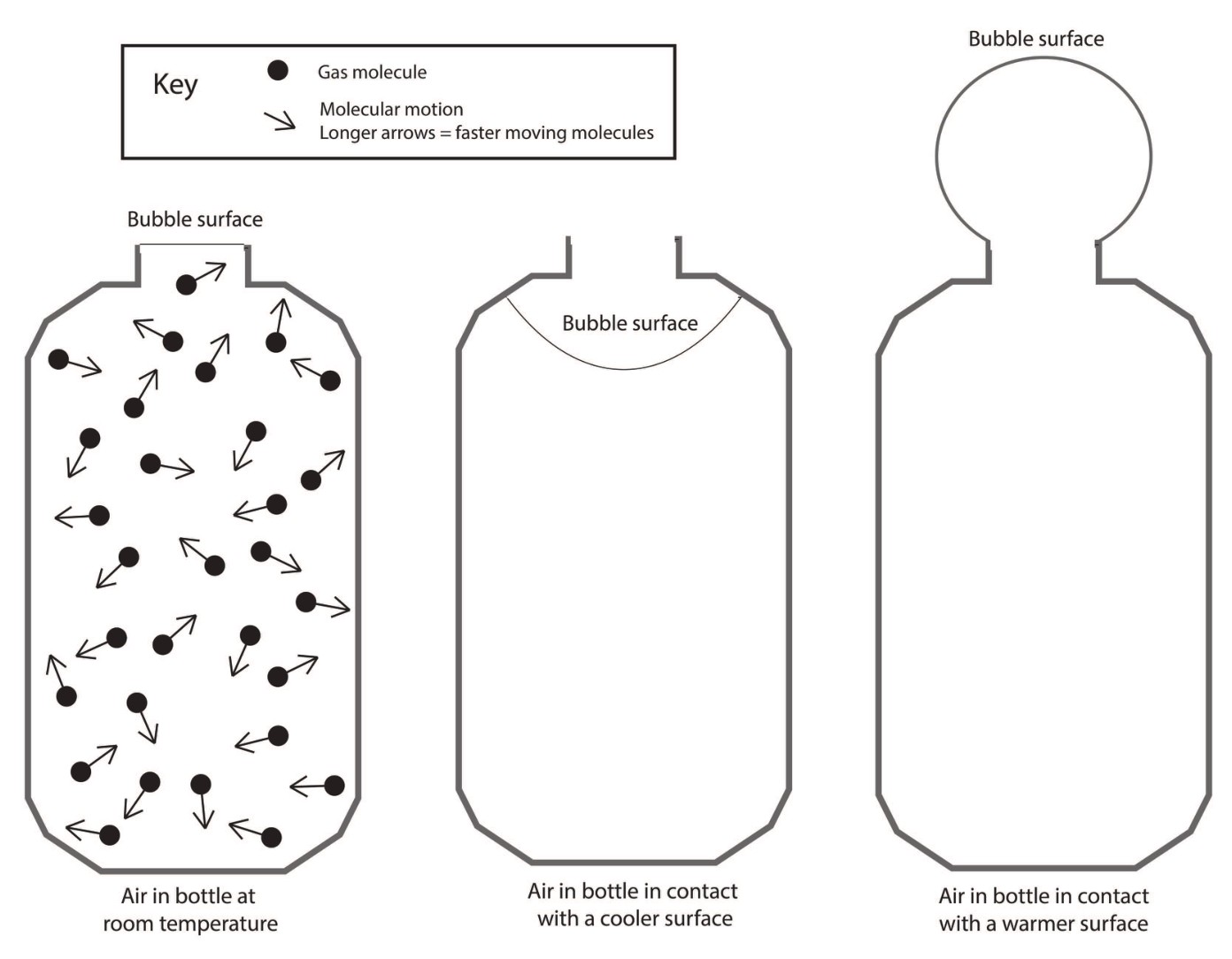
A warm room does not prove the region must have surface low pressure. Large-scale circulation, column mass and surrounding conditions matter. Explain the mechanism instead of equating warm with low in every setting.
Pause and explain
Why is surface pressure not determined by local temperature alone?
Check your reasoning after answering
It depends on the overlying air-column mass and circulation as well as thermal conditions.
Part 3 · Add rotation to a circulation model
The Coriolis effect describes apparent deflection in a rotating reference frame. For large-scale Earth motion it acts to the right of motion in the Northern Hemisphere and left in the Southern Hemisphere. Right of a northward motion is eastward, while right of an eastward motion is southward; the direction is not always east. It modifies movement initiated by other forces and is zero for air with no velocity in this simplified horizontal comparison. Friction, changing pressure patterns and boundaries also matter, so these arrows are not a complete wind forecast.
Read the visual model
Turn mentally to face each blue motion arrow, then identify its right or left side. Do not read right as a fixed page compass direction.
In the Northern Hemisphere, what direction is right of an eastward-moving parcel?
Visual reasoning — after your attempt
Southward. Coriolis changes direction relative to the moving parcel; it does not always deflect east and does not initiate motion from rest.
Earth’s rotation affects the apparent direction of large-scale moving air. Coriolis deflection is to the right of motion in the Northern Hemisphere and left in the Southern Hemisphere; it is not the initiating pressure-gradient force. Global circulation patterns also reflect friction, land distribution and seasonal changes.
A simple nonrotating hot-equator/cold-pole circulation is a first model. Adding rotation changes pathways and helps explain organized wind belts; label the first model’s missing process.
Pause and explain
Does Coriolis create wind from air initially at rest?
Check your reasoning after answering
It deflects motion in the rotating reference frame; pressure gradients and other forces initiate or sustain motion.
Part 4 · Trace radiation and latent-energy transfer
Evaporation at a surface takes energy from the local environment as liquid becomes vapor. The vapor can move with air. When it later condenses, phase-change energy is released in the new location, affecting the parcel and surrounding atmosphere. This is a form of latent-energy transfer. Solar radiation can supply energy at the surface, which then reaches the atmosphere by several pathways rather than only by direct sunlight absorption in air. Trace both water mass and energy; the same transfer diagram should not imply that energy or water is created in the cloud.
Read the visual model
Blue marks a selected vapor/matter pathway. Red arrows mark energy entering evaporation and being released by condensation at a different location.
How can the atmosphere above land gain energy associated with earlier evaporation over water?
Visual reasoning — after your attempt
Water vapor can be transported from the water surface and release latent energy when it condenses above land. The pathway links phase change and air movement.
Energy can move through radiation, contact and moving fluids. Evaporation and condensation transfer energy between surface and atmosphere. Rising moist air can release latent energy as condensation occurs, influencing weather systems. Distinguish movement of water from movement of energy and avoid treating all atmospheric heating as direct sunlight absorption.
A storm involves surface energy and moisture, air motion, phase changes and radiation. A mechanism diagram should connect these processes rather than label one arrow heat and omit the changing water state.
Pause and explain
How can evaporated surface water transfer energy to a different location?
Check your reasoning after answering
Energy absorbed during evaporation is carried with vapor and released upon condensation elsewhere.
Apply the whole unit · Compare two surface models
Illustrative equal-energy model: a dry surface warms 8 °C; a moist surface warms 3 °C and loses measurable water.
Your task
Explain two mechanisms that could contribute, propose controls to compare them, and sketch an energy-flow model with at least one stated limitation.
What your response should show
- Use the supplied evidence accurately and label units or locations.
- Explain a physical mechanism or evidence-to-claim relationship.
- Show calculations or a clearly labeled model when the task calls for one.
- Identify a meaningful assumption, uncertainty, or competing explanation.
Response guidance — after your attempt
Evaporation can use energy and water/surface properties can affect heat capacity. Equal energy is not enough unless material, exposure and measurements are comparable. Include radiation and evaporation pathways; do not assign the entire difference to one mechanism without tests.
Scientific references and adapted source material
Parent / teacher teaching notes
Ask for a pressure-gradient explanation before introducing deflection. Use diagrams with explicit arrows and labels; reteach any assertion that rotation alone starts every wind. Ask the learner to explain each visual label and causal step before calculating. Preserve a first model, attempt the changed independent case, then use feedback to revise. Diagrams state whether values are illustrative or observed. Selected OpenSciEd excerpts are middle-school source material used for supported foundations; the independent high-school explanations and supplements are not the complete OpenSciEd teacher editions or an endorsement.
The key idea
Unequal heating, water’s phase changes, and Earth’s rotation help organize atmospheric circulation.
Worked examples
Example 1
- First absorbs 100 − 60 = 40 units.
- Second absorbs 100 − 20 = 80 units.
Example 2 · Worked application
- Warmer land air rises, creating a local pressure pattern.
- Cooler near-surface air moves from sea toward land; return flow closes the circulation aloft.
Actual circulation also depends on larger-scale wind and geography.
Example 3
- The dark tile is expected to absorb a larger share of sunlight.
- Keep material, thickness, exposure and starting temperature comparable.
Example 4 · Find and fix the mistake
- Test the claim against the stated conditions: Actual circulation also depends on larger-scale wind and geography.
- Buoyancy of less dense warm air drives this convection. Heat can transfer in many directions by conduction and radiation.
Actual circulation also depends on larger-scale wind and geography.
Example 5 · Reason from the visual evidence
- Turn mentally to face each blue motion arrow, then identify its right or left side. Do not read right as a fixed page compass direction.
- Southward. Coriolis changes direction relative to the moving parcel; it does not always deflect east and does not initiate motion from rest.
Original selected-direction Coriolis diagrams in a top-view Earth frame. Arrows compare direction only and do not represent measured accelerations. The effect depends on latitude and speed; friction and other forces are omitted.
Avoid these mistakes
- Atmospheric circulation is not explained by warm air rising alone.
Check your understanding
Two identical dry tiles, one dark and one light, receive the same sunlight. Predict a difference and name a control.
Discuss the answer
The dark tile may warm more under the controlled conditions; real outdoor surfaces require additional evidence.
Why does a small convection box not fully model global winds?
Discuss the answer
A box can model selected heating and buoyancy but omits Earth rotation, globe geometry, land/ocean distribution, scales and changing pressure patterns. It cannot by itself predict all global winds.
Return to the phenomenon
Return to the initial case. How does uneven heating become moving air and storm energy? Revise your drawing or explanation using two named ideas and one stated limitation.
Compare explanations after your attempt
Angle and surface properties influence heating. Buoyancy and pressure gradients act in different comparisons; rotation modifies moving air. Transported vapor releases latent energy during later condensation, linking surface and atmospheric energy.
What should we investigate next?
Which comparison would test a remaining uncertainty? State what you would change, keep comparable and measure.
Investigate, explain and revise
Complete the tasks after studying the visual parts. Keep the first model and explain a revision before consulting the guidance.
Activity 1 · Explain the opening case
Use this unit’s opening record, Parts 1–4 and your notebook model. No external equipment or text is required for this supplied-data route.
Your task
Return to the initial case. How does uneven heating become moving air and storm energy? Revise your drawing or explanation using two named ideas and one stated limitation.
Success criteria
- Use two stated observations or conditions.
- Connect the mechanism to a labeled diagram or calculation.
- Identify what your original model missed.
- State a useful further test and a limitation.
Hint
Name the quantities and interactions before assigning a cause.
Response guidance — discuss after your attempt
Angle and surface properties influence heating. Buoyancy and pressure gradients act in different comparisons; rotation modifies moving air. Transported vapor releases latent energy during later condensation, linking surface and atmospheric energy.
Activity 2 · Transfer to a changed case
Use the figures, captions and vocabulary in this unit; cover the worked answer.
Your task
A Northern Hemisphere air parcel initially moves north, while another moves east. Give the Coriolis deflection direction for each and explain why the effect does not begin a wind from rest.
Success criteria
- Use the stated measurements or conditions, with correct units.
- Connect the result to the physical mechanism or evidence relationship.
- Identify the assumption, model limit or further evidence requested.
Hint
Separate measured values, calculated results and model assumptions.
Response guidance — discuss after your attempt
Right of northward motion is east, and right of eastward motion is south. Coriolis modifies existing motion in the rotating Earth frame; pressure-gradient or other forces initiate the wind. The complete wind also depends on friction and other forces.
Words to know
- albedo
- The fraction of incoming radiation reflected by a surface.
- convection
- Energy transfer associated with the motion of a fluid.
- latent energy transfer
- Energy absorbed or released during a change of phase.
In the real world
Exit check
Why is energy transfer part of the water cycle rather than a separate topic?
Check your explanation after answering
Changes of phase absorb or release energy, and moving water and vapor transport that energy between parts of the Earth system.
Explain your reasoning without notes. If a key idea is missing, revisit the lesson and try again.
Problem 1
Answer and explanation
150 units
200 − 50 = 150.
Problem 2
- absorbs energy from surrounding air
- releases energy to surrounding air
- destroys water molecules
- requires sunlight in every case
Answer and explanation
releases energy to surrounding air
The phase change releases energy.
Problem 3
Answer and explanation
Local terrain and conditions modify large-scale circulation.
Problem 4
Answer and explanation
The dark tile may warm more under the controlled conditions; real outdoor surfaces require additional evidence.
The dark tile is expected to absorb a larger share of sunlight.
Keep material, thickness, exposure and starting temperature comparable.
Response criteria
- Use the stated conditions.
- Show the evidence or calculation.
- Explain the conclusion and any stated limitation.
Problem 5
Hints
Actual circulation also depends on larger-scale wind and geography.
Answer and explanation
It creates temperature and pressure differences that move air and redistribute energy.
Problem 6
Hints
State what the supplied observations or conditions establish, and separate that from any assumption.
Answer and explanation
Convection transports energy with moving matter; radiation transfers energy electromagnetically.
Problem 7
Answer and explanation
Southward. Coriolis changes direction relative to the moving parcel; it does not always deflect east and does not initiate motion from rest.
Turn mentally to face each blue motion arrow, then identify its right or left side. Do not read right as a fixed page compass direction.
Southward. Coriolis changes direction relative to the moving parcel; it does not always deflect east and does not initiate motion from rest.
Response criteria
- Read the labeled quantities, reference frame or objects correctly.
- Explain the relation between the visual evidence and the mechanism.
- Keep the drawing’s stated assumptions and limits in the conclusion.
Problem 8
Answer and explanation
Right of northward motion is east, and right of eastward motion is south. Coriolis modifies existing motion in the rotating Earth frame; pressure-gradient or other forces initiate the wind. The complete wind also depends on friction and other forces.
Right of northward motion is east, and right of eastward motion is south. Coriolis modifies existing motion in the rotating Earth frame; pressure-gradient or other forces initiate the wind. The complete wind also depends on friction and other forces.
Response criteria
- Use the stated measurements or conditions, with correct units.
- Connect the result to the physical mechanism or evidence relationship.
- Identify the assumption, model limit or further evidence requested.