States of Matter & Phase Changes — Print · Grade 8 Science
Chapter: Phases of MatterStates of Matter & Phase Changes
Learning goals
- I can describe how particle arrangement and motion differ in solids, liquids, and gases.
- I can name the phase changes and describe what happens to temperature and energy during each.
Readings for this unit
Before this unit
Describe solids, liquids and gases using particles.
Use three teaching sessions of about 40–45 minutes: first observe the phenomenon, draft a model and study Parts 1–2; next explain Parts 3–4 with the figures and evidence; then work the application, examples, practice, model revision and exit check. Divide any difficult part into smaller steps and revisit after feedback. Investigations, review and quizzes have separate sessions. Study the four visual parts across the scheduled sessions, then use the illustrated worked case and independent transfer questions. Extend or revisit a session when the learner cannot explain the figure; completion time is a proposed allocation, not a mastery guarantee.
Start with something to explain
What would explain the observations in states of matter & phase changes?
Illustrative evidence case. A supplied sealed-water model contains 50 g solid, then 30 g solid plus 20 g liquid, then 50 g liquid. The chemical formula remains H₂O throughout.
Notice and wonder
What changes without changing particle identity? Write two observations from the supplied record without guessing their cause. Include a quantity and its unit when given. An observation is what was recorded; an inference is what you think explains it.
Write one question about why the pattern occurs and one question about a comparison that could distinguish competing explanations. A testable question identifies what could be observed or measured.
Your first model
Before reading the model answer, sketch the named objects or particles and label what you think changes. Track mass, identity and arrangement across the three records. Explain what a particle drawing should change and what it should keep. Keep this first version so you can compare it with your later explanation.
Build the language from the idea
- solid
- A state of matter with a fixed shape and volume; particles vibrate in place, tightly packed.
- liquid
- A state of matter with a fixed volume but no fixed shape; particles are close but can flow past each other.
- gas
- A state of matter with no fixed shape or volume; particles are far apart and move freely and quickly.
- melting point
- The temperature at which a solid turns into a liquid.
- boiling point
- The temperature at which a liquid turns into a gas throughout the whole liquid.
- condensation
- The phase change from gas to liquid.
- thermal energy
- Internal energy associated with random particle motion and particle interactions; temperature alone does not give its total amount.
- model
- A representation that explains selected features and makes predictions; it leaves other details out.
- evidence
- Relevant observations or records used to support or challenge a claim.
- system boundary
- The chosen limit separating the objects being studied from their surroundings.
- assumption
- A condition taken as true for a model or calculation and needing to be checked against the case.
Many everyday materials are described using three familiar states — solid, liquid, or gas — and the real difference between them comes down to how the tiny particles inside are arranged and how fast they're moving. In a solid, the particles are packed tightly and locked into fixed positions, so all they can do is vibrate in place; that's why a solid keeps its own shape. In a liquid, the particles are still close together but no longer locked down, so they can slide and tumble past one another — which is why a liquid flows and takes the shape of its container while keeping the same volume. In a gas, the particles have broken free almost entirely, zooming around with lots of empty space between them, so a gas spreads out to fill whatever container it's in.
The state of a substance depends on conditions including temperature and pressure, and on interactions between its particles. Heating can increase average particle kinetic energy and temperature, but during a phase change energy can instead change particle interactions and arrangement. Thermal energy includes particle motion and interactions; it is not simply another name for temperature. Particles do not become bigger when a material expands, and substances such as water can behave differently from a simple always-closer-on-cooling rule.
When enough energy is added or removed, a substance flips from one state to another in a phase change. Adding energy drives the changes that loosen particles: melting turns a solid into a liquid at its melting point, and boiling turns a liquid into a gas at its boiling point (evaporation does the same thing more gently, only at the surface). Removing energy runs these in reverse — freezing turns a liquid back into a solid, and condensation turns a gas back into a liquid, which is the fog you see forming on a cold bathroom mirror. Two less common shortcuts skip the liquid stage entirely: sublimation goes straight from solid to gas (dry ice does this), and deposition goes straight from gas to solid.
For a pure substance at fixed pressure, temperature can remain nearly constant during melting or boiling while energy continues to enter. During melting, solid and liquid may coexist while particle arrangements and interactions change. After the phase change is complete, further heating can raise temperature again. Real samples, mixtures, pressure changes, and unequal heating may produce a less sharply defined plateau, so check the conditions before assuming that every phase change has a perfectly flat temperature record.
This is why one substance, water, can be solid ice, liquid water, or gaseous water vapor without ever becoming a different chemical — it's the very same H₂O molecules the whole time, just arranged and moving differently. Understanding how adding or removing energy shuffles particles between these states is the key to everything from why sweating cools you down to how clouds and rain take shape in the sky.
During a phase change, particles remain the same chemical substance while their arrangement and interactions change. Melting water does not turn water molecules into hydrogen and oxygen. Particle diagrams should change spacing and organization while retaining the same labeled particles.
For a pure substance at fixed pressure, temperature can stay nearly constant during melting or boiling while energy is transferred. The energy changes interactions between particles. Outside a phase change, heating generally increases temperature. Mixtures can melt across a range instead of at one sharp point.
Evaporation happens at a liquid's surface at temperatures below boiling. Faster particles can escape, cooling the remaining liquid. Boiling occurs throughout the liquid when its vapor pressure reaches the surrounding pressure. A change in air pressure can therefore change boiling temperature.
Build your understanding
Where this fits
This unit helps answer the chapter question: How can adding or removing energy change matter? Keep a notebook table with the question, evidence, explanation and one unresolved issue. Revise a previous model only when you can name the new evidence or idea that changes it.
Use three teaching sessions of about 40–45 minutes: first observe the phenomenon, draft a model and study Parts 1–2; next explain Parts 3–4 with the figures and evidence; then work the application, examples, practice, model revision and exit check. Divide any difficult part into smaller steps and revisit after feedback. Investigations, review and quizzes have separate sessions.
Part 1 · Represent the same particles in different states
In a solid, particles vibrate around relatively fixed positions. In a liquid, particles remain close but change neighbors. In a gas, particles are much farther apart on average and move through the available space. This model explains shape, flow, and compressibility without turning particles themselves into miniature solid or liquid objects.
Read the visual model
What changes when liquid water freezes, and what remains the same?
Visual reasoning — after your attempt
The molecular arrangement and motion change. The molecules remain water molecules, and the total mass stays the same if none enters or leaves the system.
Draw the same number and kind of water molecules in three equal-area panels. Change their arrangement and spacing, not their identity or drawn size. Real water expands on freezing; the familiar claim that every solid is denser than its liquid has exceptions.
Pause and explain
What changes when liquid water freezes, and what remains the same?
Check your reasoning after answering
The molecular arrangement and motion change. The molecules remain water molecules, and the total mass stays the same if none enters or leaves the system.
Part 2 · Distinguish evaporation from boiling
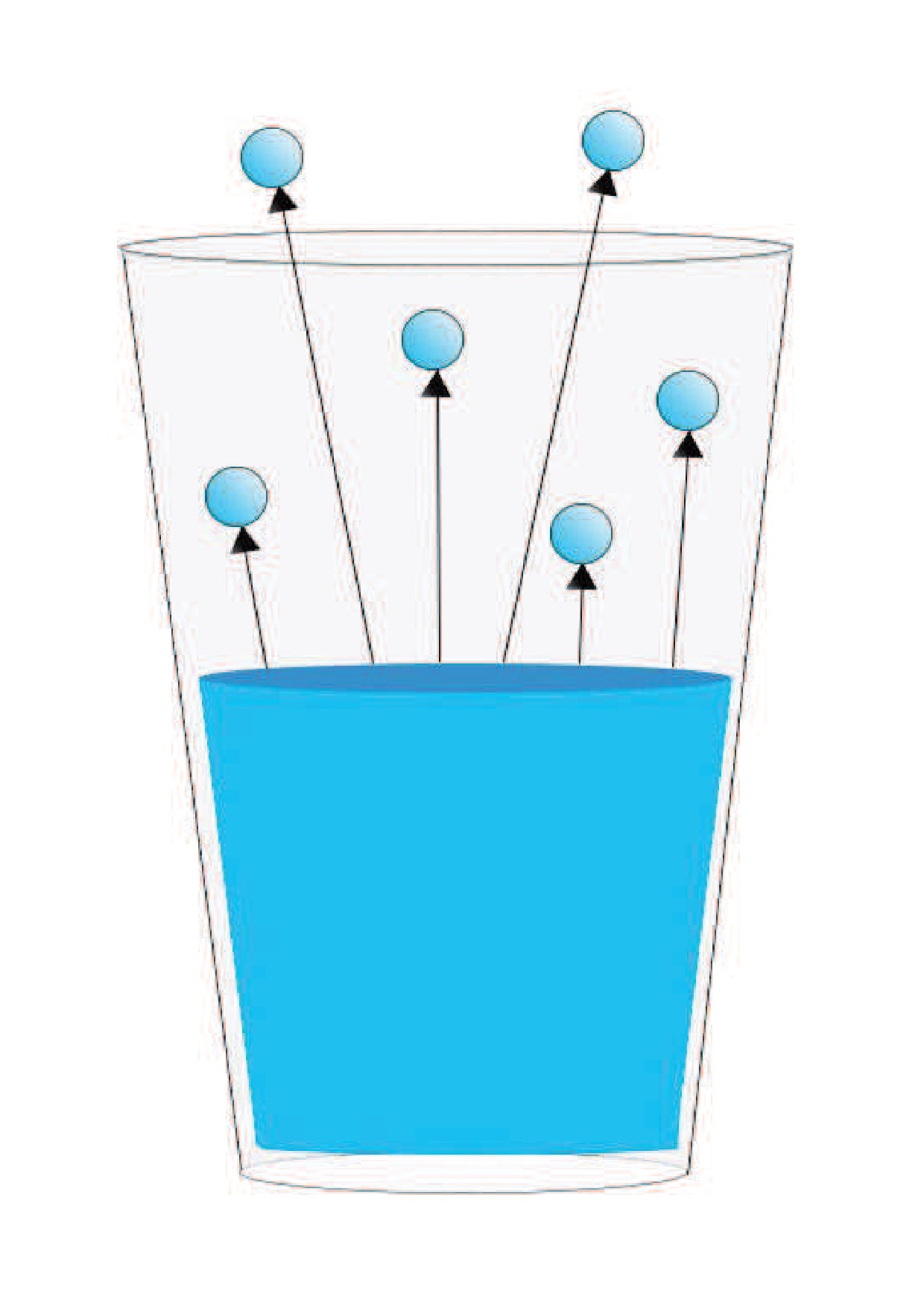
Evaporation occurs at a liquid surface, including below boiling temperature. Some molecules escape into the gas phase. Boiling occurs throughout the liquid when vapor pressure matches surrounding pressure. Temperature, exposed surface, and air movement can affect evaporation, so a fair comparison changes only the factor being tested.
Read the visual model
Bulk means the material away from only its outer surface. Water vapor is gaseous water and is invisible; visible mist consists mainly of small liquid droplets. The model separates these ideas without asking the learner to boil water.
Which feature distinguishes these two modeled phase changes, and why would a bubble from an unknown mixture need other evidence?
Visual reasoning — after your attempt
Surface-only escape versus vapor-bubble formation within the liquid distinguishes these cases. Unknown bubbles could arise from other processes, so gas identity and conditions must be established.
A wet towel dries at room temperature without boiling. Spread-out water can evaporate faster than the same amount in a narrow container under otherwise comparable conditions. The water molecules move into the air; they have not been destroyed.
Pause and explain
How can water disappear from an open dish without reaching 100°C?
Check your reasoning after answering
Surface molecules can escape by evaporation below boiling temperature. They enter the surrounding air as water vapor.
Part 3 · Interpret a temperature plateau
For a pure substance at fixed pressure, melting or boiling can occur at nearly constant temperature while energy is transferred. The transferred energy changes interactions and arrangement rather than simply increasing average particle kinetic energy. Real samples and mixtures may not show a perfectly flat plateau.
Read the visual model
Why can heating continue while temperature stays nearly constant?
Visual reasoning — after your attempt
During a phase change, energy can change particle interactions and arrangement while average kinetic energy, and therefore temperature, changes little.
On a temperature-time heating graph, a rising section indicates warming; a nearly flat melting section can indicate solid and liquid coexisting. A flat line does not mean the heater necessarily stopped supplying energy. Check what happened to the sample as well as the temperature.
Pause and explain
Why can heating continue while temperature stays nearly constant?
Check your reasoning after answering
During a phase change, energy can change particle interactions and arrangement while average kinetic energy, and therefore temperature, changes little.
Part 4 · Trace energy and matter through condensation
Water vapor is invisible. Visible mist contains tiny liquid droplets formed when vapor condenses. On a cold glass, water from surrounding air can condense on the outside; it need not have leaked through the glass. Condensation transfers energy from the condensing water to its surroundings.
Read the visual model
Condensation is a gas-to-liquid phase change. Keep chemical identity, water origin and energy transfer as separate questions. The container wall can be dry initially yet gain outside water without leaking from its interior.
Where do the droplets’ water and the transferred energy come from in this model?
Visual reasoning — after your attempt
The water comes from vapor in surrounding air. During condensation, energy transfers from the vapor/surrounding system toward the cooler wall; no new water is created.
Use a labeled before-and-after drawing with vapor outside the cup and droplets on the cold surface. A sealed cup of colored water can help distinguish a leak from outside condensation, but several observations are stronger than one picture.
Pause and explain
Are the visible white clouds above hot water water vapor itself?
Check your reasoning after answering
The visible cloud is mostly tiny condensed liquid droplets. Gaseous water vapor itself is invisible; the droplets form as warm moist air cools.
Apply the whole unit · Read a melting record
Illustrative record for a pure solid at fixed pressure: temperature rises from −5°C to 0°C, stays near 0°C while solid and liquid coexist, then rises to 8°C after the solid is gone. A heater supplies energy throughout.
Your task
Sketch and label the temperature-time pattern. Draw particle models for three stages, identify where phase change occurs, and explain energy transfer during the flat section. State one condition needed for this interpretation.
What your response should show
- Use the supplied observations and measurements accurately; include units where needed.
- Explain the science behind your answer, rather than giving only a number or label.
- Show a labeled model, calculation, or evidence comparison as requested.
- State an assumption or limitation and suggest a useful next measurement.
Response guidance — after your attempt
The graph rises, has a near-flat melting section, then rises again. During melting, added energy changes particle interactions while temperature changes little. Retain the same particle identities in all sketches. The interpretation assumes a pure substance, controlled pressure, and reliable temperature measurements; a mixture may show a broader melting range.
Scientific references and adapted teaching resources
- OpenSciEd 6.2 Thermal Energy — public unit overview
- OpenSciEd instructional model — storyline routines
- Creative Commons Attribution 4.0 — middle-school material license
Parent / teacher teaching notes
Use a graph and particle drawing together. Ask what the graph shows directly and what the model explains. Correct any drawing that enlarges molecules during heating or turns water into different elements. Adaptation credit: OpenSciEd middle-school teaching routines and public task structures by OpenSciEd, CC BY 4.0. This independent version adds original explanatory text, data and figures, terminology support and a home-study schedule. It does not reproduce the complete teacher editions or their classroom validation.
The key idea
Solid, liquid, and gas differ in particle spacing and motion; during a phase change, added or removed energy changes the state, not the temperature.
Worked examples
Example 1
- From −10°C to 0°C: the solid ice simply warms up, particles vibrating faster.
- At 0°C: the ice melts into liquid water. Temperature holds steady at 0°C the whole time it's melting, even though energy keeps flowing in.
- From 0°C to 20°C: once fully melted, the liquid water warms up normally to 20°C.
Example 2 · Worked application
- Before boiling, added energy increases average particle kinetic energy.
- During boiling, energy changes particle interactions while temperature is nearly constant.
- After vaporization, further heating can increase the gas temperature.
The particles remain the same chemical substance through the change.
Example 3
- Identify melting: the substance is changing from solid to liquid.
- Added energy changes particle interactions instead of mainly increasing average kinetic energy.
Example 4 · Find and fix the mistake
- Test the claim against the stated conditions: The particles remain the same chemical substance through the change.
- Energy can still enter during a phase change. Constant temperature does not mean constant total stored energy.
The particles remain the same chemical substance through the change.
Example 5 · Interpret the visual model
- Identify the represented objects, axes, labeled quantities and stated conditions before choosing a rule.
- Bulk means the material away from only its outer surface. Water vapor is gaseous water and is invisible; visible mist consists mainly of small liquid droplets. The model separates these ideas without asking the learner to boil water.
- Surface-only escape versus vapor-bubble formation within the liquid distinguishes these cases. Unknown bubbles could arise from other processes, so gas identity and conditions must be established.
Keep the model’s stated limits explicit: Evaporation selects surface particles escaping from liquid and can occur below boiling. In the specified boiling-water model, vapor bubbles form in the liquid’s bulk. Both are phase changes retaining water identity. Bubble size and selected particles are schematic, and neither drawing says visible white fog is invisible gas molecules or that all bubbling processes are boiling.
Avoid these mistakes
- Evaporation does not require the liquid to reach its boiling point.
Check your understanding
Ice and liquid water coexist at about 0°C at normal atmospheric pressure while heat is added. Why does the temperature stay nearly constant?
Discuss the answer
Energy is used in melting while both phases remain; temperature rises after the ice has melted if heating continues.
What changes in a particle model when ice melts, and what stays the same?
Discuss the answer
During a phase change, particles remain the same chemical substance while their arrangement and interactions change. Melting water does not turn water molecules into hydrogen and oxygen. Particle diagrams should change spacing and organization while retaining the same labeled particles. For a pure substance at fixed pressure, temperature can stay nearly constant during melting or boiling while energy is transferred. The energy changes interactions between particles. Outside a phase change, heating generally increases temperature. Mixtures can melt across a range instead of at one sharp point.
Return to the phenomenon
A supplied sealed-water model contains 50 g solid, then 30 g solid plus 20 g liquid, then 50 g liquid. The chemical formula remains H₂O throughout. Track mass, identity and arrangement across the three records. Explain what a particle drawing should change and what it should keep. Revise your first explanation using a named idea from the lesson. Mark the changed part and the evidence that supports it.
Compare explanations after your attempt
Each record accounts for 50 g water. Melting changes particle arrangement and freedom of movement while retaining H₂O identity. Show a larger liquid fraction through the sequence; do not enlarge individual molecules or turn them into new elements. A drawing with a handful of dots stands for many molecules and is not to scale.
What should we investigate next?
Which condition could be changed to test a remaining uncertainty in this explanation? State the predicted observation and what result would challenge your model.
Investigate, explain and revise
Use these tasks after the three teaching sessions as needed. Discuss an attempted explanation before opening response guidance; a matching sentence is less important than a supported mechanism.
Activity 1 · Explain the new evidence case
Use the visible scenario above, Parts 1–4 and your first notebook model. No outside reading or equipment is required.
Your task
A supplied sealed-water model contains 50 g solid, then 30 g solid plus 20 g liquid, then 50 g liquid. The chemical formula remains H₂O throughout. Track mass, identity and arrangement across the three records. Explain what a particle drawing should change and what it should keep. Write 100–150 words or give a labeled drawing with an equivalent oral explanation.
Success criteria
- Use two relevant stated records or conditions.
- Explain the mechanism rather than only repeat a definition.
- Label observation and inference.
- Name a changed model feature or a remaining uncertainty.
Hint
Read the stated boundary and conditions before selecting a relationship. The unit’s worked examples show intermediate steps.
Response guidance — discuss after your attempt
Each record accounts for 50 g water. Melting changes particle arrangement and freedom of movement while retaining H₂O identity. Show a larger liquid fraction through the sequence; do not enlarge individual molecules or turn them into new elements. A drawing with a handful of dots stands for many molecules and is not to scale.
Activity 2 · Read and extend the figure
Study the new labeled figure and its caption, then compare it with the associated teaching part.
Your task
What changes without changing particle identity? Explain what each important label represents. Add one missing feature that would be needed for a different question, and explain why the original figure leaves it out.
Success criteria
- Answer the figure question with its stated labels.
- Connect the visual representation to the scientific idea.
- Identify a specific limitation from the caption.
- Propose a useful change without misrepresenting supplied evidence.
Hint
The dots stand for particles and are not to scale or literal colors. The same substance can change arrangement and freedom of movement while retaining particle identity. Solid particles vibrate, liquids remain close but rearrange, and gases are more widely separated.
Response guidance — discuss after your attempt
Spacing, arrangement and allowed motion can change. In the gas compression model, volume changes while particle number and temperature are held fixed. The dots stand for particles and are not to scale or literal colors. The same substance can change arrangement and freedom of movement while retaining particle identity. Solid particles vibrate, liquids remain close but rearrange, and gases are more widely separated.
Words to know
- solid
- A state of matter with a fixed shape and volume; particles vibrate in place, tightly packed.
- liquid
- A state of matter with a fixed volume but no fixed shape; particles are close but can flow past each other.
- gas
- A state of matter with no fixed shape or volume; particles are far apart and move freely and quickly.
- melting point
- The temperature at which a solid turns into a liquid.
- boiling point
- The temperature at which a liquid turns into a gas throughout the whole liquid.
- condensation
- The phase change from gas to liquid.
- thermal energy
- Internal energy associated with random particle motion and particle interactions; temperature alone does not give its total amount.
- model
- A representation that explains selected features and makes predictions; it leaves other details out.
- evidence
- Relevant observations or records used to support or challenge a claim.
- system boundary
- The chosen limit separating the objects being studied from their surroundings.
- assumption
- A condition taken as true for a model or calculation and needing to be checked against the case.
The hidden 'plateau' when ice melts
If you heat a beaker of ice and graph temperature over time, you'll see something strange: the temperature stops rising at 0°C even though you keep adding heat. That flat plateau is the ice melting. All the incoming energy is going into breaking the bonds holding the solid together, not raising the temperature. Only once every bit of ice is liquid does the temperature start climbing again. The same plateau appears at 100°C during boiling. This 'hidden' energy is called latent heat.
Why sweating cools you down
Evaporation is secretly a cooling machine. When the fastest-moving water molecules escape from your skin as vapor, they carry away energy, leaving the slower (cooler) molecules behind. That's why you feel cold stepping out of a pool, and why sweating works: your body uses evaporative cooling to dump heat. It's also why rubbing alcohol feels icy — it evaporates even faster than water.
The fourth (and most common) state of matter
Solid, liquid, gas — and plasma. If you heat a gas hot enough, electrons rip away from atoms, creating a glowing, electrically charged soup. It sounds exotic, but plasma is actually the most common state of matter in the universe: every star, including the Sun, is plasma. On Earth you see it in lightning, neon signs, and the flame of a candle's hottest region.
Sublimation: skipping the liquid entirely
Some substances jump straight from solid to gas without ever becoming a liquid — that's sublimation. Dry ice (frozen carbon dioxide) does this, which is why it produces that spooky fog with no puddle. It happens because at normal air pressure, CO₂ has no stable liquid form. The reverse, gas straight to solid, is deposition — it's how frost forms on a cold window overnight.
In the real world
Meteorologists track evaporation and condensation in the atmosphere to help predict clouds, fog, and rain.
Exit check
What changes without changing particle identity? Explain the relevant mechanism and one model limitation.
Check your explanation after answering
Spacing, arrangement and allowed motion can change. In the gas compression model, volume changes while particle number and temperature are held fixed. The dots stand for particles and are not to scale or literal colors. The same substance can change arrangement and freedom of movement while retaining particle identity. Solid particles vibrate, liquids remain close but rearrange, and gases are more widely separated.
Explain your reasoning without notes. If a key idea is missing, revisit the lesson and try again.
Problem 1
- Gas
- Liquid
- Solid
- Plasma
Answer and explanation
Solid
Solids have tightly packed particles that vibrate in place rather than moving around freely.
Problem 2
- It stays the same until all the liquid has boiled away
- It rises steadily
- It drops suddenly
- It becomes negative
Answer and explanation
It stays the same until all the liquid has boiled away
At fixed pressure, added energy changes particle interactions during boiling rather than raising temperature while liquid and vapor coexist.
Problem 3
- Melting
- Evaporation
- Condensation
- Sublimation
Answer and explanation
Condensation
Gas turning into liquid is condensation.
Problem 4
Answer and explanation
Evaporation happens slowly at the surface of a liquid at almost any temperature, while boiling happens throughout the entire liquid at one specific temperature, the boiling point.
Problem 5
Answer and explanation
0 °C
The flat section on a heating curve occurs at the melting point, given here as 0°C.
Problem 6
- melting
- sublimation
- condensation
- freezing
Answer and explanation
sublimation
Sublimation is the direct change from solid to gas.
Problem 7
Answer and explanation
Energy is used in melting while both phases remain; temperature rises after the ice has melted if heating continues.
Identify melting: the substance is changing from solid to liquid.
Added energy changes particle interactions instead of mainly increasing average kinetic energy.
Response criteria
- Use the stated conditions.
- Show the evidence or calculation.
- Explain the conclusion and any stated limitation.
Problem 8
Hints
The particles remain the same chemical substance through the change.
Answer and explanation
Evaporation occurs at the surface below boiling temperature as some particles escape. The liquid need not reach its boiling point.
Problem 9
Hints
State what the supplied observations or conditions establish, and separate that from any assumption.
Answer and explanation
No. Melting changes arrangement and interactions; water molecules retain their chemical identity.
Problem 10
Answer and explanation
Surface-only escape versus vapor-bubble formation within the liquid distinguishes these cases. Unknown bubbles could arise from other processes, so gas identity and conditions must be established.
Bulk means the material away from only its outer surface. Water vapor is gaseous water and is invisible; visible mist consists mainly of small liquid droplets. The model separates these ideas without asking the learner to boil water.
Surface-only escape versus vapor-bubble formation within the liquid distinguishes these cases. Unknown bubbles could arise from other processes, so gas identity and conditions must be established.
Response criteria
- Use the named labels, directions or supplied quantities accurately.
- Connect the visual evidence to the scientific mechanism or calculation.
- State the relevant model conditions or limitation.
Problem 11
Answer and explanation
More of the sample becomes liquid and particle arrangement/freedom of movement changes. Water molecules remain water; a plateau does not mean zero energy input or motionless particles.
Interpret the plateau with the stated phase-change conditions.
Track substance identity separately from arrangement and phase fraction.
More of the sample becomes liquid and particle arrangement/freedom of movement changes. Water molecules remain water; a plateau does not mean zero energy input or motionless particles.
Response criteria
- Use the named labels, directions or supplied quantities accurately.
- Connect the visual evidence to the scientific mechanism or calculation.
- State the relevant model conditions or limitation.