Natural Selection, Adaptation & Population Change — Print · Grade 7 Science
Chapter: Evolution, Evidence & Life HistoryNatural Selection, Adaptation & Population Change
Learning goals
- I can explain natural selection, adaptation & population change.
- I can use evidence, a model, and stated assumptions to support a biological explanation.
Before this unit
Use the supplied vocabulary, distinguish an observation from an explanation, and identify any units or model assumptions. Revisit a connected earlier unit if needed; new terms are explained here.
Use three flexible 40–45-minute sessions: core background and Parts 1–2 with their checks; Parts 3–4 and the worked application; then remaining practice, a labeled model, revision, and the exit check. Checks completed during reading can count toward the practice set. Read one short part at a time. Investigations and chapter review/quiz have separate sessions, and flexible weeks allow more time.
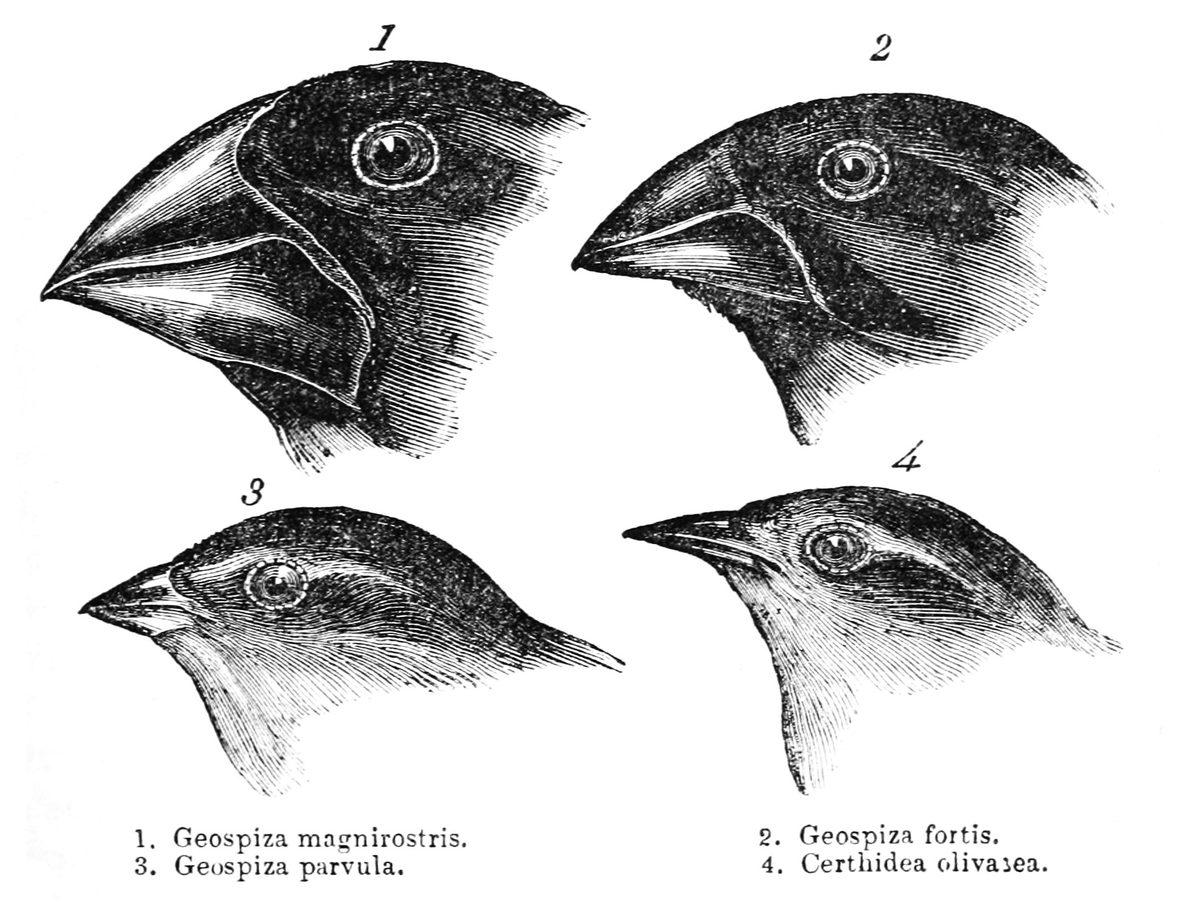
In 1977 a drought on the Galápagos island of Daphne Major killed most of the medium ground finches. The small soft seeds ran out first, and the birds that survived were disproportionately those with larger, deeper beaks able to crack the big tough seeds that remained. The next generation had measurably larger beaks than the generation before the drought — a change of a few per cent in a single year, measured bird by bird by researchers who had already been ringing and weighing the whole population for years. When the rains returned and small seeds became abundant again, beak size drifted back. That is natural selection observed directly, in the wild, with numbers.
The mechanism needs only three ingredients, and all three are things this course has already covered. First, heritable variation: individuals differ, and some of those differences are passed to offspring — which meiosis, recombination and mutation supply. Second, differences in survival and reproduction: some variants leave more offspring than others in the conditions that prevail. Third, inheritance doing its work, so the variants that left more offspring are more common in the next generation. Nothing else is required, and no intention anywhere.
The vocabulary needs care. Fitness in biology means reproductive contribution — how many surviving offspring an individual leaves — not strength or health, and a slower, weaker individual that leaves more offspring has higher fitness. An adaptation is a heritable feature that was favoured because of what it did for survival and reproduction in a particular environment, which means it is always an adaptation to something and can become a liability when conditions change. What natural selection changes is the frequency of variants in a population — the proportion carrying each — not the individuals themselves. No finch's beak grew during the drought; the population's composition changed.
Build your understanding
Where this fits
The last unit established that species change over time and that the fossil record shows it without explaining it. This unit is the mechanism. It depends on two things already covered: the variation meiosis and mutation produce in Chapter 5, and the population pathways from Chapter 6.
Use three flexible 40–45-minute sessions: core background and Parts 1–2 with their checks; Parts 3–4 and the worked application; then remaining practice, a labeled model, revision, and the exit check. Checks completed during reading can count toward the practice set. Read one short part at a time. Investigations and chapter review/quiz have separate sessions, and flexible weeks allow more time.
Part 1 · Three ingredients and nothing else
Variation comes first, and it comes from the processes in Chapter 5 rather than from need. Mutation changes sequences at random with respect to usefulness; meiosis and recombination deal those variants into new combinations every generation. By the time any environmental pressure arrives, the variation is already present.
Differential reproduction is the second ingredient and the one the environment supplies. In the conditions prevailing, some variants leave more surviving offspring than others. On Daphne Major in 1977 that was beak depth, because of which seeds remained. In other years, with other seeds, it was not.
Inheritance closes the loop. Because the favoured variants are heritable, the next generation contains a higher proportion of them. Repeat over many generations and the population can change substantially — and the process stops being directional the moment the conditions change, which is why the finches' beaks drifted back when the rains returned.
Pause and explain
What three things must be true for natural selection to occur?
Check your reasoning after answering
Individuals must vary; some of that variation must be heritable; and the variants must differ in how many surviving offspring they leave under the conditions prevailing. If all three hold, the proportion carrying the favoured variant rises in the next generation. Nothing else is needed, and no intention is involved at any stage.
Part 2 · Conditions decide which variant is favoured
No variant is better in general. A deep beak was an advantage on Daphne Major in 1977 and a disadvantage afterwards, because deep-beaked birds are less efficient on small seeds. An adaptation is always relative to an environment, and when the environment changes the same feature can become a cost.
This is why the phrase survival of the fittest misleads. Fitness is measured by surviving offspring in a given environment, so the statement is close to circular unless the environment is named. The useful version states the condition: in drought years with only large hard seeds, deeper-beaked finches left more offspring.
It also explains why selection does not produce perfection. It can only work on the variation present, it is pushed in different directions as conditions change, and a feature favoured for one reason may be costly for another. Organisms are full of compromises, which is what you would expect from this mechanism and not what you would expect from a design process.
Pause and explain
Why did the finches' average beak size drift back after the rains returned?
Check your reasoning after answering
Because the conditions that favoured deep beaks ended. With small soft seeds abundant again, smaller-beaked birds fed efficiently and left more offspring, so the frequency moved back. No variant is advantageous in general: an adaptation is relative to an environment, and the same feature can be a cost when conditions change.
Part 3 · Tracking a frequency, with its denominator
Selection is a change in proportions, so it is measured as a frequency: the number carrying a variant divided by the total examined. Stating the denominator is essential, because a count without it cannot be compared with anything.
Work the model. Generation one has 20 dark beetles out of 100, a frequency of 20 ÷ 100 = 0.2, or 20%. Generation two has 50 dark out of 100, a frequency of 0.5, or 50%. The frequency of the dark variant has risen by 30 percentage points in one generation, which is a large change.
The denominator matters because the alternative is misleading. Twenty dark beetles becoming fifty sounds like a change in the dark beetles, and it is not — it is a change in the population's composition. If the second sample had been 50 dark out of 400, the frequency would have fallen to 12.5% while the count rose. Always divide.
Pause and explain
Generation one has 20 dark beetles of 100 and generation two has 50 of 100. Calculate both frequencies and say what changed.
Check your reasoning after answering
20 ÷ 100 = 0.2 or 20%, and 50 ÷ 100 = 0.5 or 50%, so the frequency of the dark variant rose by 30 percentage points. What changed is the population's composition, not any individual beetle — no beetle became darker. Stating the denominator matters, since 50 of 400 would be a fall despite the higher count.
Part 4 · Selection is not the only thing that changes a frequency
A rising frequency is consistent with selection and with several other things. Dark beetles may have immigrated from elsewhere. Light ones may have emigrated. In a small population, chance alone shifts frequencies from generation to generation. Or the sampling method may detect dark beetles more readily on some backgrounds than others, which would change the measurement without changing the population.
The model states what strengthens the selection case here: dark beetles are harder to detect on the stated ground, which supplies a mechanism, and greater reproductive contribution is recorded, which supplies the second ingredient directly. A mechanism plus a measured reproductive difference is much stronger than a frequency change alone.
The clinching distinction, though, is the one from Chapter 5. A single beetle changing colour would not be evidence of selection at all — it would be a change within an individual's lifetime, which is not inherited. Evidence of selection is a change in the proportions of a population across generations, with the variation heritable and the reproductive difference measured. That is why the beetle model is evidence and an individual's change would not be.
Pause and explain
Name two explanations other than selection for a rising frequency of a variant.
Check your reasoning after answering
Movement — individuals carrying the variant moving in, or others moving out — and chance, which shifts frequencies noticeably in small populations regardless of any advantage. A third is measurement: if the sampling method detects one variant more readily, the recorded frequency changes while the population does not. Each needs ruling out before attributing a change to selection.
Apply the whole unit · Evaluate a selection model
Illustrative inherited-colour model, not a surveyed population: generation one has 20 dark beetles of 100; generation two has 50 dark of 100. Dark beetles are harder to detect on the stated ground, and a greater reproductive contribution from dark beetles is recorded.
Your task
Calculate both frequencies, explain the selection, and say why this evidence is stronger than a single beetle changing colour would be.
What your response should show
- Explain the relevant biological process accurately.
- Use the supplied evidence and show calculation steps with units where needed.
- Connect a labeled model or mechanism with the claim.
- State an assumption, evidence limitation, or useful next observation.
Response guidance — after your attempt
Calculate generation one: 20 ÷ 100 = 0.2, a frequency of 20%.
Calculate generation two: 50 ÷ 100 = 0.5, a frequency of 50%, a rise of 30 percentage points.
Apply the three ingredients: colour is inherited, dark beetles are harder to detect on this ground, and they are recorded as contributing more offspring.
Contrast with an individual: one beetle changing colour in its lifetime would not be heritable and would say nothing about the population's composition across generations.
The frequency of the dark variant rises from 20 ÷ 100 = 20% to 50 ÷ 100 = 50%, an increase of 30 percentage points in one generation. All three ingredients of natural selection are present in the model. The colour is stated to be inherited, so the variation is heritable. The ground makes dark beetles harder to detect, which supplies a mechanism by which they would survive better — fewer taken by predators that hunt by sight. And a greater reproductive contribution from dark beetles is recorded directly, which is the differential reproduction the mechanism requires rather than something inferred. With heritable variation, a plausible mechanism and a measured reproductive difference, the selection explanation is well supported. This is stronger evidence than a single beetle changing colour would be, for two separate reasons. A change within one individual's lifetime is not heritable, so it could not be passed to offspring and could not change the next generation whatever caused it. And selection is a change in the proportions of a population across generations, not a change in individuals: no beetle here became darker, and the composition of the population changed. Stating the denominator is part of that — 50 dark beetles would be a fall in frequency if the sample were 400. Two alternatives remain worth checking even so: movement of beetles into or out of the area, and the possibility that the same ground that hides dark beetles from predators also hides them from the people counting, which would bias the measurement in the same direction as the effect.
Scientific references for this unit
Parent / teacher teaching notes
Ask for a because-statement and a labeled relationship, not just a memorized word. Work through one calculation step at a time, permit oral or diagram responses, and use flexible sessions for difficult reading. Compare the learner’s actual evidence with the supplied model; do not reward copying or agreement with a personal preference. No private family, genetic, or medical records are required.
The key idea
Natural selection can change the frequency of inherited variants across generations when individuals differ in reproductive success related to those variants. Individuals must vary, some variation must be heritable, and conditions must affect outcomes. Merely noticing that survivors differ is not a complete demonstration of an inherited population change.
Worked examples
Example 1 · Put the order of events right
- Identify the reversed order: the account has the need producing the variation.
- State what actually comes first: mutation produces variation at random with respect to usefulness, so in a large population some cells already carry resistance before exposure.
- State what the antibiotic does: it determines which cells survive and reproduce, raising the frequency of the resistant variant in the next generation.
If an account has an organism changing because it needed to, the order is wrong.
Example 2 · Test a frequency change for alternatives
- Check movement: moths of that variant may have immigrated, or others emigrated, which changes composition without selection.
- Check population size: in a small population, chance alone shifts frequencies substantially between generations.
- Check the measurement: if the trapping method catches one variant more readily, the recorded frequency changes while the population does not.
A frequency change is the observation. Selection is one explanation among several.
Avoid these mistakes
- Mistake: organisms develop traits because they need them. Variation arises before the pressure, from mutation and recombination; the environment then determines which variants leave more offspring.
- Mistake: individuals evolve. No finch's beak grew in the drought — the population's composition changed, which is what a frequency measures.
- Mistake: fitness means strength. It means surviving offspring left; a weaker individual that leaves more offspring has higher fitness.
- Mistake: an adaptation is good in general. Deep beaks helped in the drought and cost afterwards; adaptations are relative to conditions that change.
Check your understanding
Why must inherited variation be specified?
Discuss the answer
A temporary acquired difference may not be passed to offspring, so it cannot support the same across-generation mechanism.
Is one color universally the fittest?
Discuss the answer
No. Advantage depends on conditions and effects on reproductive success.
Words to know
- natural selection
- The process by which variants leaving more surviving offspring become more common; it needs heritable variation, differential reproduction and inheritance, and nothing else.
- adaptation
- A heritable feature favoured for what it did in a particular environment; always an adaptation to something, and able to become a cost when conditions change.
- fitness
- Reproductive contribution — surviving offspring left — rather than strength or health.
- frequency
- The proportion of a population carrying a variant; a count without its denominator cannot be compared.
- heritable variation
- Differences between individuals that can be passed to offspring, supplied by mutation, meiosis and recombination before any pressure arrives.
Extend your scientific explanation
Compare a second supplied example or the linked educational reference. Identify a connection, a model limit, and an additional observation that would test the explanation.
In the real world
Use a clear question, reliable observations, and a biological mechanism to evaluate a claim. State what remains uncertain before applying a classroom model to a different setting.
Exit check
Does a small frequency change alone prove selection?
Check your explanation after answering
No. Sampling, movement, and other processes may contribute; evidence about inheritance and reproductive success is needed.
Explain your reasoning without notes. If a key idea is missing, revisit the lesson and try again.
Problem 1
Answer and explanation
A temporary acquired difference may not be passed to offspring, so it cannot support the same across-generation mechanism.
Problem 2
Answer and explanation
No. Advantage depends on conditions and effects on reproductive success.
Problem 3
Answer and explanation
The share depends on the denominator; raw counts alone may misrepresent frequency change.
Problem 4
Answer and explanation
No. Sampling, movement, and other processes may contribute; evidence about inheritance and reproductive success is needed.
Problem 5
Answer and explanation
The dark variant rises from 20% to 50%, a 30-percentage-point increase. The supplied inheritance and reproductive evidence support selection in this model, with visibility as the proposed mechanism. It concerns population proportions across generations, not one individual choosing a new trait. Real studies would also test other changes and sampling limits.
Frequencies are 20% and 50%.
Increase is 30 percentage points.
Connect inherited variation, visibility, and reproductive contribution across generations.
Response criteria
- Explain the relevant biological process accurately.
- Use the supplied evidence and show calculation steps with units where needed.
- Connect a labeled model or mechanism with the claim.
- State an assumption, evidence limitation, or useful next observation.
Problem 6
Answer and explanation
No. It can be an individual developmental response. Selection requires inherited variation and differing reproductive contribution across generations.
Response criteria
- Explain the relevant biological process accurately.
- Use the supplied evidence and show calculation steps with units where needed.
- Connect a labeled model or mechanism with the claim.
- State an assumption, evidence limitation, or useful next observation.
Problem 7
- Heritable variation and different reproductive success
- A wish to evolve
- Every individual identical
- No generation interval
Answer and explanation
Heritable variation and different reproductive success
Selection connects inherited differences with reproductive outcomes across generations.
Problem 8
Answer and explanation
30 %
18/60×100=30%.