The Nervous System, Senses & Responses · Grade 7 Science
Chapter: Coordination, Defense & ReproductionThe Nervous System, Senses & Responses
Learning goals
- I can explain the nervous system, senses & responses.
- I can use evidence, a model, and stated assumptions to support a biological explanation.
Before this unit
Use the supplied vocabulary, distinguish an observation from an explanation, and identify any units or model assumptions. Revisit a connected earlier unit if needed; new terms are explained here.
Use three flexible 40–45-minute sessions: core background and Parts 1–2 with their checks; Parts 3–4 and the worked application; then remaining practice, a labeled model, revision, and the exit check. Checks completed during reading can count toward the practice set. Read one short part at a time. Investigations and chapter review/quiz have separate sessions, and flexible weeks allow more time.
Touch something painfully hot and your hand is already moving before you feel the pain. That ordering is not an illusion and it is the clearest evidence of how your nervous system is arranged. The signal to withdraw does not travel to your brain, get considered, and come back. It takes a short route through your spinal cord and returns to the muscle directly, while a separate signal continues upward and arrives in your conscious awareness a fraction of a second later. You feel the burn after the withdrawal because the response was never waiting for you.
The pathway has named parts. A stimulus is any change the body can detect — heat, pressure, light, a chemical, a sound. A receptor is the structure that detects a particular kind of stimulus; receptors are specific, so a light receptor in your eye cannot detect sound, and pain receptors in your skin cannot detect colour. The signal then travels along a neuron, a cell specialised for carrying electrical signals, some of them extending nearly a metre from the base of your spine to your foot. A response is what finally happens: a muscle contracts or a gland releases something. Stimulus, receptor, neuron, effector, response — that sequence is the backbone of every example in this unit.
A reflex is the short route: receptor to spinal cord to muscle, with the brain informed rather than consulted. It is fast — typically well under a tenth of a second — and it is involuntary, which is precisely what makes it useful for withdrawal from damage, blinking, and keeping your balance. A deliberate response takes the longer path through the brain, where the signal is interpreted, weighed against memory and intention, and acted on or not. The two differ in route and therefore in speed, and the trade is the familiar one: the reflex is quick and inflexible, the deliberate response is slower and can take account of everything you know.
Build your understanding
Where this fits
The last chapter delivered materials to cells and removed the waste. None of that explains how a body acts as one thing — how a hand pulls back before you have thought about it. This chapter is about coordination, defence and reproduction, and it starts with the system that carries information fast enough to matter.
Use three flexible 40–45-minute sessions: core background and Parts 1–2 with their checks; Parts 3–4 and the worked application; then remaining practice, a labeled model, revision, and the exit check. Checks completed during reading can count toward the practice set. Read one short part at a time. Investigations and chapter review/quiz have separate sessions, and flexible weeks allow more time.
Part 1 · Stimulus and receptor are not the same thing
The stimulus is the change in the world; the receptor is the biological structure that detects it. Keeping them apart matters because a stimulus only exists for an organism that has a receptor for it. Bees detect ultraviolet patterns on flowers that are invisible to you, not because the light is not there but because you have no receptor for it. Some snakes detect infrared, some fish detect electric fields, and a dog's sense of smell operates at concentrations you cannot register at all.
Receptors are specific, and that specificity is structural. A receptor responds to one kind of change because of how it is built, which is why your eye cannot hear and your ear cannot see. It also means an organism's experience of its surroundings is bounded by the receptors it has — a useful corrective to assuming that what you can detect is what is there.
Receptors also adapt. Step into cold water and it is shocking; a minute later it is tolerable, though the water has not warmed. The receptors have reduced their rate of signalling in response to a constant stimulus, which is why you stop noticing the clothes you are wearing. Detection is about change more than about absolute level.
Pause and explain
A bee visits a flower with markings you cannot see. Does the flower have those markings?
Check your reasoning after answering
Yes. The markings reflect ultraviolet light, which is present whether or not anyone detects it. The bee has receptors sensitive to ultraviolet and you do not, so the stimulus exists and only one of you can respond to it. A stimulus is a change in the world; detecting it requires a receptor built for that kind of change.
Part 2 · Following information through the pathway
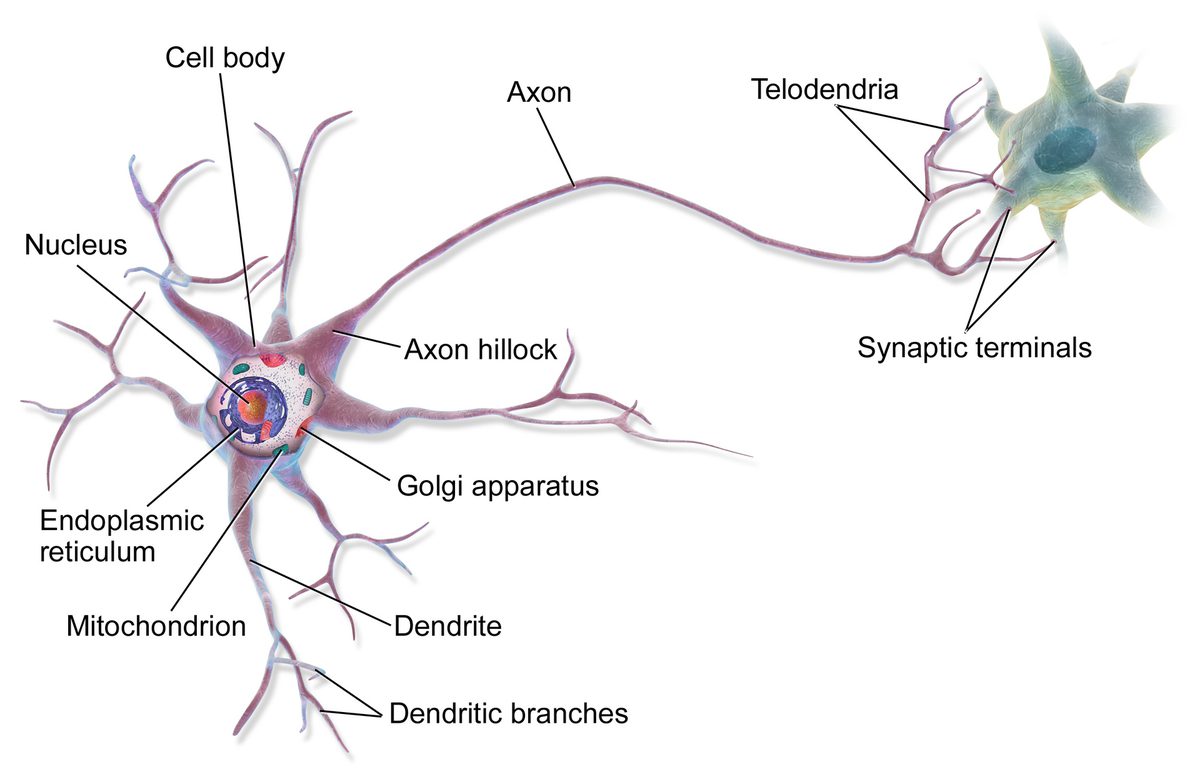
Neurons carry signals as electrical impulses along a long fibre, and they are built for it: a single neuron can run from the base of your spine to your toes. Where one neuron meets the next there is a tiny gap, and the signal crosses it chemically — a transmitter released on one side, detected on the other. That junction is where signals can be modified, blocked or combined, which is what makes the nervous system more than wiring.
The sequence is always the same. A receptor detects a stimulus and generates a signal. Sensory neurons carry it towards the spinal cord or brain. There it may pass directly to a motor neuron, or travel up for processing. A motor neuron carries the outgoing signal to an effector, which is a muscle or a gland, and the effector produces the response.
Speed comes from the route and from the fibre. Signals in large, insulated fibres travel much faster than in small bare ones, and the body uses the fast ones where speed matters. But the biggest single factor is how far the signal goes and how many junctions it crosses, which is why the reflex route is organised to minimise both.
Pause and explain
Put these in order and name each: muscle contracts, sensory neuron carries the signal, skin receptor detects heat, motor neuron carries the signal out.
Check your reasoning after answering
Skin receptor detects the heat — that is the receptor responding to a stimulus. A sensory neuron carries the signal towards the spinal cord. A motor neuron carries the outgoing signal to the effector. The muscle contracts — that is the response. The pathway is always stimulus, receptor, sensory neuron, processing, motor neuron, effector, response.
Part 3 · Why reflexes exist alongside deliberate action
A reflex trades flexibility for speed. The route is short, the number of junctions small, and no interpretation takes place, so withdrawal from a hot surface happens in a fraction of the time a considered decision would take. You cannot decide to have a different reflex, and that is the point — damage happens faster than deliberation.
Deliberate responses take the long route through the brain, where the incoming signal is compared with memory, context and intention. That costs time and buys everything a reflex cannot do: you can catch a dropped glass or deliberately hold a hot plate for the two seconds it takes to reach the counter, both of which require overriding what a reflex alone would produce.
The two coexist in the same action. Walking involves continuous reflex adjustments to balance that you never notice, inside a deliberate decision about where to go. Describing a behaviour well usually means saying which parts are reflex and which are deliberate, rather than treating the whole thing as one or the other.
Pause and explain
Why is a withdrawal reflex faster than a deliberate decision to move your hand?
Check your reasoning after answering
Because the route is shorter and crosses fewer junctions. The signal goes from receptor to spinal cord to motor neuron to muscle, without travelling to the brain to be interpreted against memory and intention. The brain is informed in parallel, which is why you feel the pain just after the hand has already moved.
Part 4 · Reading a reaction time for what it is
A reaction-time test measures one specific pathway on one occasion: a particular stimulus, a particular receptor, a particular response, under whatever conditions prevailed. It is affected by how alert you are, whether you were expecting the signal, practice, temperature, caffeine, and how the task was explained. Repeating it three times tells you about those three attempts.
So the honest statement names the task. "Mean 0.25 seconds across three trials, range 0.10 seconds, catching a dropped ruler with the dominant hand" is a measurement. "This person has fast reactions" generalises beyond one task, and "this measures intelligence" is a different kind of claim altogether — reaction time measures the speed of a signal pathway, and nothing in the measurement bears on reasoning, knowledge or judgement.
This matters beyond the arithmetic. Measurements of people get used to rank people, and the step from a number to a judgement about a person is exactly where the reasoning from Chapter 1 should be applied hardest. Ask what was measured, under what conditions, and what the number could not have detected.
Pause and explain
Why does a reaction time of 0.25 seconds not measure how clever someone is?
Check your reasoning after answering
Because it measures how fast one signal pathway completed one task on one occasion — detection, transmission and response — under conditions including alertness, expectation and practice. Reasoning, knowledge and judgement involve entirely different processes that the test never engages. The number is a measurement of a pathway, not of a person.
Apply the whole unit · Interpret a response record
Illustrative timing trials for one defined task, not clinical data: 0.20, 0.25 and 0.30 seconds. A draft reports the mean as a complete measure of the person's intelligence.
Your task
Calculate the mean and the range, describe in general terms the pathway the test measured, and correct the draft's claim.
What your response should show
- Explain the relevant biological process accurately.
- Use the supplied evidence and show calculation steps with units where needed.
- Connect a labeled model or mechanism with the claim.
- State an assumption, evidence limitation, or useful next observation.
Response guidance — after your attempt
Mean: (0.20 + 0.25 + 0.30) ÷ 3 = 0.75 ÷ 3 = 0.25 seconds.
Range: 0.30 − 0.20 = 0.10 seconds, which is a substantial spread relative to the mean across only three trials.
Describe the pathway: a stimulus detected by a receptor, carried by sensory neurons, processed, carried out by motor neurons to a muscle, which produces the response.
Correct the claim: the test measured the speed of that pathway on one task; intelligence involves reasoning and knowledge the test never engages.
The mean is 0.25 seconds, from (0.20 + 0.25 + 0.30) ÷ 3, and the range is 0.30 − 0.20 = 0.10 seconds. That range is worth noticing: a spread of 0.10 around a mean of 0.25 is large in proportion, and with only three trials the mean is not a stable estimate — practice, alertness and expectation can move it easily. What the test measured is a signal pathway: a stimulus detected by a receptor, a signal carried along sensory neurons to the central nervous system, processed there, and carried out along motor neurons to a muscle that produced the response. Each stage takes time, and the total is what the stopwatch recorded. The draft's claim does not follow. Intelligence, however it is defined, involves reasoning, knowledge, memory and judgement, none of which this task required and none of which a transmission speed could reveal. The measurement also has no control for the conditions that affect it — whether the person was expecting the signal, how many practice attempts they had, how alert they were, the temperature of the room. A defensible report would read: mean 0.25 seconds, range 0.10 seconds, over three trials of one stated task, under unstated conditions, which measures the speed of one response pathway and nothing about the person beyond it.
Scientific references for this unit
Parent / teacher teaching notes
Ask for a because-statement and a labeled relationship, not just a memorized word. Work through one calculation step at a time, permit oral or diagram responses, and use flexible sessions for difficult reading. Compare the learner’s actual evidence with the supplied model; do not reward copying or agreement with a personal preference. No private family, genetic, or medical records are required.
The key idea
The nervous system receives information, processes it, and helps coordinate responses. Receptors respond to particular stimuli, such as light or pressure, and signals travel through nervous pathways. The brain and spinal cord contribute to processing; nerves connect with other parts of the body. A sensory experience involves more than a receptor alone.
Worked examples
Example 1 · Explain an ordering you can feel
- Identify the two routes the signal takes: a short one through the spinal cord to the muscle, and a longer one up to the brain.
- Compare the distances and junctions: the reflex route is shorter and crosses fewer junctions, so it completes sooner.
- Connect to what you experience: the withdrawal is produced by the short route, and conscious pain arrives when the longer signal reaches the brain.
The order of your own experience is evidence about the route a signal takes.
Example 2 · Say what a measurement cannot cover
- Identify what the task measures: one pathway, one stimulus type, one response, on one occasion.
- List what else affects the number: expectation, practice, alertness, hand used, how the task was explained, temperature.
- Consider what is not measured: every other sensory system, coordination, endurance, and anything requiring judgement.
Name the task, the conditions and the number of trials before drawing any conclusion about a person.
Avoid these mistakes
- Mistake: the brain decides to pull your hand away. The reflex route goes receptor to spinal cord to muscle; the brain is informed in parallel, which is why you feel the pain after the hand has moved.
- Mistake: a stimulus only exists if you can detect it. Ultraviolet flower markings are present whether or not you have a receptor for them; a bee does.
- Mistake: stimulus and receptor are two words for the same thing. The stimulus is the change in the world; the receptor is the structure built to detect that kind of change.
- Mistake: reaction time measures intelligence. It measures how fast one signal pathway completed one task, and is affected by expectation, practice and alertness.
Check your understanding
Is a receptor alone the whole sensory experience?
Discuss the answer
No. Signals and processing contribute to perception, interpretation, and response.
Does seeing a ball mean the ball travels through a nerve?
Discuss the answer
No. Signals carry information about detected light; the physical ball does not move through the nerve pathway.
Words to know
- stimulus
- A change the body can detect — heat, pressure, light, a chemical — which exists in the world whether or not an organism has a receptor for it.
- receptor
- A structure that detects one particular kind of stimulus; specificity is structural, which is why an eye cannot hear.
- neuron
- A cell specialised for carrying electrical signals, some running nearly a metre, with chemical junctions between them where signals can be modified.
- reflex
- A fast involuntary response using a short route through the spinal cord, with the brain informed rather than consulted.
- response
- What the body finally does — a muscle contracting or a gland releasing something — at the end of the pathway.
Extend your scientific explanation
Compare a second supplied example or the linked educational reference. Identify a connection, a model limit, and an additional observation that would test the explanation.
In the real world
Use a clear question, reliable observations, and a biological mechanism to evaluate a claim. State what remains uncertain before applying a classroom model to a different setting.
Exit check
Can one reaction-time score establish overall intelligence?
Check your explanation after answering
No. It measures one task under particular conditions and can be affected by several non-intelligence factors.
Explain your reasoning without notes. If a key idea is missing, revisit the lesson and try again.