Flowers, Seeds & Plant Life Cycles — Print · Grade 7 Science
Chapter: Coordination, Defense & ReproductionFlowers, Seeds & Plant Life Cycles
Learning goals
- I can explain flowers, seeds & plant life cycles.
- I can use evidence, a model, and stated assumptions to support a biological explanation.
Before this unit
Use the supplied vocabulary, distinguish an observation from an explanation, and identify any units or model assumptions. Revisit a connected earlier unit if needed; new terms are explained here.
Use three flexible 40–45-minute sessions: core background and Parts 1–2 with their checks; Parts 3–4 and the worked application; then remaining practice, a labeled model, revision, and the exit check. Checks completed during reading can count toward the practice set. Read one short part at a time. Investigations and chapter review/quiz have separate sessions, and flexible weeks allow more time.
A dandelion seed has a parachute. A burr has hooks. A coconut floats and can survive months at sea. A cherry is wrapped in something an animal wants to eat, around a stone it cannot digest. Each is a solution to the same problem: a plant is rooted, and its offspring have to end up somewhere other than directly underneath it, where they would compete with the parent for the same light and water. Movement is the thing plants cannot do for themselves, and both halves of their reproduction — getting pollen to an ovule, and getting a seed away from the parent — are built around borrowing it from wind, water or animals.
Pollination is the transfer of pollen from the male part of a flower to the female part, and it is only the delivery. Fertilisation is a separate, later event in which a nucleus from the pollen grain fuses with the egg cell inside an ovule. Keeping these apart matters, because a flower can be pollinated and still produce no seed — pollen from the wrong species, or arriving too late, or failing to grow its tube. Pollination is transport; fertilisation is fusion; and only the second creates a new individual.
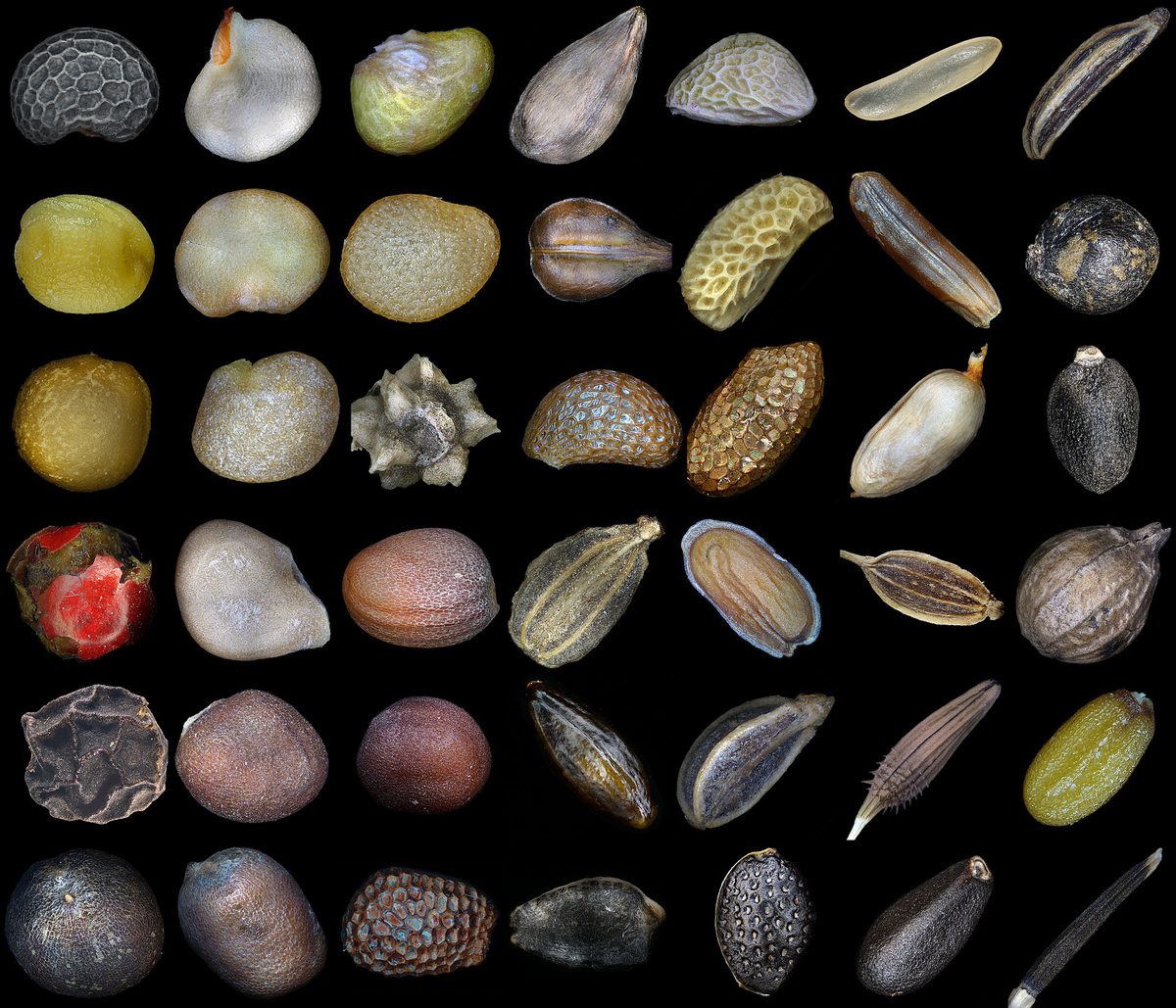
After fertilisation the ovule develops into a seed. Inside it is an embryo, a tiny plant with the beginnings of a root and shoot, packed alongside a food store and wrapped in a protective coat. That package can wait — through a winter, a drought, or in the Masada date palm's case two thousand years — until conditions suit. Germination is the resumption of growth: water is taken up, the stored food is mobilised, the root emerges first to anchor and absorb, then the shoot. Meanwhile the ovary around the seed often becomes a fruit, which is a dispersal device — the parachute, the hook, the float, or the sweet flesh that gets a seed carried and deposited somewhere new.
Build your understanding
Where this fits
The last unit compared the two ways of producing new individuals. Plants do both, and their sexual reproduction solves a problem animals do not have: a plant cannot go anywhere to find a partner or to settle its offspring. This unit is how a rooted organism manages both, and it closes the chapter by designing a comparison of the kind Chapter 1 set out.
Use three flexible 40–45-minute sessions: core background and Parts 1–2 with their checks; Parts 3–4 and the worked application; then remaining practice, a labeled model, revision, and the exit check. Checks completed during reading can count toward the practice set. Read one short part at a time. Investigations and chapter review/quiz have separate sessions, and flexible weeks allow more time.
Part 1 · Pollen transfer is not fertilisation
A flower's structures divide along the two functions. Anthers produce pollen, which carries the male gametes. The stigma receives pollen, and below it a style leads down to the ovary containing one or more ovules, each holding an egg cell. Petals and scent and nectar are not reproductive organs at all — they are advertising, aimed at whatever animal the plant uses as a courier.
Pollination is pollen landing on a stigma of the right species. What follows is not automatic: a compatible pollen grain grows a tube down through the style to an ovule, and only when a nucleus from that pollen fuses with the egg cell has fertilisation occurred. Between the two events there are several ways for the process to fail, which is why plants produce vastly more pollen than could ever be needed.
The courier shapes the flower. Wind-pollinated plants — grasses, many trees — have small dull flowers, no scent, no nectar, feathery stigmas to catch grains from the air, and they release pollen in enormous quantities, which is what hay fever is. Insect-pollinated plants have conspicuous petals, scent, nectar and sticky pollen, and need far less of it because delivery is targeted. You can often read the pollination method off the flower.
Pause and explain
A flower is pollinated but produces no seed. Is that possible, and why?
Check your reasoning after answering
Yes. Pollination is only the transfer of pollen to a stigma. Fertilisation requires a compatible pollen grain to grow a tube down the style to an ovule and a nucleus from it to fuse with the egg cell. Pollen from the wrong species, arriving too late, or failing to grow a tube, leaves the flower pollinated and unfertilised, so no seed forms.
Part 2 · What is inside a seed, and what germination starts
A seed contains three things: an embryo with the rudiments of a root and a shoot, a store of food, and a coat protecting both. The food store is what allows a seedling to grow before it can photosynthesise — the first root and leaves are built entirely on supplies packed in by the parent, which is also why large seeds tend to produce more robust seedlings.
Germination needs water first. Water is taken up, the seed swells, enzymes become active and begin breaking the stored starch into sugars the embryo can use, and growth resumes. The root emerges before the shoot, which makes sense of the order: anchoring and taking up water matter before reaching for light, and the seedling has its own food supply for the time being.
Dormancy is not the absence of life, as Chapter 1 established. It is a state the seed can hold until conditions are suitable, and many species require a specific trigger before they will germinate at all — a period of cold that signals winter has passed, scarring of the coat, or in some cases the heat of a fire. Those requirements are timing mechanisms, stopping a seed from germinating into conditions that would kill the seedling.
Pause and explain
Why does the root emerge before the shoot?
Check your reasoning after answering
Because the seedling's immediate needs are anchorage and water, and it does not yet need light. Its energy comes from the food store packed into the seed, so photosynthesis can wait; without water and a hold in the soil, nothing else can proceed. The order matches the sequence of needs rather than being arbitrary.
Part 3 · Dispersal, and the variation that travels with it
Dispersal solves the competition problem. A seed that falls directly beneath its parent lands in shade, in soil the parent is already drawing from, among its own siblings. Every dispersal mechanism is a way of borrowing movement: wind takes a parachute or a winged seed, water carries a float, an animal carries a hook on its fur or eats a fruit and deposits the seed elsewhere — often with a supply of fertiliser attached.
Dispersal moves the offspring; sexual reproduction makes them different. The two work together. A varied set of seeds scattered across varied locations means a population is testing several combinations in several places at once, and in a changing environment that is a far better bet than many copies in one spot.
Asexual reproduction in plants trades the other way, as the last unit showed. A runner or a tuber puts a genetically identical offspring close by, which works well when the parent's spot is good and the conditions are holding. Many plants keep both, deploying copies locally and sending varied seeds further afield.
Pause and explain
Why is it a disadvantage for a seed to land directly beneath its parent?
Check your reasoning after answering
Because it lands in the parent's shade, in soil the parent is already drawing water and nutrients from, and among its own siblings competing for the same resources. Dispersal mechanisms — parachutes, hooks, floats, edible fruits — borrow movement from wind, water or animals to put offspring where they are not competing with a large established plant.
Part 4 · Designing a germination comparison
Germination is an unusually good thing to investigate at home, because the outcome is countable rather than judged. Take two trays of twenty seeds of the same species from the same packet, hold everything the same except the one factor you are testing, and after a set number of days count how many have germinated. The result is a proportion, which is easy to compare.
Report it as a percentage of the number planted, not as a bare count — 18 of 20 is 90 per cent, 12 of 20 is 60 per cent, and the percentages are what let you compare trays of different sizes. State the interval too, because germination is a race as well as a total: a treatment that reaches the same percentage three days later is not performing equally.
Then bound the claim. A germination percentage measures germination over the stated days under the stated conditions. It does not measure how well the resulting plants grow, how much they yield, or whether they survive — those are later and separate outcomes needing their own measurements. This is the discipline of Chapter 1 applied to a tray of seeds, and it is the last thing this chapter asks you to practise.
Pause and explain
Why report germination as a percentage rather than a count?
Check your reasoning after answering
Because a percentage is a proportion of the number planted, so trays with different numbers of seeds can be compared directly — 18 of 20 is 90 per cent and 12 of 20 is 60 per cent. A bare count depends on how many were planted, so it cannot be compared across trials or reported meaningfully on its own.
Apply the whole unit · Compare seed treatments
Illustrative seven-day record, not a measured experiment: treatment A produced 18 germinated seeds out of 20 planted, and treatment B produced 12 out of 20. Species and all other conditions are stated as matched; the treatment is the amount of water.
Your task
Calculate both percentages, describe the difference the record measured, and qualify what it can say about the plants' later success.
What your response should show
- Explain the relevant biological process accurately.
- Use the supplied evidence and show calculation steps with units where needed.
- Connect a labeled model or mechanism with the claim.
- State an assumption, evidence limitation, or useful next observation.
Response guidance — after your attempt
Calculate A: 18 ÷ 20 = 0.9, which is 90 per cent germination within seven days.
Calculate B: 12 ÷ 20 = 0.6, which is 60 per cent germination within the same seven days.
State the difference precisely: 30 percentage points more seeds germinated under treatment A within the stated interval.
Qualify the claim: germination percentage over seven days says nothing about later growth, yield or survival, and twenty seeds per treatment is a small sample run once.
Treatment A germinated 18 of 20 seeds, which is 18 ÷ 20 = 90 per cent, and treatment B germinated 12 of 20, which is 12 ÷ 20 = 60 per cent. The difference is 30 percentage points more germination under A within the seven days recorded. Because the record states that species and all other conditions were matched and that water amount was the treatment, the comparison is structured to attribute the difference to water, which is more than most informal comparisons manage. Two things are still worth saying about what it measures. It is a total at one moment, not a rate: a tray that reaches 60 per cent by day seven might reach 90 by day ten, and the record cannot distinguish a treatment that prevents germination from one that merely delays it. And twenty seeds per treatment, run once, is a small sample, so ordinary variation in seed quality could account for part of a difference this size. What the record cannot address at all is anything after germination. A seed that germinates may still produce a weak seedling, and the water amount that favours germination is not necessarily the one that favours growth, flowering or yield — those are separate outcomes over longer periods, needing their own measurements. The supportable claim is narrow and useful: under these conditions, over seven days, treatment A was associated with 90 per cent germination against B's 60 per cent.
Scientific references for this unit
Parent / teacher teaching notes
Ask for a because-statement and a labeled relationship, not just a memorized word. Work through one calculation step at a time, permit oral or diagram responses, and use flexible sessions for difficult reading. Compare the learner’s actual evidence with the supplied model; do not reward copying or agreement with a personal preference. No private family, genetic, or medical records are required.
The key idea
Flowering plants reproduce through structures and processes connecting pollen transfer, fertilization, seeds, and growth. Pollen carries cells involved in producing or delivering male gametes; an ovule contains structures involved in female reproduction. Pollination moves pollen to a suitable receptive surface; fertilization is a later fusion event. These terms should not be used interchangeably.
Worked examples
Example 1 · Read a flower's courier from its structure
- Match X's features to a target: colour, scent and nectar are signals and rewards, which only matter to an animal that can detect them.
- Match Y's features to wind: no signals are needed, light dry pollen travels on air, and feathery stigmas present a large area to catch grains.
- Connect to quantity: targeted delivery by an insect needs far less pollen than scattering it on the wind, which is why Y produces so much more.
Structures are usually readable as solutions. Ask what problem each one solves.
Example 2 · Distinguish prevented from delayed
- Identify what was measured: the proportion germinated by one particular day, which is a total at a moment.
- Identify the alternative the data cannot exclude: B's remaining seeds may germinate later, making the difference one of rate rather than of final total.
- Name what would separate them: continuing the count for several more days and recording when each seed germinated.
A measurement at one moment cannot by itself tell you about a process over time.
Avoid these mistakes
- Mistake: pollination and fertilisation are the same event. Pollination is pollen reaching a stigma; fertilisation is a nucleus from that pollen fusing with an egg cell, and a flower can be pollinated without ever being fertilised.
- Mistake: a seed needs soil nutrients to germinate. It germinates on the food store packed inside it, which is why cress will sprout on damp paper; water is the trigger it cannot do without.
- Mistake: the shoot comes first. The root emerges first, because anchorage and water matter before light while the seed's own food store lasts.
- Mistake: 18 of 20 against 12 of 20 shows which plants will do better. It shows germination within seven days — 90 against 60 per cent — and says nothing about later growth, yield or survival.
Check your understanding
Does observing a pollinator visit prove viable seeds formed?
Discuss the answer
No. The visit is one stage; transfer, compatibility, fertilization, and development need further evidence.
Why can early germination occur before a seedling has green leaves?
Discuss the answer
The seed can use stored resources and cellular respiration to support initial growth.
Words to know
- pollination
- The transfer of pollen to a stigma — delivery only, and separate from the fertilisation that may or may not follow.
- ovule
- The structure inside the ovary holding an egg cell; after fertilisation it develops into a seed.
- embryo
- The tiny plant inside a seed, with the beginnings of a root and shoot, packed alongside a food store.
- germination
- The resumption of growth when a seed takes up water and mobilises its food store; the root emerges before the shoot.
- dispersal
- Moving seeds away from the parent by borrowing movement from wind, water or animals, so offspring do not compete with an established plant.
Extend your scientific explanation
Compare a second supplied example or the linked educational reference. Identify a connection, a model limit, and an additional observation that would test the explanation.
In the real world
Use a clear question, reliable observations, and a biological mechanism to evaluate a claim. State what remains uncertain before applying a classroom model to a different setting.
Exit check
Why should the denominator include all tested seeds?
Check your explanation after answering
It defines success relative to the original sample; excluding failures would inflate the reported germination percentage.
Explain your reasoning without notes. If a key idea is missing, revisit the lesson and try again.
Problem 1
Answer and explanation
No. The visit is one stage; transfer, compatibility, fertilization, and development need further evidence.
Problem 2
Answer and explanation
The seed can use stored resources and cellular respiration to support initial growth.
Problem 3
Answer and explanation
No. Location changes environmental conditions; mutation is a change in genetic material and is a different process.
Problem 4
Answer and explanation
It defines success relative to the original sample; excluding failures would inflate the reported germination percentage.
Problem 5
Answer and explanation
A has 90% germination and B 60%, a 30-percentage-point difference in this illustrative comparison. It supports a treatment-related germination question under the matched conditions, but does not establish adult survival, universal species response, or every causal detail. Replicate independent groups and record later growth separately.
A: 18/20×100=90%.
B: 12/20×100=60%.
Difference is 30 percentage points.
Limit the claim to the stipulated germination interval.
Response criteria
- Explain the relevant biological process accurately.
- Use the supplied evidence and show calculation steps with units where needed.
- Connect a labeled model or mechanism with the claim.
- State an assumption, evidence limitation, or useful next observation.
Problem 6
Answer and explanation
Species can have different requirements and tolerances. Evidence from one species and interval needs qualification before generalizing.
Response criteria
- Explain the relevant biological process accurately.
- Use the supplied evidence and show calculation steps with units where needed.
- Connect a labeled model or mechanism with the claim.
- State an assumption, evidence limitation, or useful next observation.
Problem 7
- Pollen transfer
- Every seed’s first leaf
- DNA duplication
- All adult survival
Answer and explanation
Pollen transfer
Pollination is pollen transfer; fertilization and development are subsequent distinct processes.
Problem 8
Answer and explanation
80 %
8/10×100=80%.