Kidneys, Excretion & Internal Balance — Print · Grade 7 Science
Chapter: Body Organization, Transport & MovementKidneys, Excretion & Internal Balance
Learning goals
- I can explain kidneys, excretion & internal balance.
- I can use evidence, a model, and stated assumptions to support a biological explanation.
Before this unit
Use the supplied vocabulary, distinguish an observation from an explanation, and identify any units or model assumptions. Revisit a connected earlier unit if needed; new terms are explained here.
Use three flexible 40–45-minute sessions: core background and Parts 1–2 with their checks; Parts 3–4 and the worked application; then remaining practice, a labeled model, revision, and the exit check. Checks completed during reading can count toward the practice set. Read one short part at a time. Investigations and chapter review/quiz have separate sessions, and flexible weeks allow more time.
Your kidneys filter something like 180 litres of fluid a day, and you produce roughly 1.5 litres of urine. Almost everything that goes through the filter is taken straight back. That ratio is the whole design, and it looks wasteful until you see what it buys: rather than trying to pick individual waste molecules out of the blood, the kidney pushes nearly everything small out of the blood and then deliberately reclaims what it wants to keep. Sorting by removal and selective return turns out to be far easier than sorting by selection, and it is why the kidney can handle substances it has never encountered before.
The vocabulary separates two things people run together. Excretion is the removal of waste products made by the body's own chemistry — carbon dioxide from respiration, urea from breaking down surplus amino acids. Egestion, passing undigested food out of the gut, is not excretion at all, because that material never took part in the body's metabolism; it passed through. Several organs excrete: lungs remove carbon dioxide, skin loses some water and salts in sweat, and the kidneys remove urea and adjust water and salt.
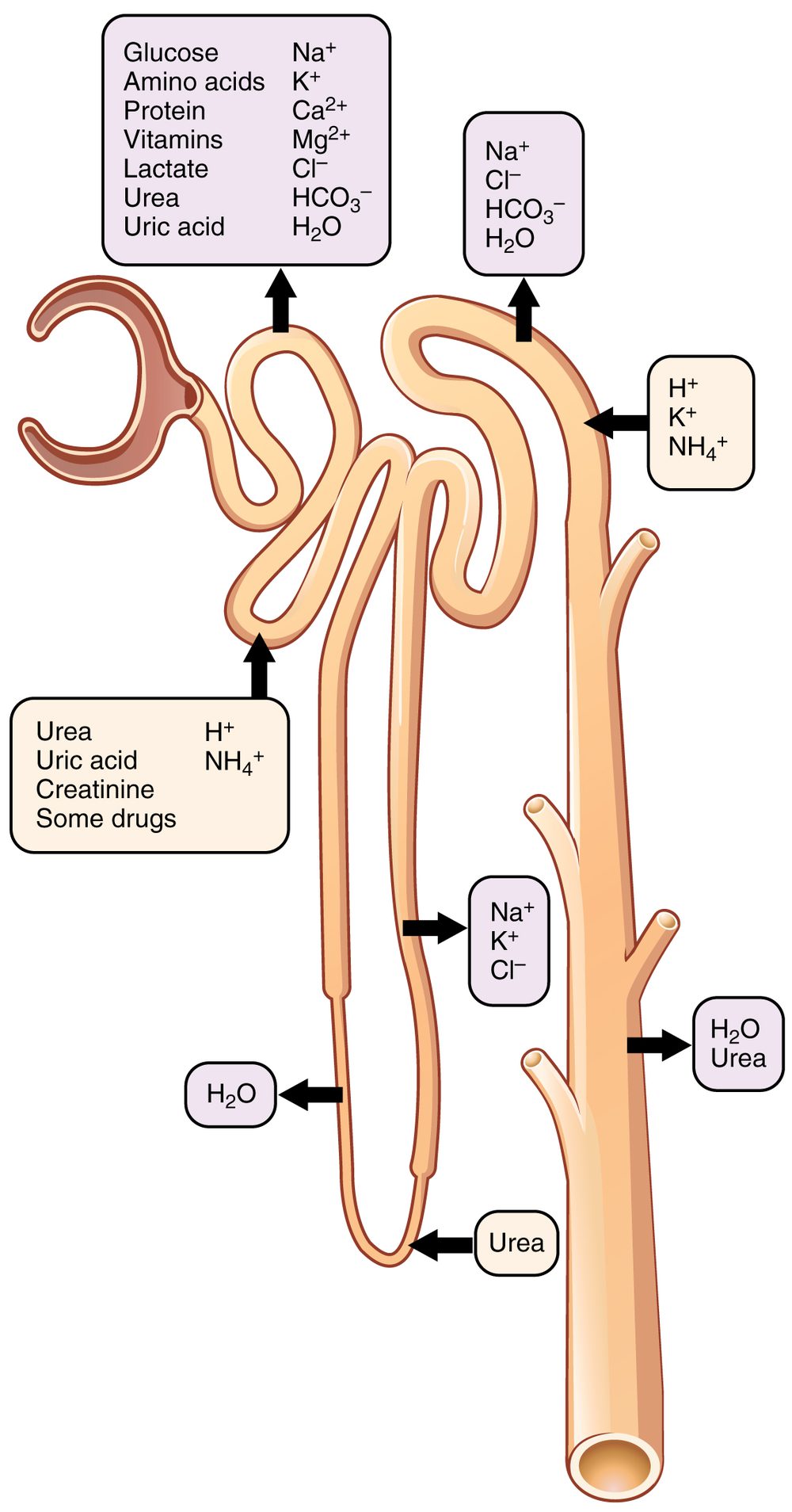
The kidney does its work in two stages. Filtration forces water and small dissolved molecules out of the blood under pressure, leaving blood cells and large proteins behind because they are too big to pass. What crosses is called filtrate, and it contains useful things and waste together — glucose, salts, water and urea all go through. Then comes reabsorption: as the filtrate travels along a tubule, the useful substances are taken back into the blood, glucose almost entirely, water and salts in amounts the body adjusts. What is left at the end is urine. The adjustment is the point — on a hot day with little to drink, far more water is reabsorbed and the urine is concentrated.
Build your understanding
Where this fits
This chapter has followed materials in: food broken down and absorbed, oxygen collected, both delivered, and energy released in cells doing work. Every one of those reactions produces something the body has to get rid of. This unit closes the chapter with the system that removes waste while keeping what is still useful — and it introduces the balance-sheet reasoning the ecology chapter will use again.
Use three flexible 40–45-minute sessions: core background and Parts 1–2 with their checks; Parts 3–4 and the worked application; then remaining practice, a labeled model, revision, and the exit check. Checks completed during reading can count toward the practice set. Read one short part at a time. Investigations and chapter review/quiz have separate sessions, and flexible weeks allow more time.
Part 1 · Which wastes leave by which route
Carbon dioxide is produced by respiration in every cell, diffuses into the blood, and is removed at the lungs. It is a genuine excretory product, and the lungs are therefore an excretory organ as well as a gas exchange surface — which surprises people who associate excretion only with the kidneys.
Urea comes from a different source. Surplus amino acids cannot be stored, so the liver breaks them down, and the nitrogen-containing part becomes urea, which is toxic if it accumulates. The liver makes it, the blood carries it, and the kidney removes it. Three organs in three systems for one waste product, which is a good illustration of why organs are grouped by function rather than by location.
Undigested food is the case that does not belong. Fibre and other material that passed through the gut without being absorbed never entered the body's chemistry, so passing it out is egestion, not excretion. The distinction is not a word game: it tells you where to look for a cause when something goes wrong, because an excretory problem and a digestive one have completely different origins.
Pause and explain
Why is passing undigested food out of the gut not excretion?
Check your reasoning after answering
Because excretion is the removal of waste produced by the body's own metabolism, and undigested food never took part in it — it passed through the gut without being absorbed into cells or reactions. Carbon dioxide from respiration and urea from breaking down surplus amino acids are excretory products; fibre is not.
Part 2 · Filter almost everything, then take back what you want
Filtration happens at a dense knot of capillaries under high pressure. The pressure drives water and small dissolved molecules out through a barrier that holds back blood cells and large proteins purely by size. Nothing is being selected at this stage: glucose, salts, amino acids, water and urea all cross together, which is why the volume filtered is so enormous.
Selection happens afterwards, along the tubule. Glucose is reabsorbed essentially completely, because losing it would waste the output of digestion. Salts and water are reabsorbed in amounts that vary with what the body needs. Urea is largely left behind, since removing it is the point of the exercise. By the end of the tubule the filtrate has been transformed from something resembling blood plasma into urine.
Reabsorption is not free. Taking glucose and salts back across into the blood often means moving them from a lower concentration to a higher one, which is the active transport from Chapter 2 — it needs pumps and it needs energy from respiration. The kidney is among the most energy-hungry organs in the body for exactly this reason, and that cost is what buys the flexibility of filtering first and sorting later.
Pause and explain
Why does the kidney filter far more fluid than it excretes?
Check your reasoning after answering
Because filtering is unselective: pressure pushes water and all small dissolved molecules out of the blood together, waste and useful substances alike. The sorting is done afterwards by reabsorbing what the body wants to keep. Filtering broadly and reclaiming selectively is simpler than picking individual waste molecules out, and it works on substances the body has never met before.
Part 3 · Tracking amounts within a stated boundary
Any system that takes something in and lets something out can be checked with a balance sheet, and doing so catches errors quickly. Draw a boundary — here, the processing of one batch of filtrate. Count what enters. Count what leaves by each route. If the two do not match, either something is accumulating inside the boundary or a route has been missed.
Work the model. Suppose 100 units of water enter the filtrate, 96 return to the blood, and 4 leave in the urine. Input is 100; output is 96 + 4 = 100; the model balances, and nothing is accumulating. The fraction returned is 96 ÷ 100 = 96 per cent, which says that almost all the filtered water is reclaimed — the central fact about how the kidney works.
The discipline matters more than the arithmetic. If the same model had shown 96 returning and 8 leaving, the total would be 104 against an input of 100, and you would know immediately that something was wrong with the figures rather than with the kidney. The same check will reappear with carbon and water in the ecology chapter, where it is the main defence against a plausible-sounding but impossible account.
Pause and explain
In the model, 100 units enter the filtrate, 96 return to the blood and 4 leave in the urine. Does the model balance, and what fraction returns?
Check your reasoning after answering
Yes. The output is 96 + 4 = 100 units, matching the 100 that entered, so nothing is unaccounted for and nothing is accumulating inside the boundary. The fraction returned is 96 ÷ 100, which is 96 per cent — almost all of the filtered water is reabsorbed, which is the central feature of how the kidney works.
Part 4 · Regulation, and what an invented model cannot tell you
How much water is reabsorbed is not fixed. Sensors detect how concentrated the blood is; a hormone released in response adjusts the permeability of part of the tubule; more water is reclaimed and the urine becomes concentrated. Drink a litre of water and the reverse happens within the hour. This is the negative feedback the next chapter takes up, with the kidney as its clearest case: a deviation is detected and a response reduces it.
Notice how many systems one piece of regulation involves. The circulatory system delivers the blood and carries the hormone; the hormonal system produces it; the nervous system contributes to the thirst that changes behaviour; and the kidney does the work. A regulated quantity is maintained by a loop running through several systems, not by one organ deciding something.
Finally, be clear about what a teaching model is. The 100-unit model above is invented to show the structure of filtration and selective return. Its numbers are chosen for arithmetic, not measured, and the real figures depend on body size, temperature, activity and what a person has drunk. It is not a statement about how much anyone should drink, and a model that balances neatly is evidence that the model is consistent, not that it is true of any particular body.
Pause and explain
On a hot day with little to drink, what changes in the kidney, and what detects the need?
Check your reasoning after answering
More water is reabsorbed along the tubule, so less leaves and the urine is more concentrated. The need is detected by sensors responding to how concentrated the blood has become; a hormone released in response increases the permeability of part of the tubule so more water returns to the blood. That is negative feedback: the deviation triggers the response that reduces it.
Apply the whole unit · Balance a supplied water model
Illustrative processing record for one model interval, not measured data: 100 water units enter the filtrate, 96 return to the blood pathway, and 4 leave through the urine pathway.
Your task
Check that the model balances, calculate the fraction returned, and explain why these figures are not a recommendation about how much anyone should drink.
What your response should show
- Explain the relevant biological process accurately.
- Use the supplied evidence and show calculation steps with units where needed.
- Connect a labeled model or mechanism with the claim.
- State an assumption, evidence limitation, or useful next observation.
Response guidance — after your attempt
Add the outputs: 96 units returned plus 4 units leaving gives 100 units, which matches the 100 that entered, so the model balances and nothing is unaccounted for.
Calculate the returned fraction: 96 ÷ 100 = 0.96, or 96 per cent of the filtered water reabsorbed.
Interpret the figure: it shows selective return rather than wholesale excretion, which is the central feature of kidney function.
State the limits: the numbers are invented for one stated boundary and one interval, and real values vary with body size, temperature, activity and intake.
The model balances. Its 100 input units are accounted for exactly by 96 units returning to the blood and 4 leaving in the urine, which sum to 100, so nothing is accumulating inside the boundary and no route has been missed. The returned fraction is 96 ÷ 100, which is 96 per cent. What that figure illustrates is the kidney's basic strategy: filtration is unselective, pushing water and all small dissolved molecules out of the blood together, and the sorting happens afterwards as reabsorption reclaims almost all of the water along with the glucose and the salts the body wants to keep. Only a small remainder, carrying the urea, leaves as urine. This is also why the kidney consumes so much energy, since much of that reabsorption is active transport working against a concentration gradient. The figures cannot be read as advice. They are invented for one stated boundary over one model interval, chosen so the arithmetic is clear, and a real kidney's filtered volume and reabsorbed fraction depend on body size, temperature, activity, health and how much a person has drunk. A model balancing neatly shows that the model is internally consistent, which is a different claim from being true of any particular body. What would move this towards a measurement is a stated interval, a stated body, and values obtained rather than assumed.
Scientific references for this unit
Parent / teacher teaching notes
Ask for a because-statement and a labeled relationship, not just a memorized word. Work through one calculation step at a time, permit oral or diagram responses, and use flexible sessions for difficult reading. Compare the learner’s actual evidence with the supplied model; do not reward copying or agreement with a personal preference. No private family, genetic, or medical records are required.
The key idea
Cells produce waste materials through metabolism, and organisms regulate internal water and dissolved substances. Excretion removes metabolic wastes; it differs from elimination of unabsorbed food from the digestive tract. Lungs release carbon dioxide, while kidneys help remove some dissolved wastes and regulate blood composition.
Worked examples
Example 1 · Find the missing route in a balance
- Add the stated outputs: 90 + 4 = 94 units leaving by the two named routes.
- Compare with the input: 100 units entered, so 6 units are unaccounted for.
- Interpret: either a route is missing from the model, or something is accumulating inside the boundary, or one of the figures is wrong.
Inputs must equal outputs plus accumulation. When they do not, suspect the model first.
Example 2 · Predict a change from a demand
- Identify the regulated quantity: the concentration of the blood, which rises when water is lost and falls when water is taken in.
- Apply the response for the dehydrated person: sensors detect more concentrated blood, a hormone increases water reabsorption along the tubule, so less water leaves.
- Apply the reverse for the other: dilute blood means less reabsorption, so more water leaves.
Name the detected quantity and the response that reduces the deviation — that is the shape of negative feedback.
Avoid these mistakes
- Mistake: passing faeces is excretion. Undigested food never entered the body's metabolism, so that is egestion; carbon dioxide and urea are excretory products.
- Mistake: only the kidneys excrete. The lungs remove carbon dioxide and the skin loses water and salts in sweat, so both are excretory organs too.
- Mistake: the kidney selects waste out of the blood. It filters almost everything small out indiscriminately and then reabsorbs what it wants to keep — in the model, 96 of every 100 water units.
- Mistake: a model that balances is a measurement. The 100-unit model is invented so the arithmetic is clear; real volumes depend on body size, temperature, activity and intake, and it is not advice about drinking.
Check your understanding
Why is excretion not identical to eliminating unabsorbed food?
Discuss the answer
Excretion removes wastes produced by metabolism; unabsorbed food is material that did not enter those cellular pathways.
Does entering a filtrate guarantee a substance leaves in urine?
Discuss the answer
No. Some substances are returned to blood during subsequent processing.
Words to know
- excretion
- Removing waste made by the body's own metabolism — carbon dioxide from respiration, urea from surplus amino acids — which is not the same as passing undigested food out.
- filtration
- Forcing water and small dissolved molecules out of the blood under pressure, holding back cells and large proteins by size alone; nothing is selected at this stage.
- reabsorption
- Taking useful substances back from the filtrate into the blood, often by active transport against a gradient, which is why the kidney is so energy-hungry.
- urine
- What remains of the filtrate after reabsorption: mostly water with urea and surplus salts, concentrated or dilute according to what the body needs.
- metabolism
- The chemical reactions going on inside an organism; excretion removes their products, which is why material that merely passed through the gut does not count.
Extend your scientific explanation
Compare a second supplied example or the linked educational reference. Identify a connection, a model limit, and an additional observation that would test the explanation.
In the real world
Use a clear question, reliable observations, and a biological mechanism to evaluate a claim. State what remains uncertain before applying a classroom model to a different setting.
Exit check
Does regulation require an unchanging number at every instant?
Check your explanation after answering
No. Regulated conditions can vary within ranges while feedback and exchanges help maintain function.
Explain your reasoning without notes. If a key idea is missing, revisit the lesson and try again.
Problem 1
Answer and explanation
Excretion removes wastes produced by metabolism; unabsorbed food is material that did not enter those cellular pathways.
Problem 2
Answer and explanation
No. Some substances are returned to blood during subsequent processing.
Problem 3
Answer and explanation
Input and output amounts are comparable only when they refer to the same period and boundary.
Problem 4
Answer and explanation
No. Regulated conditions can vary within ranges while feedback and exchanges help maintain function.
Problem 5
Answer and explanation
The model balances its 100 input units with 100 output units, and 96% return through the stated pathway. It represents selective processing rather than all filtrate being excreted. The numbers are invented for one boundary and interval; they do not describe a person’s whole water budget or prescribe fluid intake.
Add outputs: 96+4=100.
Calculate returned share: 96/100×100%.
Identify the simplified boundary and invented units.
Response criteria
- Explain the relevant biological process accurately.
- Use the supplied evidence and show calculation steps with units where needed.
- Connect a labeled model or mechanism with the claim.
- State an assumption, evidence limitation, or useful next observation.
Problem 6
Answer and explanation
Kidneys process materials from blood and regulate excretion and balance. Digestive absorption moves food-related materials across the intestinal lining; circulation connects the systems but the steps differ.
Response criteria
- Explain the relevant biological process accurately.
- Use the supplied evidence and show calculation steps with units where needed.
- Connect a labeled model or mechanism with the claim.
- State an assumption, evidence limitation, or useful next observation.
Problem 7
- Carbon dioxide
- Every chromosome
- Whole bone
- Every unabsorbed food piece
Answer and explanation
Carbon dioxide
Carbon dioxide produced in cellular metabolism can be transported to lungs and released.
Problem 8
Answer and explanation
90 %
45/50×100=90%, for the invented model.