Digestion, Absorption & Food Molecules · Grade 7 Science
Chapter: Body Organization, Transport & MovementDigestion, Absorption & Food Molecules
Learning goals
- I can explain digestion, absorption & food molecules.
- I can use evidence, a model, and stated assumptions to support a biological explanation.
Before this unit
Use the supplied vocabulary, distinguish an observation from an explanation, and identify any units or model assumptions. Revisit a connected earlier unit if needed; new terms are explained here.
Use three flexible 40–45-minute sessions: core background and Parts 1–2 with their checks; Parts 3–4 and the worked application; then remaining practice, a labeled model, revision, and the exit check. Checks completed during reading can count toward the practice set. Read one short part at a time. Investigations and chapter review/quiz have separate sessions, and flexible weeks allow more time.
In 1822 a fur trapper named Alexis St. Martin was shot in the side at close range. He survived, but the wound healed into a permanent opening into his stomach, and the army surgeon who treated him, William Beaumont, spent years running experiments through it — lowering pieces of food on silk threads, withdrawing them at intervals, even extracting gastric juice to watch it work in a cup. It was the first direct look at digestion as a chemical process rather than a grinding one. Food, Beaumont could see, was not simply crushed. Something in the stomach dissolved it.
That something is an enzyme, and the distinction Beaumont glimpsed is the backbone of this unit. Digestion happens two ways at once. Mechanical digestion makes pieces smaller without changing what they are made of — teeth chewing, the stomach churning, bile breaking fat into droplets. Chemical digestion changes the molecules themselves, cutting large ones into small ones, and enzymes are the proteins that do the cutting. Each enzyme works on a particular kind of molecule: amylase on starch, protease on protein, lipase on fat. Neither kind of digestion is optional, and the first exists largely to serve the second — small pieces expose more surface for enzymes to work on.
Breaking food down is only half the job; it then has to get in. Absorption is the movement of those small molecules out of the gut and into the blood, and it happens mostly in the small intestine, which is built for nothing else. Its lining is folded, the folds carry finger-like projections called villi, and the cells covering the villi carry thousands of smaller projections each. The result is an enormous surface area packed into a few metres — estimates run to about thirty square metres, roughly the floor of a small room. Surface area is the recurring idea here: it governs how fast enzymes work on food and how fast absorbed molecules can cross into the blood.
Build your understanding
Where this fits
The last unit set out the levels of organisation and followed glucose from a sandwich to a muscle. This unit takes the first stage of that journey in detail: how food is broken into molecules small enough to cross a cell membrane, and how a surface the size of a room gets folded into an organ a few metres long.
Use three flexible 40–45-minute sessions: core background and Parts 1–2 with their checks; Parts 3–4 and the worked application; then remaining practice, a labeled model, revision, and the exit check. Checks completed during reading can count toward the practice set. Read one short part at a time. Investigations and chapter review/quiz have separate sessions, and flexible weeks allow more time.
Part 1 · Mechanical and chemical digestion do different jobs
Chewing a piece of bread changes its size and not its chemistry: the fragments are still starch. That is mechanical digestion, and it happens again when the stomach churns and again when bile emulsifies fat into fine droplets. Nothing is converted; surfaces are created.
Chemical digestion is the conversion. Starch is a long chain of glucose units, and amylase cuts the chain; protein is a chain of amino acids, and proteases cut that; fats are broken by lipase. The products are small enough to cross a cell membrane, which the originals are not — and that is precisely why the chemical stage is indispensable.
The two work together rather than in sequence. Mechanical breakdown multiplies the surface available, and enzymes act at surfaces, so the same mass of food in smaller pieces is digested faster. That is why chewing matters, and it is the mechanism behind the comparison at the end of this unit.
Pause and explain
Why can a piece of bread not be absorbed, even after thorough chewing?
Check your reasoning after answering
Because chewing is mechanical digestion: it makes the pieces smaller without changing the molecules, and starch is still a long chain far too large to cross a cell membrane. Absorption needs chemical digestion as well, in which amylase cuts the starch chain into small sugars that can pass through the lining of the small intestine.
Part 2 · Following food, and who contributes what
The mouth starts both processes: teeth chew, and saliva contributes amylase, which begins cutting starch. The stomach adds acid and protease, churns for a few hours, and passes a liquid mixture onward. The acid matters twice over — it kills many microorganisms and it provides the conditions the stomach's protease needs, since enzymes work within a range of acidity and are disabled outside it.
The small intestine is where most chemical digestion is completed, and it does not work alone. The pancreas delivers enzymes for starch, protein and fat into it, and the liver supplies bile, stored in the gall bladder, which emulsifies fat mechanically so that lipase has surface to act on. Three organs contributing to a process happening inside a fourth is a clear case of why systems are described rather than organs.
What remains passes to the large intestine, where water and some minerals are absorbed and the residue is compacted. Nothing is wasted carelessly: the water reclaimed here is a substantial part of the body's daily balance, which is why a disruption that prevents it has consequences well beyond the gut.
Pause and explain
Name two organs that contribute to digestion in the small intestine without food passing through them.
Check your reasoning after answering
The pancreas, which delivers enzymes for starch, protein and fat into the small intestine, and the liver, which produces bile to emulsify fat. Food passes through neither. They are part of the digestive system by function, which is why the system rather than any single organ is the right unit of description.
Part 3 · Why the surface is folded, and folded again
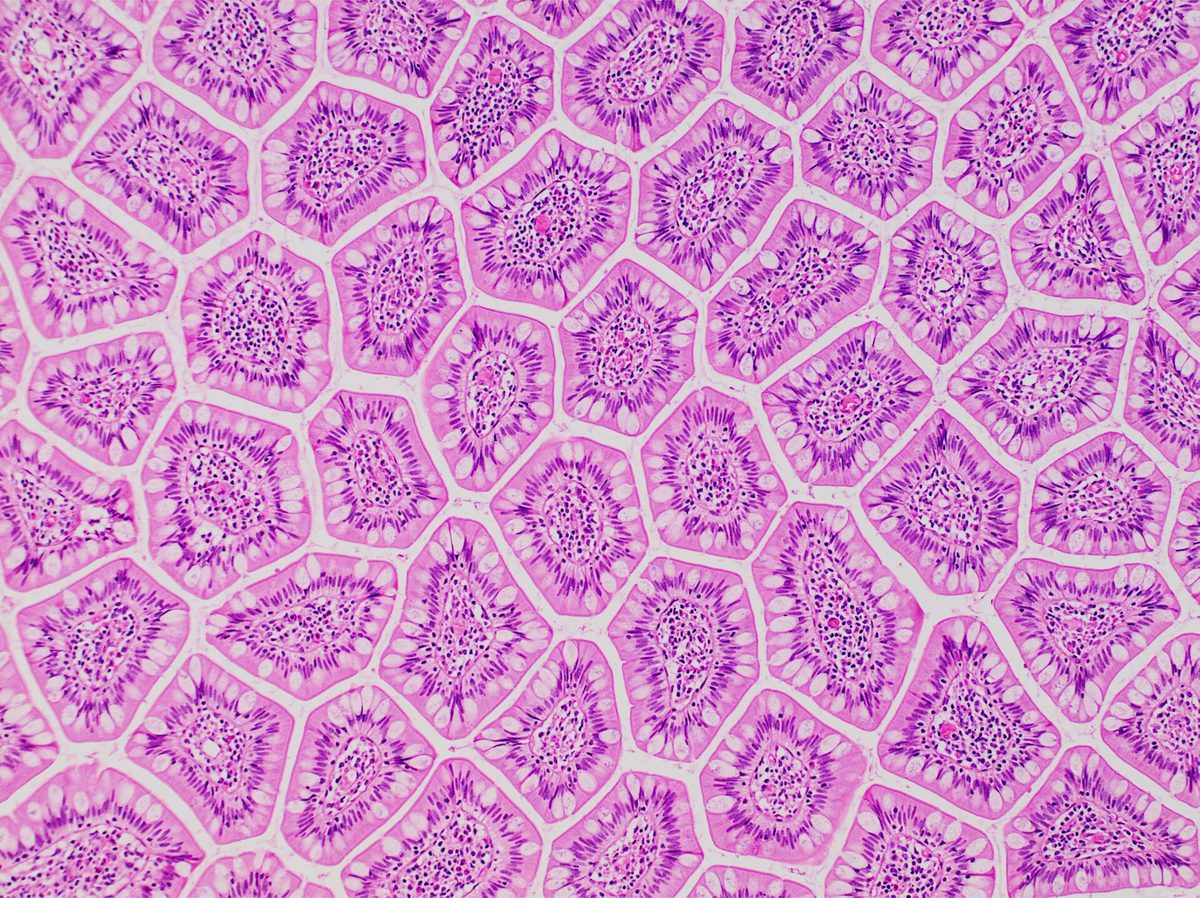
Absorption happens across a surface, so the rate depends on how much surface there is. A smooth tube a few metres long would offer a few hundred square centimetres. The small intestine instead has three levels of folding: large circular folds in the wall, finger-like villi standing up from those folds, and on each cell of each villus a dense brush of smaller projections. Each level multiplies the area, and together they reach something like thirty square metres.
This is the same geometrical idea that will reappear in the lungs and in the gills of a fish: when an exchange has to happen fast, evolution folds the surface. It is also the reason mechanical digestion matters on the food side — breaking one lump into many pieces increases the exposed surface without changing the mass at all.
Each villus also contains a capillary network and a lymph vessel, so an absorbed molecule has a very short distance to travel before it is carried away. Short distance and large area together are what make the rate possible; either on its own would not be enough.
Pause and explain
Why does the same mass of food digest faster when cut into small pieces?
Check your reasoning after answering
Because enzymes act at surfaces, and cutting a lump into pieces increases the exposed surface without changing the mass. More surface means more enzyme molecules can be in contact with the food at once, so the rate of breakdown rises. It is the same reason the intestinal lining is folded into villi — surface area governs the rate of a surface process.
Part 4 · From absorbed molecules to cellular work
Absorption is not the end of the story, and treating it as one is the error this unit most wants to prevent. Once glucose crosses into the blood it is transported, and it is only useful when it reaches a cell, crosses that cell's membrane, and is broken down in a mitochondrion with oxygen to release energy. Digestion supplies the raw material; the energy release happens somewhere else entirely, in the process from Chapter 2.
Amino acids follow a different route with the same shape. Absorbed into the blood, they are delivered to cells and used to build the proteins that cell needs, following its own DNA instructions. The protein in a meal is not transferred into your muscles; it is dismantled into amino acids and those are reassembled into entirely different proteins.
So an experiment that shows food breaking down faster has shown exactly that and nothing more. It has not shown that absorption occurred, that transport happened, or that any energy was released. Each stage needs its own evidence, which is the discipline from Chapter 1 applied to a body instead of a windowsill.
Pause and explain
Does protein eaten in a meal become muscle protein directly?
Check your reasoning after answering
No. Digestion cuts dietary protein into amino acids, which are absorbed and transported to cells. Each cell then builds its own proteins from those amino acids, in the order its own DNA specifies. The amino acids are reused; the original protein is not transferred, which is why one food protein can contribute to thousands of different body proteins.
Apply the whole unit · Interpret a digestion model
Illustrative comparison, not a measured experiment: Sample A is left in one large piece; Sample B has the same mass but is divided into small pieces. Both are placed under the same stated enzyme conditions, and B breaks down faster.
Your task
Explain the mechanism through surface area, distinguish what was observed from what is inferred, and connect the result to absorption.
What your response should show
- Explain the relevant biological process accurately.
- Use the supplied evidence and show calculation steps with units where needed.
- Connect a labeled model or mechanism with the claim.
- State an assumption, evidence limitation, or useful next observation.
Response guidance — after your attempt
State the mechanism: enzymes act where they touch the food, so the rate depends on exposed surface, and dividing a sample increases surface without changing mass.
Separate observation from inference: the observation is that B broke down faster under the stated conditions; the inference is that the greater exposed surface caused it.
Name what the result does not show: nothing about absorption, transport or energy release, which are separate stages needing separate evidence.
Connect to the body: this is why chewing precedes chemical digestion, and why the intestinal lining is folded into villi — the same surface-area principle on the food side and the gut side.
B breaking down faster is consistent with a surface-area mechanism. Enzymes work where they are in contact with their substrate, so the rate of chemical digestion depends on how much of the food is exposed. Dividing a sample into small pieces leaves the mass unchanged and multiplies the exposed surface, so more enzyme molecules can act at once and breakdown proceeds faster. The observation here is narrow and worth stating precisely: under the stated enzyme conditions, the divided sample broke down more quickly than the intact one. The mechanism is an inference, and a plausible rival worth checking would be that the act of dividing also warmed the sample or changed how the enzyme solution circulated around it, either of which could contribute. The result says nothing at all about the later stages. It does not show that any product was absorbed, that anything was transported, or that energy was released, because each of those happens elsewhere and would need its own evidence — a measurement of what crossed a membrane, or of oxygen consumed. In the body the same principle appears twice: chewing increases the food's surface before the enzymes reach it, and the intestinal lining is folded into villi and then into a brush of finer projections, reaching an absorbing area of roughly thirty square metres so that absorption can keep pace.
Scientific references for this unit
Parent / teacher teaching notes
Ask for a because-statement and a labeled relationship, not just a memorized word. Work through one calculation step at a time, permit oral or diagram responses, and use flexible sessions for difficult reading. Compare the learner’s actual evidence with the supplied model; do not reward copying or agreement with a personal preference. No private family, genetic, or medical records are required.
The key idea
Digestion breaks food into smaller components that can be absorbed and used. Mechanical processes such as chewing change size; chemical digestion changes large molecules into smaller molecules through reactions. Enzymes help these reactions occur. Digestion does not simply convert food directly into blood or energy.
Worked examples
Example 1 · Predict the effect of removing a contribution
- Identify what bile does: it emulsifies fat, breaking large droplets into many small ones — mechanical digestion, not chemical.
- Identify what lipase needs: it acts at the surface of fat droplets, so the rate depends on the total droplet surface available.
- Combine the two: without emulsification the fat stays in large droplets with much less surface, so lipase works far more slowly even though it is present in normal amounts.
A mechanical contribution can limit a chemical process. Ask what each step supplies.
Example 2 · Judge what an experiment showed
- State what was observed: starch was converted to sugar in the presence of saliva within ten minutes.
- Identify the mechanism that supports: amylase in saliva cuts the starch chain into smaller sugars — chemical digestion.
- Check the conclusion against the stages: energy release requires the sugar to enter a cell and be respired in a mitochondrion with oxygen, none of which happened in the test tube.
Each stage of the chain needs its own evidence. A test tube cannot show what a cell does.
Avoid these mistakes
- Mistake: chewing is enough to let food be absorbed. Chewing is mechanical — the starch is still a long chain; amylase has to cut it before anything can cross a membrane.
- Mistake: bile digests fat. Bile emulsifies fat into small droplets, which is mechanical; lipase does the chemical digestion, and it works faster because of the surface bile created.
- Mistake: eating protein builds muscle protein directly. Protein is cut into amino acids, absorbed, and reassembled by each cell into entirely different proteins its own DNA specifies.
- Mistake: faster breakdown shows energy was released. Breakdown, absorption, transport and respiration are four stages; an experiment showing one of them shows nothing about the other three.
Check your understanding
Why is grinding alone not complete chemical digestion?
Discuss the answer
It changes piece size and surface area but does not necessarily break the relevant chemical bonds into absorbable components.
Why is the stomach-only model incomplete?
Discuss the answer
Processing, transport, digestive contributions, and much absorption occur through several organs, especially the small intestine.
Words to know
- digestion
- Breaking food down, mechanically into smaller pieces and chemically into smaller molecules; only the chemical stage makes molecules small enough to absorb.
- enzyme
- A protein that cuts a particular kind of molecule — amylase on starch, protease on protein, lipase on fat — working within a range of acidity and temperature.
- absorption
- The movement of small food molecules out of the gut and into the blood, mostly across the lining of the small intestine.
- small intestine
- The organ where most chemical digestion is completed and most absorption happens, with enzymes delivered into it by the pancreas and bile by the liver.
- surface area
- How much surface is exposed; it governs the rate of any surface process, which is why food is chewed and the gut lining is folded.
Extend your scientific explanation
Compare a second supplied example or the linked educational reference. Identify a connection, a model limit, and an additional observation that would test the explanation.
In the real world
Use a clear question, reliable observations, and a biological mechanism to evaluate a claim. State what remains uncertain before applying a classroom model to a different setting.
Exit check
Does absorbing sugar mean all its energy has already been used?
Check your explanation after answering
No. Absorption makes material available for transport; later cellular processes transfer its stored energy or use its matter.
Explain your reasoning without notes. If a key idea is missing, revisit the lesson and try again.