Wave Properties · Grade 12 Science
Chapter: Waves, Sound & OpticsWave Properties
Learning goals
- I can distinguish transverse from longitudinal waves and identify amplitude, wavelength, frequency, and period.
- I can relate frequency, wavelength, and speed using v = f λ, and predict the result of two waves interfering.
Readings for this unit
Before this unit
Period, frequency, and wave speed.
Use the detailed parent plan: two core 50–60-minute sessions per focused unit, with a third assigned for selected calculation/modeling topics. First study the core explanation and Parts 1–2 with their figures/checks; next study Parts 3–4, the whole-unit application, worked cases, varied practice and exit check. Attempt reasoning before opening guidance. Extend time when actual understanding requires it; investigations and chapter assessments have separate sessions.
Start with something to explain
Does a crest carry the same bit of rope all the way across?
Illustrative evidence case. A rope marker oscillates locally while a crest moves onward.
Notice and wonder
Record two observations using the stated quantities or relationships. Keep observations separate from possible causes. Write one question that a new measurement could help answer.
Does a crest carry the same bit of rope all the way across?
Your first model
Separate marker motion from pattern propagation and label each axis.
Build the language from the idea
- wave
- A disturbance that transfers energy through space or a medium without transferring matter.
- transverse wave
- A wave in which the particles (or fields) vibrate perpendicular to the direction the wave travels, like a wave on a rope or light.
- longitudinal wave
- A wave in which particles vibrate parallel to the direction the wave travels, forming compressions and rarefactions, like sound.
- amplitude
- The maximum displacement of a wave from its rest position; a wave's energy is proportional to the square of its amplitude.
- wavelength (λ)
- The distance between two consecutive matching points on a wave, such as crest to crest, measured in meters.
- frequency (f)
- The number of complete waves passing a point each second, measured in hertz (Hz); the period is its inverse, T = 1/f.
- interference
- The result of two or more waves overlapping, adding together to reinforce (constructive) or cancel (destructive).
A wave propagates a disturbance and can transfer energy through interactions. In simple small-amplitude models, medium particles oscillate locally rather than traveling the entire propagation distance. Real surface waves can involve particle drift and other fluid motion, so a floating marker does not universally remain at one exact location. Electromagnetic waves require no material medium. State the wave model before using a no-net-matter-transfer approximation.
Waves come in two fundamental shapes. In a transverse wave, the particles of the medium vibrate *perpendicular* to the direction the wave travels — think of snapping a rope up and down while the pulse races horizontally away from your hand. Light and all electromagnetic waves are transverse. In a longitudinal wave, the particles vibrate *parallel* to the wave's travel, bunching into compressions and spreading into rarefactions; sound is the classic example, and you can model it by pushing and pulling one end of a stretched spring. Recognizing which type you are dealing with tells you a great deal about how the wave will behave.
Every wave is described by a small set of measurable quantities. Amplitude is the maximum displacement from rest, and it is the property tied to energy — but the link is sharper than 'bigger means stronger.' A wave's energy is proportional to the *square* of its amplitude, so doubling the amplitude carries four times the energy. Wavelength (λ) is the distance between matching points, easiest to measure crest to crest. Frequency (f), in hertz, counts how many whole waves pass each second, and the period (T) is the time for a single wave to pass. Frequency and period are reciprocals: if many waves pass each second, each must take very little time, so T = 1 ÷ f.
These quantities lock together in the single most useful relationship in the unit: wave speed equals frequency times wavelength, v = f × λ. The logic is direct — if many waves pass each second (high f) and each one is long (large λ), the wave front must be advancing quickly. Because the three quantities are linked, knowing any two always yields the third: f = v ÷ λ or λ = v ÷ f. A crucial subtlety for later units: the *speed* of a mechanical wave is set by the medium, not by the source. Shake a rope faster and you raise the frequency, but the pulse speed stays the same, so the wavelength shortens to compensate.
In a linear wave model, overlapping disturbances add signed displacements at each point. Matching phase can give constructive interference, while opposite phase can give local destructive interference. Zero combined displacement at a location does not mean energy is destroyed or absent throughout the system. Wave behavior outside a linear small-disturbance regime may not follow unchanged simple superposition. Keep the full pattern and model conditions in the account.
Master this handful of ideas and an enormous range of nature and technology opens up. The pitch of a note, the color of light, the channel your phone locks onto, and the destructive power of a storm swell all reduce to amplitude, wavelength, and frequency. Engineers who design antennas, concert halls, ultrasound scanners, and fiber-optic networks are, at bottom, controlling these same wave properties with precision — which is exactly why physicists insist on getting the vocabulary and the math of waves exactly right.
Model check: A wave transfers energy without requiring bulk material travel with the pattern. v=fλ=10 m/s andT=1/f=.20 s.
Build your understanding
Use the detailed parent plan: two core 50–60-minute sessions per focused unit, with a third assigned for selected calculation/modeling topics. First study the core explanation and Parts 1–2 with their figures/checks; next study Parts 3–4, the whole-unit application, worked cases, varied practice and exit check. Attempt reasoning before opening guidance. Extend time when actual understanding requires it; investigations and chapter assessments have separate sessions.
Part 1 · Separate propagation from local motion
A wave transports a disturbance and energy through space. In this transverse example, local material oscillates up and down while the pattern propagates horizontally. A material marker need not travel the entire distance with the crest. Sound in air is instead primarily longitudinal: local compression and expansion occur along propagation. Name which quantity oscillates and which direction the pattern travels before applying a rope picture to a different wave type.
Read the visual model
Identify the labeled structures and units, then trace the arrows or compare values under the caption’s stated conditions. Separate the displayed evidence from a further inference. Write your reasoning before opening the guidance.
Does the red up/down arrow mean energy propagates vertically in this drawing?
Visual reasoning — after your attempt
No. It indicates local transverse oscillation; the displayed wave propagates horizontally.
A wave carries a disturbance and transfers energy through a system. Local medium particles generally oscillate rather than traveling the entire wave distance. Transverse and longitudinal labels compare the direction of local oscillation with propagation; electromagnetic waves do not require a material medium.
A rope pulse travels along the rope while marked rope segments move mostly across that direction. A sound model uses local compression and expansion instead.
Pause and explain
Does a wave’s travel require each particle to travel with it?
Check your reasoning after answering
No. Interactions pass the disturbance along while local particles can oscillate about their positions.
Part 2 · Distinguish a spatial snapshot from a time record
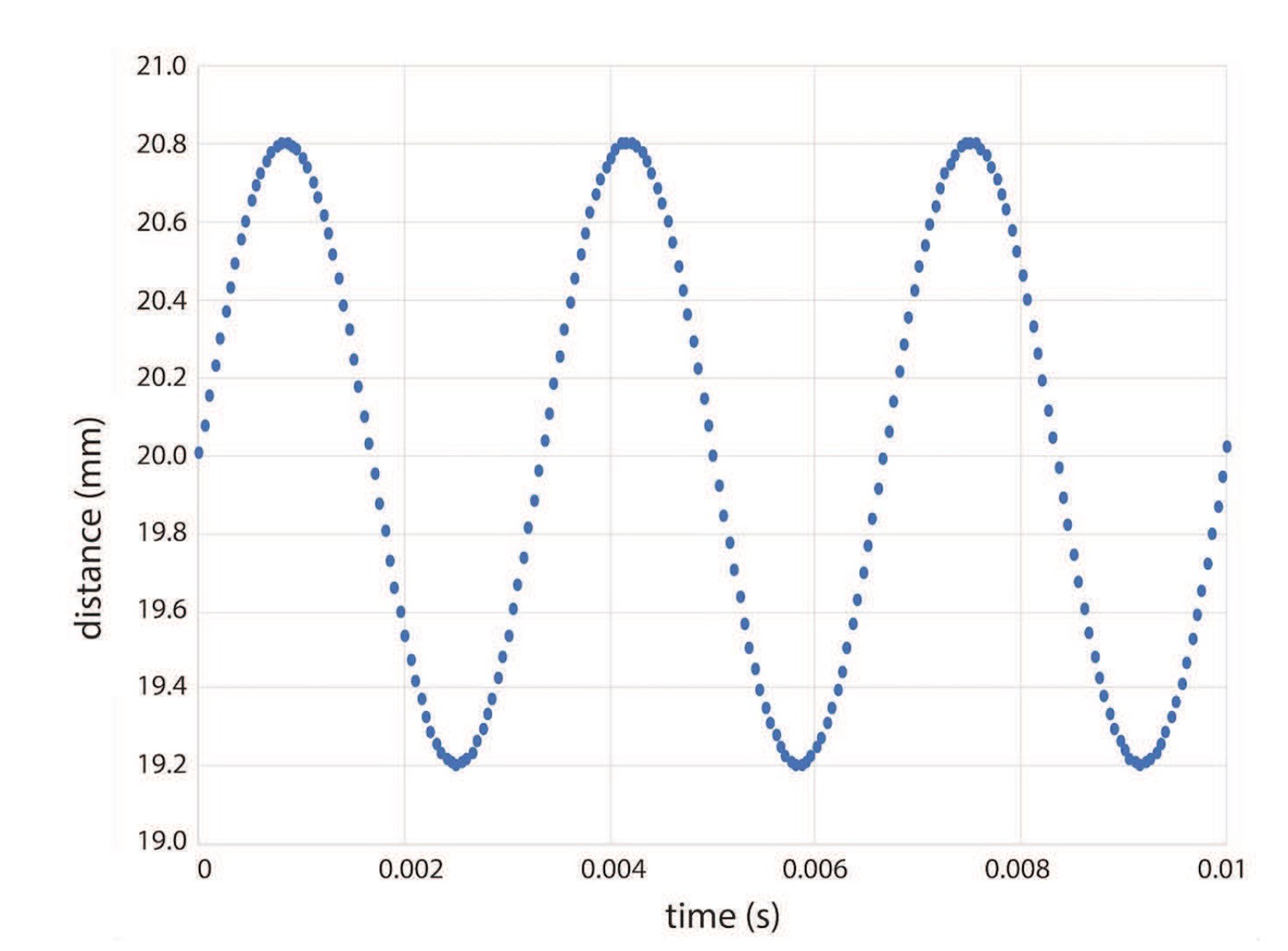
Wavelength λ is the distance between equal-phase locations, such as adjacent crests, at one time. Period T is the interval between equal-phase events at one location, and frequency f=1/T counts cycles per second. A spatial curve and a time trace may look similar but their horizontal axes have different units. Never read a time period directly from a position axis or call a fixed-point oscillation trace a travel path.
Read the visual model
Identify the labeled structures and units, then trace the arrows or compare values under the caption’s stated conditions. Separate the displayed evidence from a further inference. Write your reasoning before opening the guidance.
What is frequency when the measured period is 0.004 s?
Visual reasoning — after your attempt
f=1/0.004=250 Hz; wavelength requires speed or a spatial record.
Wavelength is spatial separation between matching phase points, while period is the time for a repeating cycle at a location. A displacement-position graph and displacement-time graph can look alike but use different horizontal axes. Amplitude is measured from equilibrium, not crest to trough.
Two successive crests separated by 0.50 m identify wavelength. A marker returning to the same phase every 0.20 s identifies period.
Pause and explain
Why is crest-to-trough height twice amplitude for a symmetric wave?
Check your reasoning after answering
Amplitude is the maximum displacement from equilibrium; crest and trough lie on opposite sides, separated by two amplitudes.
Part 3 · Use the propagation relationship with conditions
Wave speed satisfies v=fλ for a steady periodic traveling wave. Frequency is cycles per second and wavelength is meters per cycle, so their product gives meters per second. In a nondispersive medium, changing source frequency changes wavelength while speed stays approximately fixed. In a dispersive medium, speed can depend on frequency, so “speed is always fixed” is too broad. Identify the medium, wave type and relevant approximation.
Read the visual model
Identify the labeled structures and units, then trace the arrows or compare values under the caption’s stated conditions. Separate the displayed evidence from a further inference. Write your reasoning before opening the guidance.
At speed 340 m/s, what wavelength corresponds to 680 Hz?
Visual reasoning — after your attempt
λ=v/f=0.50 m under the stated medium conditions.
For a periodic wave, v=fλ and f=1/T connect speed, frequency, wavelength, and period. Wave speed depends on the medium and conditions. When a source’s frequency remains fixed at a boundary, a speed change can change wavelength without changing frequency.
At fixed speed, increasing frequency reduces wavelength. At fixed frequency, a faster medium gives a longer wavelength. State which quantities are held fixed.
Pause and explain
Does a shorter wavelength always mean a faster wave?
Check your reasoning after answering
No. Speed depends on both frequency and wavelength; many comparisons change one while keeping the other or the medium fixed.
Part 4 · Distinguish amplitude from speed and frequency
Amplitude is the maximum departure from an equilibrium value for the chosen oscillating quantity. The two curves show different displacement amplitudes with the same wavelength. Within the same linear wave model, this change does not automatically alter frequency or propagation speed. Wave energy commonly depends on amplitude squared under specified conditions, but the proportionality depends on the medium and the quantity being plotted. Define the amplitude units before comparing waves.
Read the visual model
Identify the labeled structures and units, then trace the arrows or compare values under the caption’s stated conditions. Separate the displayed evidence from a further inference. Write your reasoning before opening the guidance.
Are the two curves enough to determine their numerical frequencies?
Visual reasoning — after your attempt
No. They show spatial shapes without a time record or numerical wave speed.
Amplitude can relate to carried energy in a specified wave model, but it is not the same as frequency or propagation speed. Simple linear wave models often treat speed as amplitude-independent over their range. Strong nonlinear disturbances can require a different model.
A more vigorous rope oscillation can increase amplitude without changing the source’s cycle rate. Compare one controlled variable at a time.
Pause and explain
What evidence tests an amplitude-independent speed claim?
Check your reasoning after answering
Measure travel time over the same distance for several amplitudes under the same medium conditions, and compare uncertainties.
Apply the whole unit · Connect a wave snapshot and timer record
Illustrative wave crests are 0.600 m apart and a fixed marker completes five cycles in 2.00 s. Assume uniform periodic propagation.
Your task
Find frequency, period, and wave speed. Predict wavelength in a second medium where speed is 2.00 m/s and source frequency remains unchanged, and explain the assumption.
What your response should show
- Define the system, quantities, units, and relevant conditions before selecting a model.
- Show intermediate calculations or a labeled evidence account, including signs or denominators.
- Explain how the supplied evidence supports the conclusion rather than reporting only an answer.
- Identify a meaningful uncertainty, model limit, or measurement needed to test the conclusion.
Response guidance — after your attempt
f=5/2.00=2.50 Hz; T=1/f=0.400 s.
v=fλ=2.50×0.600=1.50 m/s.
In the second medium λ=2.00/2.50=0.800 m.
The spatial and temporal measurements describe different features of the same periodic model. The boundary prediction keeps the source frequency fixed; the wavelength adjusts to the propagation speed. Neither record provides amplitude or total wave energy, so those quantities cannot be recovered from v=fλ alone.
Scientific references and source-model foundations
- OpenStax — thin-lens image formation
- OpenSciEd 8.2 — sound-wave foundations
- OpenSciEd public middle-school figure license — CC BY 4.0
Parent / teacher teaching notes
Ask students to label whether the horizontal axis represents position or time before reading any graph. Use that distinction to diagnose wavelength-period confusion. Ask the learner to explain each symbol, axis, unit and arrow before calculating. Calculated examples, supplied illustrative records and actual historical observations are labeled separately. Selected public OpenSciEd middle-school source figures are foundation examples, not complete high-school editions or an endorsement; all advanced explanations are supplied locally.
An animated transverse wave showing crests, troughs, amplitude, and wavelength.
The key idea
Waves propagate disturbances and energy; material can oscillate locally. Define spatial wavelength, time period and amplitude separately and state the model for v=fλ.
Wave Speed
v = f × λ
f is frequency in hertz (Hz); λ is wavelength in meters (m); v is wave speed in m/s. Rearranges to f = v ÷ λ or λ = v ÷ f.
Period and Frequency
T = 1 ÷ f
T is the period in seconds; f is frequency in Hz. Equivalently f = 1 ÷ T.
Worked examples
Example 1
- Use the wave speed equation v = f × λ.
- v = 25 × 8.
- = 200.
Example 2 · Worked application
- λ=v/f=100/25=4 m.
- T=1/f=1/25=0.040 s.
- Frequency and period are reciprocals.
Check v=fλ independently.
Example 3
- By superposition, the displacements add. In-phase waves interfere constructively.
- Add the amplitudes: 4 + 4.
- = 8.
Example 4 · Find and fix the mistake
- Test the claim against the stated conditions: Check v=fλ independently.
- Speed is set by the medium and wave type under that model; higher f then means shorter λ.
Check v=fλ independently.
Example 5 · Reason from the visual model
- Wave speed satisfies v=fλ for a steady periodic traveling wave. Frequency is cycles per second and wavelength is meters per cycle, so their product gives meters per second. In a nondispersive medium, changing source frequency changes wavelength while speed stays approximately fixed. In a dispersive medium, speed can depend on frequency, so “speed is always fixed” is too broad. Identify the medium, wave type and relevant approximation.
- λ=v/f=0.50 m under the stated medium conditions.
Calculated compatible wave quantities; the two table rows assume the same nondispersive speed.
Avoid these mistakes
- A wave transfers energy without requiring bulk material travel with the pattern.
Check your understanding
f=5 Hz,λ=2 m. Find speed and period.
Discuss the answer
v=fλ=10 m/s andT=1/f=.20 s.
Return to the phenomenon
Return to the initial case. Does a crest carry the same bit of rope all the way across? Revise your drawing or explanation using two named ideas and one stated limitation.
Compare explanations after your attempt
Energy propagates while material oscillates locally; wavelength, period and amplitude describe different features.
What should we investigate next?
Which comparison would test a remaining uncertainty? State what you would change, keep comparable and measure.
Investigate, calculate and revise
Keep a first model and an evidence-supported revision. Attempt each task before opening guidance; all required explanations and supplied-data routes are available locally.
Activity 1 · Return to the opening case
Use the opening phenomenon, unit definitions and explained Parts 1–4.
Your task
Return to the initial case. Does a crest carry the same bit of rope all the way across? Revise your drawing or explanation using two named ideas and one stated limitation.
Success criteria
- Use the stated observations and appropriate units.
- Connect a labeled model with the physical/environmental mechanism.
- State assumptions and an evidence limitation.
- Explain a substantive revision or next test.
Hint
Keep object/material identity, material transfer and energy account distinct.
Response guidance — discuss after your attempt
Energy propagates while material oscillates locally; wavelength, period and amplitude describe different features.
Activity 2 · Transfer to a changed case
Cover the worked answer and use the explained models, relationships and notebook.
Your task
A wave has period 0.020 s and wavelength 0.80 m. Find frequency and speed. If frequency doubles in the same nondispersive medium, find the new wavelength.
Success criteria
- Use the stated measurements or conditions, with correct units.
- Connect the result to the physical or environmental mechanism or evidence relationship.
- Identify the assumption, model limit or further evidence requested.
Hint
Name known quantities and conditions, show intermediate steps and check conservation.
Response guidance — discuss after your attempt
f=50 Hz and v=40 m/s. At100 Hz with the same 40 m/s speed, λ=0.40 m.
Words to know
- wave
- A disturbance that transfers energy through space or a medium without transferring matter.
- transverse wave
- A wave in which the particles (or fields) vibrate perpendicular to the direction the wave travels, like a wave on a rope or light.
- longitudinal wave
- A wave in which particles vibrate parallel to the direction the wave travels, forming compressions and rarefactions, like sound.
- amplitude
- The maximum displacement of a wave from its rest position; a wave's energy is proportional to the square of its amplitude.
- wavelength (λ)
- The distance between two consecutive matching points on a wave, such as crest to crest, measured in meters.
- frequency (f)
- The number of complete waves passing a point each second, measured in hertz (Hz); the period is its inverse, T = 1/f.
- interference
- The result of two or more waves overlapping, adding together to reinforce (constructive) or cancel (destructive).
Energy goes as amplitude squared — why a tsunami is so devastating
The lesson says bigger amplitude means more energy, but the real relationship is sharper: a wave's energy is proportional to the square of its amplitude, not just its amplitude. Double the amplitude and you carry four times the energy; triple it and you carry nine times. This is the same doubling-becomes-quadrupling pattern you meet in kinetic energy (KE = ½mv²). It is exactly why a tsunami — whose amplitude can be many times that of a normal swell — arrives with wildly disproportionate destructive power, and why earthquake engineers care so much about the amplitude of ground shaking, not merely its frequency.
Superposition and the magic of noise-cancelling headphones
The principle of superposition says that when waves overlap, their displacements simply add, point by point — and then each wave passes through untouched. Noise-cancelling headphones turn this into a product: a tiny microphone samples the incoming rumble of an engine, a processor generates a wave that is its exact mirror image (a crest wherever the noise has a trough), and the two superpose to near-silence through destructive interference. The same physics gives some seats in an auditorium 'dead spots,' and it is how engineers cancel vibration in everything from car cabins to precision telescopes.
Transverse and longitudinal together: reading an earthquake
Earthquakes broadcast both kinds of wave at once, and seismologists exploit the difference to find the epicenter. Fast P waves (primary) are longitudinal, squeezing and stretching the rock like sound; slower S waves (secondary) are transverse, shaking the ground side to side — and, tellingly, S waves cannot travel through liquid, which is how we first learned Earth's outer core is molten. Because P waves outrun S waves, the time gap between their arrivals at a station reveals the distance to the quake; combine readings from three stations and you triangulate the exact location.
Standing waves: when a trapped wave becomes music
Trap a wave between two boundaries — the fixed ends of a guitar string, the ends of an organ pipe — and its reflections superpose to form a standing wave: a frozen pattern of motionless nodes and violently oscillating antinodes. Only certain wavelengths 'fit' the length exactly, so an instrument sounds a specific set of frequencies (a fundamental plus its harmonics) rather than a smear of noise. This is the bridge from pure wave physics into the next lesson on sound, resonance, and why every instrument has its own characteristic voice.
Huygens vs. Newton: three centuries arguing what a wave even is
In the 1670 s the Dutch physicist Christiaan Huygens argued that light travels as a wave, while Isaac Newton favored tiny particles, or 'corpuscles.' Newton's towering reputation kept the particle picture dominant for over a century — until Thomas Young's 1801 double-slit experiment produced interference fringes that only waves can make. The debate seemed settled for the wave, yet twentieth-century physics revealed a stranger truth still: light behaves as both wave and particle, a paradox you will meet head-on in the lesson on the electromagnetic spectrum.
In the real world
Noise-cancelling headphones sample incoming sound and generate a wave that is exactly out of phase with it, using destructive interference to silence the roar of a jet engine.
Exit check
f=5 Hz,λ=2 m. Find speed and period.
Check your explanation after answering
v=fλ=10 m/s andT=1/f=.20 s.
Explain your reasoning without notes. If a key idea is missing, revisit the lesson and try again.