The Gas Laws — Practice · Grade 11 Science
Chapter: States of Matter & GasesWhat this practice covers
By the end of The Gas Laws you should be able to:
- I can use Boyle's, Charles's, Gay-Lussac's, and the combined gas law to predict how a gas's pressure, volume, and temperature change.
- I can convert Celsius to kelvin and explain why gas-law calculations must use the Kelvin scale.
11 questions, multiple choice, numeric and written answer, each with a worked explanation.
Vocabulary used: Boyle's Law, Charles's Law, Gay-Lussac's Law, combined gas law, Kelvin scale, absolute zero, pressure.
Problem 1
- completely unrelated
- inversely proportional
- directly proportional
- always equal
Answer and explanation
inversely proportional
Boyle's Law: as volume decreases, pressure increases in inverse proportion, so P₁V₁ = P₂V₂.
Problem 2
Answer and explanation
2 L
Boyle's Law: V₂ = P₁V₁/P₂ = (1.0 × 6.0)/3.0 = 2.0 L.
Problem 3
Answer and explanation
6 L
Charles's Law: V₂ = V₁ × (T₂/T₁) = 4.0 × (300/200) = 6.0 L.
Problem 4
Answer and explanation
4 atm
Gay-Lussac's Law (constant volume): P₂ = P₁ × (T₂/T₁) = 2.0 × (600/300) = 4.0 atm.
Problem 5
Answer and explanation
The gas laws describe direct proportionality with the true amount of particle motion, and only the Kelvin scale starts at absolute zero (genuine zero energy). Celsius has an arbitrary zero and negative values, so ratios like V/T come out wrong unless temperatures are first converted with K = °C + 273.
Problem 6
Answer and explanation
2.25 L
Combined gas law: V₂ = V₁ × (P₁/P₂) × (T₂/T₁) = 3.0 × (1.0/2.0) × (450/300) = 3.0 × 0.5 × 1.5 = 2.25 L.
Problem 7
Hints
The qualitative direction is an independent check.
Answer and explanation
V₂=2.0×450/300=3.0 L.
Problem 8
Hints
State what the supplied observations or conditions establish, and separate that from any assumption.
Answer and explanation
Absolute temperatures are about 293 K and 313 K; Celsius ratios do not measure proportional thermal energy.
Problem 9
Answer and explanation
250 kPa absolute, the sum of the gauge reading and atmospheric reference.
Absolute pressure is measured relative to vacuum, while gauge pressure is measured relative to the surrounding atmosphere. An ordinary gauge reading of zero therefore does not mean zero molecular collisions or vacuum. In the selected example, a 150 kPa gauge reading with 100 kPa atmosphere corresponds to 250 kPa absolute. Gas-law equations use the absolute pressure; temperature also uses an absolute scale. State both reference conditions rather than treating the printed number on an instrument as automatically suitable.
250 kPa absolute, the sum of the gauge reading and atmospheric reference.
Response criteria
- Interpret labels, structures, axes, units and directions correctly.
- Explain the chemistry relationship or mechanism.
- Respect stated assumptions and distinguish observation from inference.
Problem 10
Answer and explanation
V₂=3.00(100/150)(350/300)=2.33 L. Assume the same gas amount and ideal behavior; leakage, reaction or condensation would require another account.
V₂=3.00(100/150)(350/300)=2.33 L. Assume the same gas amount and ideal behavior; leakage, reaction or condensation would require another account.
Response criteria
- Use the stated measurements or conditions, with correct units.
- Connect the result to the chemical mechanism or evidence relationship.
- Identify the assumption, model limit or further evidence requested.
Problem 11
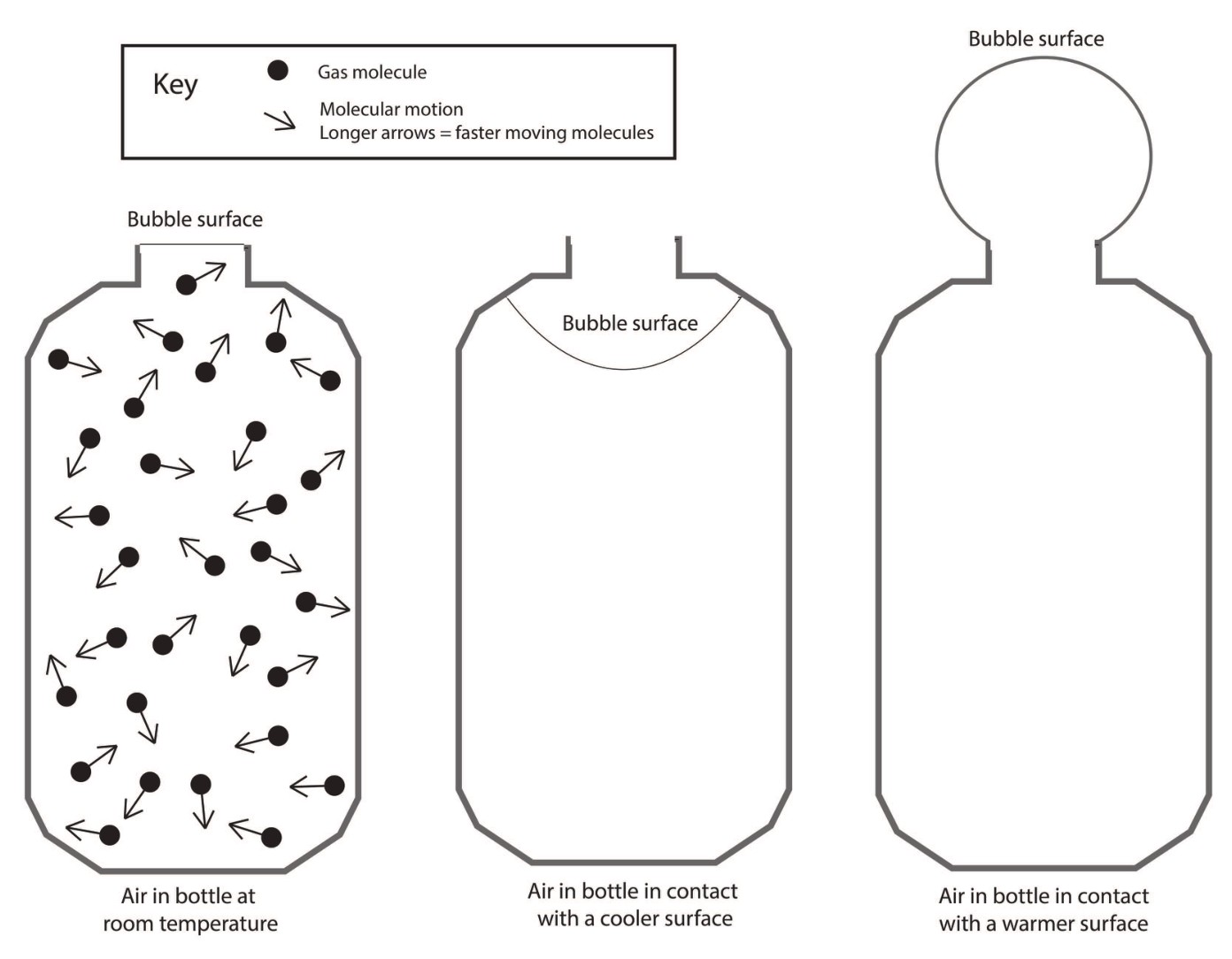
Answer and explanation
Mean translational energy increases with kelvin temperature, characteristic speed for the same species increases with √T, and volume increases proportionally to T under the fixed-pressure ideal model. Keep molecule identity and total count fixed. A rigid sealed vessel fixes volume, so pressure rises instead; blank template regions do not mean zero particles.
Identify the source’s visible labels, scales and unfinished or omitted information.
Use the local complete explanations to connect the observation with an explicit mechanism.
State assumptions and a limit before extending the model.
Response criteria
- Interpret the source symbols and boundary correctly.
- Explain the relevant mechanism using quantities/species consistently.
- State a meaningful omission, assumption or evidence limitation.