States of Matter & Gases — Print · Physical Science: Chemistry, Grade 11
Relate particle motion, attractions, gas models, and phase-change energy.
Printable chapter lessons and review.
Kinetic Molecular Theory & Phase Changes
Learning goals
- I can state the assumptions of the kinetic molecular theory and use them to explain how gases behave.
- I can describe the particle arrangement in solids, liquids, and gases, and interpret heating curves and phase diagrams for all six phase changes.
Readings for this unit
Before this unit
Temperature, energy, and phases.
Use the detailed parent plan: two core 50–60-minute sessions per focused unit, with a third assigned for selected calculation/modeling topics. First study the core explanation and Parts 1–2 with their figures/checks; next study Parts 3–4, the whole-unit application, worked cases, varied practice and exit check. Attempt reasoning before opening guidance. Extend time when actual understanding requires it; investigations and chapter assessments have separate sessions.
Start with something to explain
Does warming a gas make every molecule expand or move at the same new speed?
Illustrative evidence case. A sealed sample is warmed while the number of molecules remains fixed.
Notice and wonder
Record two observations using the stated quantities or relationships. Keep observations separate from possible causes. Write one question that a new measurement could help answer.
Does warming a gas make every molecule expand or move at the same new speed?
Your first model
Keep molecular identity, speed distribution and container response as separate parts of the model.
Build the language from the idea
- kinetic molecular theory (KMT)
- A model that explains the behavior of gases by picturing them as huge numbers of tiny particles in constant, random, straight-line motion.
- kinetic energy
- The energy of motion; the average kinetic energy of a substance's particles is directly proportional to its Kelvin temperature.
- phase change
- A physical change in which a substance moves between the solid, liquid, and gas states without becoming a new substance.
- heating curve
- A graph of temperature versus energy added (or time) as a substance is heated; it shows flat plateaus during phase changes.
- heat of fusion
- The energy absorbed to melt a given amount of a solid (and released when that amount freezes).
- heat of vaporization
- The energy absorbed to boil a given amount of a liquid (and released when that amount condenses); larger than the heat of fusion.
- phase diagram
- A pressure-versus-temperature graph showing which phase is stable under each set of conditions, including the triple point and critical point.
- sublimation
- The phase change directly from solid to gas, skipping the liquid state; deposition is the reverse.
Picture the air in the room around you. It looks like empty nothingness, yet it is actually a swarm of trillions upon trillions of molecules, each one hurtling along at hundreds of meters per second, colliding, rebounding, and racing off again. The kinetic molecular theory (KMT) is the model chemists use to make sense of that invisible chaos. Rather than tracking any single particle, KMT describes the *average* behavior of an enormous crowd of them — and from that average it successfully predicts everything a gas does, from the pressure in a tire to the lift under a hot-air balloon.
The theory rests on a few clean assumptions about an ideal gas. First, gas particles are in constant, random, straight-line motion, changing direction only when they collide. Second, the particles themselves are so tiny compared with the distances between them that their own volume is essentially zero — a gas is mostly empty space. Third, the particles neither attract nor repel one another, and their collisions are perfectly elastic, meaning no kinetic energy is lost when they bounce. Fourth, and most important, the mean translational kinetic energy per ideal-gas particle is directly proportional to the Kelvin temperature: at thermal equilibrium a greater kelvin temperature gives a greater mean translational energy, with a distribution of particle speeds.
That same idea of particle motion explains the three familiar states of matter, which really come down to a tug-of-war between the kinetic energy pulling particles apart and the attractive forces trying to hold them together. In a solid, the attractions win: particles are locked in a rigid arrangement and can only vibrate in place, so a solid keeps its shape and volume. In a liquid, the two are more evenly matched: particles stay close but can slide past one another, so a liquid keeps its volume but flows to fit its container. In a gas, motion wins completely: particles fly apart with vast empty gaps between them, so a gas expands to fill any space it is given.
Add or remove enough energy and a substance flips between states in a phase change. There are six, and they come in reverse-pairs. Adding energy drives melting (solid to liquid), vaporization (liquid to gas), and sublimation (solid straight to gas) — all endothermic, meaning they absorb energy. Removing energy drives their opposites — freezing, condensation, and deposition — all exothermic, releasing energy. The energy needed to melt a sample is its heat of fusion; the (larger) energy needed to boil it is its heat of vaporization.
A heating curve separates warming within a phase from changing phase fraction. For a selected pure substance at fixed pressure and suitable heating conditions, a melting or boiling region can remain near constant temperature while energy enters. Real curves can depart from a flat plateau through mixtures, loss, gradients or changing conditions. Segment duration depends on mass, power and energy required, and phase conversion changes intermolecular arrangements rather than ordinarily breaking internal molecular covalent bonds.
Zoom out to a phase diagram and you get the whole picture at once: pressure on the vertical axis, temperature on the horizontal, and boundary lines dividing the map into solid, liquid, and gas regions. Where all three lines meet is the triple point, the single condition where solid, liquid, and gas coexist. Follow the liquid-gas line up and it ends at the critical point, beyond which the distinction between liquid and gas disappears into a supercritical fluid. Most substances behave tidily, but water is a famous rebel — its solid-liquid boundary tilts backward (negative slope) because ice is less dense than liquid water. Carbon dioxide is another oddball: its triple point sits above normal air pressure, so at 1 atm solid CO₂ (dry ice) skips the liquid entirely and sublimes straight to gas.
Model check: Average kinetic energy is not the same as total internal energy. Energy changes particle arrangements/interactions during phase coexistence rather than mainly raising the kinetic-temperature scale.
Build your understanding
Use the detailed parent plan: two core 50–60-minute sessions per focused unit, with a third assigned for selected calculation/modeling topics. First study the core explanation and Parts 1–2 with their figures/checks; next study Parts 3–4, the whole-unit application, worked cases, varied practice and exit check. Attempt reasoning before opening guidance. Extend time when actual understanding requires it; investigations and chapter assessments have separate sessions.
Part 1 · Explain phase using motion and interactions
A phase is a region with a characteristic physical state and composition. In a simple molecular model, solid particles vibrate around constrained positions, liquid particles remain close but rearrange, and gas particles are widely separated relative to their size. The molecules themselves do not expand into larger molecules when the sample expands. Interparticle motion and interactions jointly determine phase; a regular solid-dot picture is only one structural model and does not describe every amorphous solid.
Read the visual model
Identify the labeled structures and units, then trace the arrows or compare values under the caption’s stated conditions. Separate the displayed evidence from a further inference. Write your reasoning before opening the guidance.
Which changes in the drawing distinguish liquid from gas without changing each molecule’s identity?
Visual reasoning — after your attempt
Spacing and freedom of relative movement differ. The dots keep the same species meaning; individual molecules do not become larger gas particles.
Particle motion and attractions help explain phases under stated temperature and pressure. Solid particles vibrate around positions; liquids remain close while changing neighbors; gases have much greater average separation. Particles do not expand into larger atoms when the bulk material expands.
Use the same molecule labels across water phases. A phase change rearranges and changes interactions between molecules rather than decomposing each H₂O molecule.
Pause and explain
What stays chemically unchanged when pure water boils?
Check your reasoning after answering
Water molecules retain their chemical identity. Intermolecular organization changes, rather than ordinary boiling breaking water into hydrogen and oxygen.
Part 2 · Use the ideal gas assumptions deliberately
The kinetic molecular theory ideal-gas model treats particles as small compared with their separation, with negligible intermolecular forces between collisions and elastic collisions. Pressure arises from momentum transfer to container walls, averaged over many impacts. It is not a property of one particle pushing outward continuously. Actual gases deviate when interactions or finite molecular volume matter, especially at high density or near condensation. State the model before translating a motion-arrow picture into a pressure prediction.
Read the visual model
Identify the labeled structures and units, then trace the arrows or compare values under the caption’s stated conditions. Separate the displayed evidence from a further inference. Write your reasoning before opening the guidance.
Why does a single arrow touching the wall not supply a pressure value?
Visual reasoning — after your attempt
Pressure requires the momentum transferred per time and wall area over many particles and collisions, not one selected trajectory.
The ideal kinetic model treats gas particles as negligible in volume, moving randomly with elastic collisions and negligible attractions except during collisions. Pressure comes from momentum exchange with container walls. These assumptions work best sufficiently far from condensation and at lower densities.
Compressing at constant temperature increases collision frequency per wall area in the model. Real molecules still have size and attractions, so the ideal description is an approximation.
Pause and explain
Why can ideal-gas predictions fail near liquefaction?
Check your reasoning after answering
Attractions and finite particle volumes become important, violating assumptions of negligible interactions and volume.
Part 3 · Relate Kelvin temperature to average kinetic energy
For an ideal gas, mean translational kinetic energy per particle is proportional to absolute temperature in kelvin: 3kBT/2. The corresponding molar quantity uses R rather than kB. At a given temperature particles have a distribution of speeds; none of these statements requires every molecule to move at one speed. Doubling T doubles the mean translational energy, while a characteristic speed for the same particle mass scales as the square root of T. Celsius ratios do not express this relation.
Read the visual model
Identify the labeled structures and units, then trace the arrows or compare values under the caption’s stated conditions. Separate the displayed evidence from a further inference. Write your reasoning before opening the guidance.
At 600 K versus 300 K, does a characteristic speed of the same gas double?
Visual reasoning — after your attempt
No. Mean translational kinetic energy doubles, while a characteristic speed increases by √2, approximately 1.41.
Average translational kinetic energy in the ideal model is proportional to absolute temperature. Kelvin temperature is Celsius plus 273.15. Doubling Celsius is not doubling absolute temperature. At the same temperature, different gas species share average translational kinetic energy but can have different speeds.
A lighter molecule generally moves faster on average than a heavier one at the same temperature. Equal temperature does not mean equal molecular speed.
Pause and explain
Why is 20°C to 40°C not a doubling of ideal kinetic energy?
Check your reasoning after answering
The absolute temperatures are about 293 K and 313 K, whose ratio is much less than two. The proportional relationship uses Kelvin.
Part 4 · Interpret phase changes and dynamic exchange
Evaporation transfers molecules from a liquid to vapor, while condensation returns vapor molecules to liquid. In a closed vessel at equilibrium, the opposing rates can be equal even though molecules continue crossing the interface. A stable liquid level is therefore not proof that particles stopped moving. Boiling occurs when vapor bubbles can persist under the surrounding pressure, while surface evaporation can occur below the boiling temperature. Keep chemical identity, boundary conditions and phase-transfer rates distinct.
Read the visual model
Identify the labeled structures and units, then trace the arrows or compare values under the caption’s stated conditions. Separate the displayed evidence from a further inference. Write your reasoning before opening the guidance.
What does equal evaporation and condensation rate mean for the visible amount of each phase?
Visual reasoning — after your attempt
There is no net change from that exchange under steady conditions, despite continuing molecular motion and transfer in both directions.
During evaporation, surface molecules escape and can cool the remaining liquid. In a closed container, condensation can balance evaporation dynamically. A constant macroscopic vapor amount does not require zero molecular exchange. Temperature plateaus during pure-substance phase changes need pressure and energy conditions.
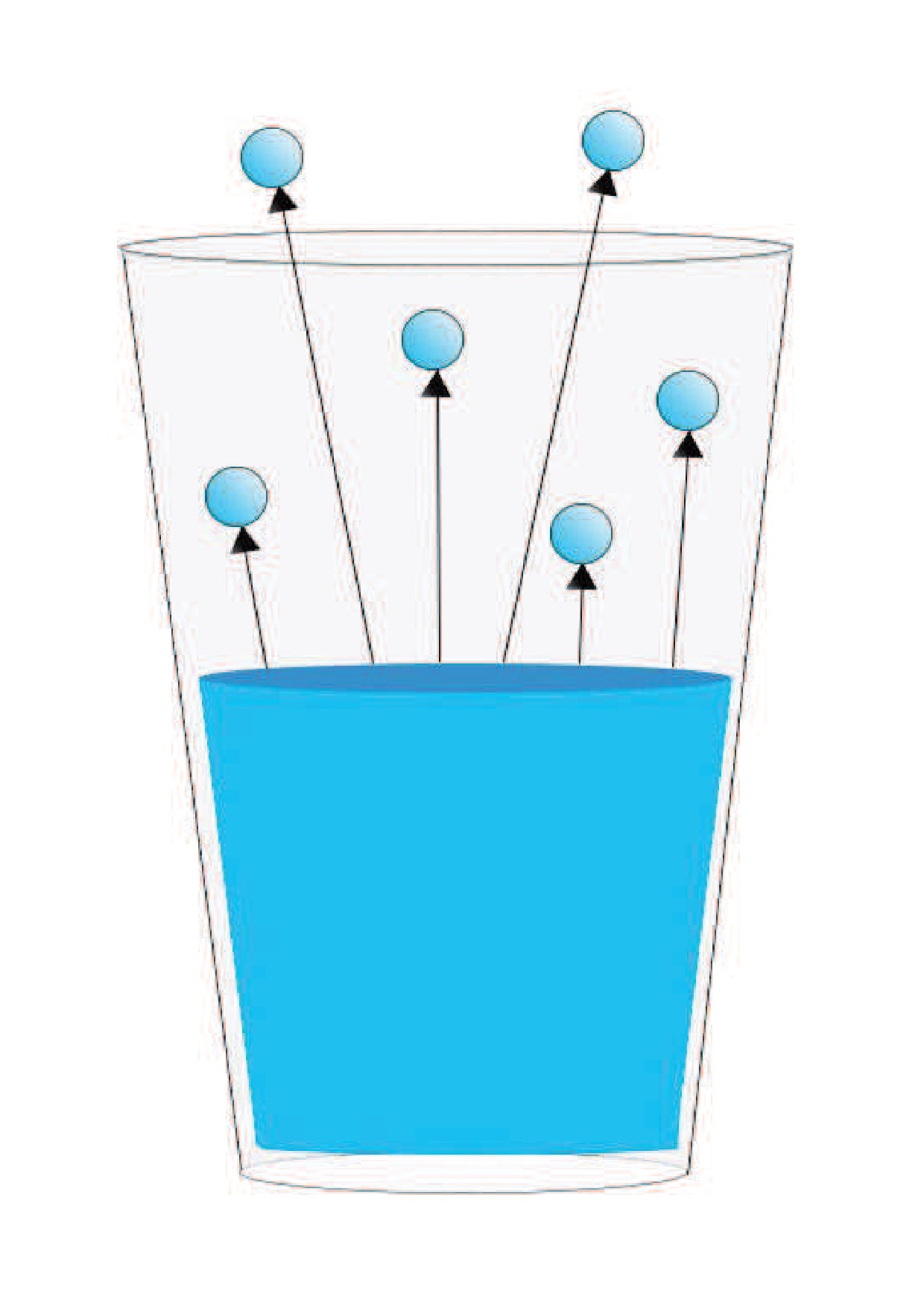
At liquid-vapor equilibrium, molecules continue crossing the interface in both directions at equal average rates.
Pause and explain
Does equilibrium stop evaporation?
Check your reasoning after answering
No. Evaporation and condensation continue, with equal average rates so the macroscopic amount remains steady.
Apply the whole unit · Compare ideal gas temperatures
Illustrative sealed rigid vessel has an ideal gas at 300 K and pressure 100 kPa. It is heated to 450 K without changing gas amount or vessel volume.
Your task
Predict pressure, explain the particle mechanism, compare the absolute-temperature ratio, and state conditions that could make a real gas depart from the prediction.
What your response should show
- Choose the appropriate chemical model or relationship and state its conditions.
- Show substitutions, units, particle or charge counts, and intermediate reasoning as relevant.
- Use supplied evidence to justify the conclusion; distinguish observation from inference.
- Identify a meaningful limitation, uncertainty, or next measurement.
Response guidance — after your attempt
At fixed n and V, ideal pressure is proportional to T.
T₂/T₁=450/300=1.50.
P₂=100×1.50=150 kPa.
The ideal prediction is 150 kPa, associated with greater average translational kinetic energy and wall momentum transfer. It is not based on a Celsius ratio or particle growth. Leaks, nonrigid volume, finite molecular size, attractions, or temperature gradients can invalidate the assumptions. This is supplied-data work, not a pressure-vessel heating experiment.
Scientific references and source-model foundations
- OpenStax — gas laws and the ideal-gas model
- OpenSciEd public middle-school source license — CC BY 4.0
Parent / teacher teaching notes
Use the assumptions alongside every particle explanation. Keep equal average kinetic energy separate from equal particle speed. Ask the learner to explain each particle symbol, axis, unit and arrow before calculating. Distinguish hypothetical models and calculated curves from measured records. Public OpenSciEd excerpts here are selected foundation prompts, not complete high-school teacher editions or an endorsement. All required advanced explanations and practice are provided locally.
An animation showing the particle arrangement and motion in the solid, liquid, and gas states of matter.
The key idea
An ideal-gas kinetic model relates mean translational energy to absolute temperature and pressure to wall momentum transfer. Phase behavior also depends on interparticle interactions and conditions, not temperature alone.
Average Kinetic Energy & Temperature
KE(avg) ∝ T (T in kelvin)
the average kinetic energy of a substance's particles is directly proportional to the absolute (Kelvin) temperature; doubling the Kelvin temperature doubles the average kinetic energy.
Kelvin Temperature Conversion
T(K) = T(°C) + 273.15
converts Celsius to the absolute (Kelvin) scale; 0 K is absolute zero. Many problems round the constant to 273.
Worked examples
Example 1
- A flat plateau on a heating curve means energy is still flowing in but the temperature is not changing — the signature of a phase change.
- The lower plateau (80°C) is the first change as the substance warms from solid: it is melting (solid to liquid) at its melting point.
- The higher plateau (218°C) is the next change up the curve: it is boiling (liquid to gas) at its boiling point.
Example 2 · Worked application
- Particle number and volume remain fixed.
- Higher Kelvin temperature means greater average kinetic energy.
- More forceful and frequent wall interactions raise pressure.
Specify fixed volume and amount before applying the relation.
Example 3
- (a) Frost forming is gas turning directly into solid — that is deposition. Going to a more ordered, tightly held state releases energy, so it is exothermic.
- (b) Melting is solid turning into liquid. Loosening the particle arrangement requires energy to be absorbed, so it is endothermic.
Example 4 · Find and fix the mistake
- Test the claim against the stated conditions: Specify fixed volume and amount before applying the relation.
- Particle separations and motion change; kinetic-molecular theory does not require individual molecules to inflate.
Specify fixed volume and amount before applying the relation.
Example 5 · Reason from the visual model
- For an ideal gas, mean translational kinetic energy per particle is proportional to absolute temperature in kelvin: 3kBT/2. The corresponding molar quantity uses R rather than kB. At a given temperature particles have a distribution of speeds; none of these statements requires every molecule to move at one speed. Doubling T doubles the mean translational energy, while a characteristic speed for the same particle mass scales as the square root of T. Celsius ratios do not express this relation.
- No. Mean translational kinetic energy doubles, while a characteristic speed increases by √2, approximately 1.41.
Original ideal-gas temperature comparison. The bars show T, not a speed distribution or total energy for samples of unspecified amount.
Avoid these mistakes
- Average kinetic energy is not the same as total internal energy.
Check your understanding
Why can melting absorb energy without warming?
Discuss the answer
Energy changes particle arrangements/interactions during phase coexistence rather than mainly raising the kinetic-temperature scale.
Return to the phenomenon
Return to the initial case. Does warming a gas make every molecule expand or move at the same new speed? Revise your drawing or explanation using two named ideas and one stated limitation.
Compare explanations after your attempt
Temperature changes mean translational energy and the distribution, not molecular identity or one universal speed. Volume or pressure response depends on the boundary conditions.
What should we investigate next?
Which comparison would test a remaining uncertainty? State what you would change, keep comparable and measure.
Investigate, calculate and revise
Keep a first model and an evidence-supported revision. Attempt each task before opening guidance; all required explanations and supplied-data routes are available locally.
Activity 1 · Return to the opening case
Use the opening phenomenon, unit definitions and explained Parts 1–4.
Your task
Return to the initial case. Does warming a gas make every molecule expand or move at the same new speed? Revise your drawing or explanation using two named ideas and one stated limitation.
Success criteria
- Use the stated observations and appropriate units.
- Connect a labeled model with the chemical mechanism.
- State assumptions and an evidence limitation.
- Explain a substantive revision or next test.
Hint
Keep species identity, material transfer and energy account distinct.
Response guidance — discuss after your attempt
Temperature changes mean translational energy and the distribution, not molecular identity or one universal speed. Volume or pressure response depends on the boundary conditions.
Activity 2 · Transfer to a changed case
Cover the worked answer and use the explained models, relationships and notebook.
Your task
Two equal-mass ideal-gas particles are compared through samples at 250 K and 500 K. Give the ratio of mean translational energy and characteristic speed, and explain why Celsius values cannot replace kelvin in these ratios.
Success criteria
- Use the stated measurements or conditions, with correct units.
- Connect the result to the chemical mechanism or evidence relationship.
- Identify the assumption, model limit or further evidence requested.
Hint
Name known quantities and conditions, show intermediate steps and check conservation.
Response guidance — discuss after your attempt
The energy ratio is 2 and the characteristic speed ratio √2≈1.41. Kelvin is an absolute scale proportional to this mean energy; Celsius has an offset and its numeric ratios do not express the same physical relation.
Words to know
- kinetic molecular theory (KMT)
- A model that explains the behavior of gases by picturing them as huge numbers of tiny particles in constant, random, straight-line motion.
- kinetic energy
- The energy of motion; the average kinetic energy of a substance's particles is directly proportional to its Kelvin temperature.
- phase change
- A physical change in which a substance moves between the solid, liquid, and gas states without becoming a new substance.
- heating curve
- A graph of temperature versus energy added (or time) as a substance is heated; it shows flat plateaus during phase changes.
- heat of fusion
- The energy absorbed to melt a given amount of a solid (and released when that amount freezes).
- heat of vaporization
- The energy absorbed to boil a given amount of a liquid (and released when that amount condenses); larger than the heat of fusion.
- phase diagram
- A pressure-versus-temperature graph showing which phase is stable under each set of conditions, including the triple point and critical point.
- sublimation
- The phase change directly from solid to gas, skipping the liquid state; deposition is the reverse.
Just how fast are the molecules around you?
The air molecules brushing past your face right now are not drifting — they are sprinting. A typical nitrogen molecule at room temperature averages about 500 meters per second, roughly 1,800 km/h, faster than the speed of sound and faster than most rifle bullets. They do not travel far before crashing, though: each molecule slams into another about five billion times every second, ricocheting after a flight of only a few dozen nanometers. What feels like still, empty air is really an unimaginably frantic pinball game.
How we know atoms really move: Brownian motion
For centuries, atoms were just a useful idea — no one had seen evidence they move. The proof came from a strange observation: in 1827 botanist Robert Brown watched tiny pollen grains in water jiggle and stagger with no cause. In 1905, Albert Einstein showed mathematically that the dance was caused by invisible water molecules bombarding the grains from all sides, and Jean Perrin's experiments soon confirmed it. That jittery motion, now called Brownian motion, was the first hard evidence that atoms and molecules are real and constantly moving — exactly what KMT assumes.
The myth that all particles move at the same speed
KMT talks about the average kinetic energy, and students often picture every molecule cruising at that one speed. In reality the speeds are spread across a wide range described by the Maxwell–Boltzmann distribution: at any instant some molecules are crawling, some are rocketing along, and most are somewhere in the middle. This spread is why liquids evaporate below their boiling point — only the fastest, highest-energy molecules at the surface escape into the air, which is also why the liquid left behind cools down.
Why water boils cooler on a mountaintop
Boiling is not fixed at 100°C — that number only holds at sea-level pressure. Boiling happens when a liquid's molecules can push out against the surrounding air pressure, so lower pressure means a lower boiling point. In Denver, a mile high, water boils around 95°C; near the summit of Everest it boils at only about 70°C, too cool to properly cook an egg or brew tea. A pressure cooker does the opposite, trapping steam to raise the internal pressure so water boils above 100°C and food cooks far faster.
Beyond the critical point: neither liquid nor gas
Follow the liquid–gas line on a phase diagram up to the critical point and something bizarre happens — heat and squeeze a substance past it and the boundary between liquid and gas simply vanishes, leaving a supercritical fluid that flows like a gas but dissolves like a liquid. Supercritical carbon dioxide is a favorite of industry: it seeps into coffee beans to strip out caffeine, leaving flavor behind, and cleans without toxic solvents. At the other extreme, the triple point of water was so reliable it was used for decades to define the exact size of the kelvin.
In the real world
Freeze-drying food and medicine relies on sublimation: frozen material is placed under low pressure so its ice turns straight to vapor, preserving structure without ever going through a soggy liquid stage.
Exit check
Why can melting absorb energy without warming?
Check your explanation after answering
Energy changes particle arrangements/interactions during phase coexistence rather than mainly raising the kinetic-temperature scale.
Explain your reasoning without notes. If a key idea is missing, revisit the lesson and try again.
The Gas Laws
Learning goals
- I can use Boyle's, Charles's, Gay-Lussac's, and the combined gas law to predict how a gas's pressure, volume, and temperature change.
- I can convert Celsius to kelvin and explain why gas-law calculations must use the Kelvin scale.
Readings for this unit
Before this unit
Ratios, kelvin, and a fixed amount of gas.
Use the detailed parent plan: two core 50–60-minute sessions per focused unit, with a third assigned for selected calculation/modeling topics. First study the core explanation and Parts 1–2 with their figures/checks; next study Parts 3–4, the whole-unit application, worked cases, varied practice and exit check. Attempt reasoning before opening guidance. Extend time when actual understanding requires it; investigations and chapter assessments have separate sessions.
Start with something to explain
Why can warming one gas sample increase pressure and another sample’s volume?
Illustrative evidence case. One selected vessel is rigid and sealed; another has a movable boundary under nearly constant outside pressure.
Notice and wonder
Record two observations using the stated quantities or relationships. Keep observations separate from possible causes. Write one question that a new measurement could help answer.
Why can warming one gas sample increase pressure and another sample’s volume?
Your first model
Label fixed and changing variables for both boundaries before drawing motion arrows.
Build the language from the idea
- Boyle's Law
- At constant temperature, the pressure and volume of a fixed amount of gas are inversely proportional: P₁V₁ = P₂V₂.
- Charles's Law
- At constant pressure, the volume of a fixed amount of gas is directly proportional to its Kelvin temperature: V₁/T₁ = V₂/T₂.
- Gay-Lussac's Law
- At constant volume, the pressure of a fixed amount of gas is directly proportional to its Kelvin temperature: P₁/T₁ = P₂/T₂.
- combined gas law
- A single relationship that merges the three individual laws: P₁V₁/T₁ = P₂V₂/T₂.
- Kelvin scale
- An absolute temperature scale whose zero point (0 K) is absolute zero; K = °C + 273.15.
- absolute zero
- The lowest possible temperature, 0 K (about −273°C), where particle motion is at its theoretical minimum.
- pressure
- The force per unit area exerted by gas particles colliding with the walls of their container; measured in atm, kPa, mmHg, or torr.
Gases are the most cooperative state of matter to study, because they all respond to squeezing and heating in the same predictable ways. Over the 1600 s and 1700 s, careful experimenters — Robert Boyle, Jacques Charles, and Joseph Gay-Lussac among them — pinned those responses down into simple mathematical gas laws. The trick behind every one of them is to hold some quantities fixed while watching how the rest trade off. Keep the amount of gas constant and you are left with three players to juggle: pressure (P), volume (V), and temperature (T).
Boyle's Law freezes the temperature and pins down the relationship between pressure and volume: they are *inversely* proportional. Squeeze a gas into half the space and its pressure doubles; let it expand into twice the room and its pressure is cut in half. It makes intuitive sense through KMT — cram the same fast-moving particles into a smaller box and they strike the walls more often, driving the pressure up. Mathematically, the product stays constant: P₁V₁ = P₂V₂. This is the physics of a syringe, a bicycle pump, and your own lungs.
Charles's Law freezes the pressure instead and links volume to temperature, and here the two rise together — they are *directly* proportional. Warm a gas and it expands; chill it and it shrinks, which is exactly why a balloon left in a hot car swells and a balloon dunked in liquid nitrogen collapses. The law is written V₁/T₁ = V₂/T₂, but there is a non-negotiable catch: T must be in kelvin. Double the Kelvin temperature and you genuinely double the volume; try that with Celsius and the math falls apart.
Gay-Lussac's Law freezes the volume — think of a rigid, sealed steel container that cannot expand — and links pressure to temperature, again directly proportional: P₁/T₁ = P₂/T₂. Heat the gas inside a can and the particles move faster and hit the walls harder, so the pressure climbs. This is the reason aerosol cans carry a warning never to incinerate them, and why a sealed container of gas can burst if it gets too hot. As always, temperature goes in as kelvin.
Why the constant insistence on kelvin? Because these laws describe proportionality with the *true* amount of particle motion, and only the Kelvin scale starts at the right place. Its zero, absolute zero (0 K ≈ −273°C), is the point of minimum particle motion — genuine zero energy. The Celsius zero, by contrast, is just the freezing point of water, an arbitrary landmark with plenty of motion still going on and negative numbers below it. Plug 0°C or a negative Celsius value into V/T and you get nonsense; convert with K = °C + 273.15 first and everything works.
Finally, the combined gas law stitches all three together for situations where pressure, volume, *and* temperature all change at once: P₁V₁/T₁ = P₂V₂/T₂. Every earlier law is just this equation with one variable held constant, so if you memorize this one you can recreate the others. The reliable strategy for any gas-law problem is the same: list what you know, convert every temperature to kelvin, make sure your pressure and volume units match on both sides, then rearrange and solve for the missing piece.
Model check: Use absolute pressure and kelvin; Celsius doubling is not absolute-temperature doubling. V₂=2(450/300)=3L; the larger absolute temperature gives proportionally larger volume.
Build your understanding
Use the detailed parent plan: two core 50–60-minute sessions per focused unit, with a third assigned for selected calculation/modeling topics. First study the core explanation and Parts 1–2 with their figures/checks; next study Parts 3–4, the whole-unit application, worked cases, varied practice and exit check. Attempt reasoning before opening guidance. Extend time when actual understanding requires it; investigations and chapter assessments have separate sessions.
Part 1 · Choose the held-constant quantities
Boyle’s law states that an ideal-gas sample at fixed amount and temperature has constant pressure–volume product. Doubling volume halves absolute pressure in that model. The pressure–volume curve is inverse, not a straight descending line. It does not apply unchanged if gas leaks, temperature changes substantially or the gas condenses. Identify the controlled variables and whether each quantity is absolute before selecting a proportionality or substituting numbers.
Read the visual model
Identify the labeled structures and units, then trace the arrows or compare values under the caption’s stated conditions. Separate the displayed evidence from a further inference. Write your reasoning before opening the guidance.
At 2 L the selected pressure is 200 kPa. What does this model predict at 4 L?
Visual reasoning — after your attempt
100 kPa, because fixed n and T give the same 400 kPa·L product.
Boyle’s relationship compares pressure and volume at constant amount and temperature; Charles’s compares volume and absolute temperature at constant amount and pressure. A gas-law name is incomplete without the controlled variables. Check whether the system leaks or changes phase before applying a simple relationship.
For a closed isothermal compression, halving volume ideally doubles pressure. If temperature also rises, Boyle’s simple comparison is insufficient.
Pause and explain
Why can a pressure-volume comparison need more than Boyle’s law?
Check your reasoning after answering
Temperature or gas amount may also change. The relationship applies only when its required constants are appropriate.
Part 2 · Use absolute temperature and absolute pressure
Charles’s law gives V/T constant for a fixed ideal-gas amount at constant pressure. Use kelvin, obtained by adding 273.15 to Celsius temperature. A graph extrapolated toward zero kelvin expresses the mathematical idealization, not a way to cool a real sample into zero volume; phase changes and quantum effects intervene. A flexible boundary can allow volume changes, while a rigid sealed vessel instead tends to change pressure when heated. Decide which boundary the experiment actually uses.
Read the visual model
Identify the labeled structures and units, then trace the arrows or compare values under the caption’s stated conditions. Separate the displayed evidence from a further inference. Write your reasoning before opening the guidance.
Why is changing from 20°C to 40°C not a doubling of absolute gas temperature?
Visual reasoning — after your attempt
Those temperatures are 293.15 and 313.15 K. The absolute ratio is about 1.068, not two.
Gas-law temperature ratios require Kelvin, not Celsius. Pressure must be absolute, not a gauge reading relative to atmospheric pressure. Use compatible units for both endpoints. A stated gauge pressure needs atmospheric pressure added before a gas-law ratio.
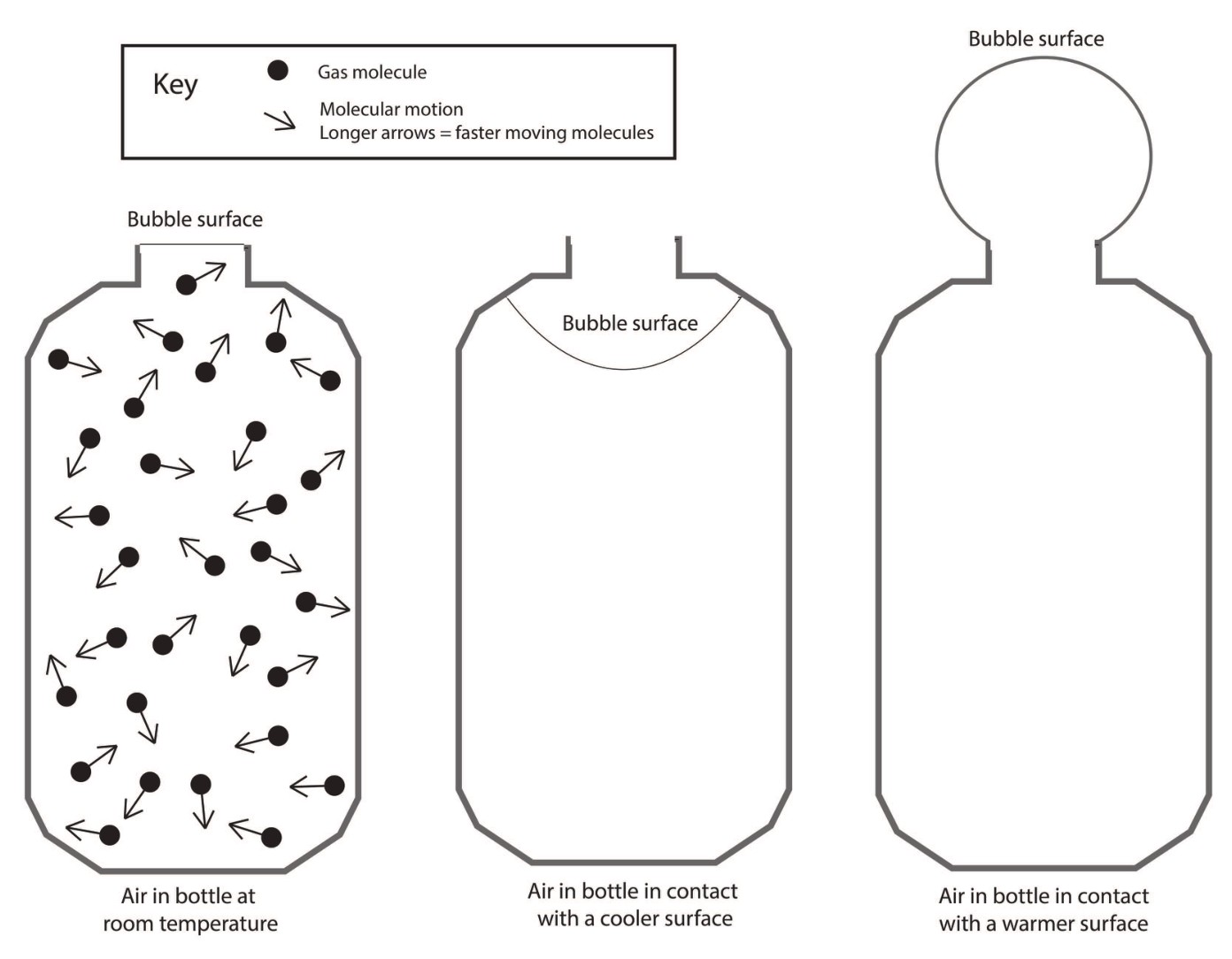
20°C is 293.15 K. A gauge reading of 50 kPa with atmospheric pressure 100 kPa corresponds to 150 kPa absolute.
Pause and explain
Why does zero gauge pressure not mean no gas pressure?
Check your reasoning after answering
It means pressure equals the atmospheric reference. Gas-law equations use pressure relative to vacuum, so the absolute pressure is not zero.
Part 3 · Use the combined law with its assumptions
Absolute pressure is measured relative to vacuum, while gauge pressure is measured relative to the surrounding atmosphere. An ordinary gauge reading of zero therefore does not mean zero molecular collisions or vacuum. In the selected example, a 150 kPa gauge reading with 100 kPa atmosphere corresponds to 250 kPa absolute. Gas-law equations use the absolute pressure; temperature also uses an absolute scale. State both reference conditions rather than treating the printed number on an instrument as automatically suitable.
Read the visual model
Identify the labeled structures and units, then trace the arrows or compare values under the caption’s stated conditions. Separate the displayed evidence from a further inference. Write your reasoning before opening the guidance.
If the gauge reads 150 kPa and the atmosphere is 100 kPa, what pressure enters the ideal-gas equation?
Visual reasoning — after your attempt
250 kPa absolute, the sum of the gauge reading and atmospheric reference.
For fixed amount of ideal gas, P₁V₁/T₁=P₂V₂/T₂. Solve algebraically before substituting and check whether compression or heating should raise pressure. The equation cannot silently accommodate added gas or a reaction that changes the gas amount.
If both volume and temperature change, account for both ratios. A numerator/denominator reversal can produce a plausible-looking but physically reversed result.
Pause and explain
What physical check helps identify an inverted volume ratio?
Check your reasoning after answering
At fixed temperature and amount, smaller final volume should give greater final pressure, not smaller pressure.
Part 4 · Separate mathematical extrapolation from physical feasibility
The combined gas law relates P, V and T for the same ideal-gas amount before and after a change. Rearranging before substitution helps keep the pressure and temperature ratios in the correct direction. If n changes, include it explicitly through PV=nRT rather than canceling it. A numerical result must also be checked for physical feasibility: condensation, chemical reaction, leakage or container limits can invalidate the simple model. Algebra alone does not establish that an imagined apparatus can realize the states.
Read the visual model
Identify the labeled structures and units, then trace the arrows or compare values under the caption’s stated conditions. Separate the displayed evidence from a further inference. Write your reasoning before opening the guidance.
Why can the combined expression fail when a vessel’s valve releases gas during the change?
Visual reasoning — after your attempt
The amount n is no longer fixed, so it cannot be canceled from the initial and final ideal-gas accounts.
A linear ideal-gas extrapolation is not evidence that an ordinary gas stays gaseous at every predicted temperature. Condensation and nonideal behavior intervene. A calculated endpoint should include phase and material constraints rather than being treated as an experimental instruction.
Predicting a very small ideal volume near absolute zero does not mean a real sample can be compressed or cooled according to the same line indefinitely.
Pause and explain
Why should a gas-law line not be extended without limit?
Check your reasoning after answering
The assumed gas phase, ideal interactions, and physical apparatus conditions eventually fail. The mathematical model has a limited range.
Apply the whole unit · Combine compression and heating
Illustrative ideal gas: P₁=100 kPa,V₁=2.00 L,T₁=300 K; final V₂=1.50 L,T₂=330 K, with amount fixed and pressures absolute.
Your task
Calculate final pressure, show a dimensional and qualitative check, and explain why the result would change if gas escaped or if gauge pressure were used incorrectly.
What your response should show
- Choose the appropriate chemical model or relationship and state its conditions.
- Show substitutions, units, particle or charge counts, and intermediate reasoning as relevant.
- Use supplied evidence to justify the conclusion; distinguish observation from inference.
- Identify a meaningful limitation, uncertainty, or next measurement.
Response guidance — after your attempt
Solve P₂=P₁(V₁/V₂)(T₂/T₁).
Substitute 100×(2.00/1.50)×(330/300)=146.7 kPa.
Report about 147 kPa with precision limited by the supplied data.
Compression and heating both raise pressure in this model, so a result below 100 kPa would require checking the ratio or assumptions. Gas escape changes n and invalidates the fixed-amount comparison. Gauge pressure is not interchangeable with the supplied absolute pressure. State actual phase and temperature-uniformity conditions for a real sample.
Scientific references and source-model foundations
- OpenStax — gas laws and the ideal-gas model
- OpenSciEd public middle-school source license — CC BY 4.0
Parent / teacher teaching notes
Have students list what stays constant before choosing an equation. Require Kelvin and an expected-trend prediction before arithmetic. Ask the learner to explain each particle symbol, axis, unit and arrow before calculating. Distinguish hypothetical models and calculated curves from measured records. Public OpenSciEd excerpts here are selected foundation prompts, not complete high-school teacher editions or an endorsement. All required advanced explanations and practice are provided locally.
The key idea
Gas-law ratios require fixed quantities to be identified, absolute pressure and kelvin temperature. The combined ideal relation applies to a fixed gas amount within its stated physical domain.
Boyle's Law
P₁V₁ = P₂V₂
constant temperature and amount of gas; P = pressure, V = volume. Pressure and volume are inversely proportional.
Charles's Law
V₁/T₁ = V₂/T₂
constant pressure and amount of gas; T must be in kelvin. Volume is directly proportional to absolute temperature.
Gay-Lussac's Law
P₁/T₁ = P₂/T₂
constant volume and amount of gas; T must be in kelvin. Pressure is directly proportional to absolute temperature.
Combined Gas Law
P₁V₁/T₁ = P₂V₂/T₂
constant amount of gas; T in kelvin. Merges Boyle's, Charles's, and Gay-Lussac's laws into one relationship.
Worked examples
Example 1
- Temperature is constant, so use Boyle's Law: P₁V₁ = P₂V₂.
- Substitute the knowns: (2.0 atm)(4.0 L) = P₂(1.0 L).
- Solve: P₂ = (2.0 × 4.0) / 1.0 = 8.0 atm.
Example 2 · Worked application
- Use P₁V₁=P₂V₂.
- P₂=150×2.0/3.0=100 kPa.
- Expansion at fixed temperature lowers pressure.
The qualitative direction is an independent check.
Example 3
- Convert both temperatures to kelvin: 27 + 273 = 300 K and 127 + 273 = 400 K.
- Pressure is constant, so use Charles's Law: V₁/T₁ = V₂/T₂, giving 1.5/300 = V₂/400.
- Solve: V₂ = 1.5 × (400 / 300) = 2.0 L.
Example 4 · Find and fix the mistake
- Test the claim against the stated conditions: The qualitative direction is an independent check.
- At fixed temperature and amount, pressure is inversely proportional to volume.
The qualitative direction is an independent check.
Example 5 · Reason from the visual model
- Absolute pressure is measured relative to vacuum, while gauge pressure is measured relative to the surrounding atmosphere. An ordinary gauge reading of zero therefore does not mean zero molecular collisions or vacuum. In the selected example, a 150 kPa gauge reading with 100 kPa atmosphere corresponds to 250 kPa absolute. Gas-law equations use the absolute pressure; temperature also uses an absolute scale. State both reference conditions rather than treating the printed number on an instrument as automatically suitable.
- 250 kPa absolute, the sum of the gauge reading and atmospheric reference.
Original selected pressure-reference example; atmospheric pressure is supplied as 100 kPa rather than asserted as universal.
Avoid these mistakes
- Use absolute pressure and kelvin; Celsius doubling is not absolute-temperature doubling.
Check your understanding
A2L gas at 300 K warms to 450 K at constant P and n. Find volume.
Discuss the answer
V₂=2(450/300)=3L; the larger absolute temperature gives proportionally larger volume.
Return to the phenomenon
Return to the initial case. Why can warming one gas sample increase pressure and another sample’s volume? Revise your drawing or explanation using two named ideas and one stated limitation.
Compare explanations after your attempt
The same temperature change can appear as different macroscopic responses. Use the relevant controlled quantities and absolute scales to choose the gas-law relation.
What should we investigate next?
Which comparison would test a remaining uncertainty? State what you would change, keep comparable and measure.
Investigate, calculate and revise
Keep a first model and an evidence-supported revision. Attempt each task before opening guidance; all required explanations and supplied-data routes are available locally.
Activity 1 · Return to the opening case
Use the opening phenomenon, unit definitions and explained Parts 1–4.
Your task
Return to the initial case. Why can warming one gas sample increase pressure and another sample’s volume? Revise your drawing or explanation using two named ideas and one stated limitation.
Success criteria
- Use the stated observations and appropriate units.
- Connect a labeled model with the chemical mechanism.
- State assumptions and an evidence limitation.
- Explain a substantive revision or next test.
Hint
Keep species identity, material transfer and energy account distinct.
Response guidance — discuss after your attempt
The same temperature change can appear as different macroscopic responses. Use the relevant controlled quantities and absolute scales to choose the gas-law relation.
Activity 2 · Transfer to a changed case
Cover the worked answer and use the explained models, relationships and notebook.
Your task
A fixed ideal-gas amount occupies 3.00 L at 100 kPa absolute and 300 K. Find its volume at 150 kPa and 350 K, and name one model limitation.
Success criteria
- Use the stated measurements or conditions, with correct units.
- Connect the result to the chemical mechanism or evidence relationship.
- Identify the assumption, model limit or further evidence requested.
Hint
Name known quantities and conditions, show intermediate steps and check conservation.
Response guidance — discuss after your attempt
V₂=3.00(100/150)(350/300)=2.33 L. Assume the same gas amount and ideal behavior; leakage, reaction or condensation would require another account.
Words to know
- Boyle's Law
- At constant temperature, the pressure and volume of a fixed amount of gas are inversely proportional: P₁V₁ = P₂V₂.
- Charles's Law
- At constant pressure, the volume of a fixed amount of gas is directly proportional to its Kelvin temperature: V₁/T₁ = V₂/T₂.
- Gay-Lussac's Law
- At constant volume, the pressure of a fixed amount of gas is directly proportional to its Kelvin temperature: P₁/T₁ = P₂/T₂.
- combined gas law
- A single relationship that merges the three individual laws: P₁V₁/T₁ = P₂V₂/T₂.
- Kelvin scale
- An absolute temperature scale whose zero point (0 K) is absolute zero; K = °C + 273.15.
- absolute zero
- The lowest possible temperature, 0 K (about −273°C), where particle motion is at its theoretical minimum.
- pressure
- The force per unit area exerted by gas particles colliding with the walls of their container; measured in atm, kPa, mmHg, or torr.
How a graph revealed absolute zero
When early scientists plotted the volume of a gas against its Celsius temperature and drew the line, they noticed every gas gave a straight line that, extended backward, hit zero volume at about −273°C. Different gases, different starting points — yet all the lines pointed to the same impossible floor, a temperature so cold a gas would shrink to nothing. That shared vanishing point had to be the coldest temperature possible, absolute zero, and it is exactly why William Thomson (Lord Kelvin) built a new temperature scale starting there. The gas laws didn't just use the Kelvin scale; they helped discover it.
Robert Boyle and the birth of the experiment
In 1662, Robert Boyle trapped a pocket of air in the sealed short arm of a J-shaped tube and poured mercury into the long arm to squeeze it. By carefully measuring how the trapped volume shrank as he added weight, he showed pressure and volume trade off in exact inverse proportion — one of the first physical laws pinned down by deliberate, quantitative experiment rather than pure reasoning. Boyle is often called a father of modern chemistry, and in France the same relationship is still credited to Edme Mariotte, who found it independently.
Why your tire-pressure light blinks on the first cold morning
Ever notice the low-tire warning glow after the season's first cold snap, even with no leak? That is Gay-Lussac's Law in your driveway. A tire is essentially a rigid, fixed-volume container, so when the overnight temperature plunges, the air inside cools, its molecules slow down, and the pressure drops — roughly 1 psi for every 10°F of cooling. Nothing escaped; the gas just pushes less hard when it is cold, and it climbs right back up once you drive and warm the tires.
The weather balloon that starts wrinkly and bursts fat
A weather balloon looks almost comically under-filled at launch — floppy and half-empty. That is deliberate Boyle's Law engineering. As the balloon climbs into the thin upper atmosphere, the outside pressure drops toward almost nothing, so the helium inside expands enormously, swelling the balloon to many times its launch size. By about 30 kilometers up the stretched latex finally can't take it and bursts, and the instrument package parachutes back to Earth.
The most common mistake: forgetting kelvin
Here is the error that wrecks more gas-law answers than any other: leaving temperature in Celsius. Suppose a gas at 27°C is heated to 54°C — the Celsius number doubled, so the volume doubles, right? Wrong. Convert first: 27°C is 300 K and 54°C is 327 K, a rise of only 9%, so the volume grows by just 9%, not 100%. The Celsius scale's arbitrary zero quietly poisons every ratio; always convert to kelvin before you divide, never after.
In the real world
Scuba divers live by these laws: as they descend, higher water pressure shrinks the air in their lungs and gear (Boyle's Law), which is why they must never hold their breath while rising — the expanding gas could rupture a lung.
Exit check
A2L gas at 300 K warms to 450 K at constant P and n. Find volume.
Check your explanation after answering
V₂=2(450/300)=3L; the larger absolute temperature gives proportionally larger volume.
Explain your reasoning without notes. If a key idea is missing, revisit the lesson and try again.
The Ideal Gas Law
Learning goals
- I can use the ideal gas law PV = nRT to solve for pressure, volume, moles, or temperature, choosing the correct value of R.
- I can calculate the molar volume of a gas at STP and use it to convert between moles and liters.
Readings for this unit
Before this unit
Moles, kelvin, pressure units, and rearranging equations.
Use the detailed parent plan: two core 50–60-minute sessions per focused unit, with a third assigned for selected calculation/modeling topics. First study the core explanation and Parts 1–2 with their figures/checks; next study Parts 3–4, the whole-unit application, worked cases, varied practice and exit check. Attempt reasoning before opening guidance. Extend time when actual understanding requires it; investigations and chapter assessments have separate sessions.
Start with something to explain
Does the same gas volume always contain the same number of particles?
Illustrative evidence case. Two equal-size vessels have different absolute pressures or temperatures.
Notice and wonder
Record two observations using the stated quantities or relationships. Keep observations separate from possible causes. Write one question that a new measurement could help answer.
Does the same gas volume always contain the same number of particles?
Your first model
Write the P, V, T and n relationship before equating their entity counts.
Build the language from the idea
- ideal gas law
- The equation PV = nRT, which relates the pressure, volume, moles, and Kelvin temperature of a gas in a single snapshot.
- ideal gas constant (R)
- The proportionality constant in PV = nRT; equal to 0.0821 L·atm/(mol·K), or 8.314 J/(mol·K) in SI units.
- mole (n)
- A count of 6.02 × 10²³ particles; the amount of gas, symbolized n, in the ideal gas law.
- STP
- Standard Temperature and Pressure: 0°C (273 K) and 1 atm, the reference conditions for comparing gases.
- molar volume
- The volume occupied by exactly one mole of a gas; it is 22.4 L at STP for any ideal gas.
- Avogadro's Law
- Equal volumes of gases at the same temperature and pressure contain equal numbers of particles; volume is directly proportional to moles (V ∝ n).
- ideal gas
- A hypothetical gas that perfectly obeys the KMT assumptions; real gases behave most ideally at low pressure and high temperature.
The combined gas law is perfect for a gas that *changes* from one condition to another, but it has a blind spot: it never tells you how *much* gas you actually have. The ideal gas law closes that gap by adding the amount of gas, in moles, right into the equation. In one compact statement — PV = nRT — it ties together all four of a gas's defining quantities: pressure, volume, the number of moles, and the Kelvin temperature. Instead of comparing a 'before' and 'after,' it describes a single gas sample at a single moment.
Each letter earns its place. P is pressure, V is volume, n is the number of moles, T is the Kelvin temperature, and R is the ideal gas constant — the fixed number that makes the units balance. R comes in two common flavors, and picking the right one is half the battle: use R = 0.0821 L·atm/(mol·K) when pressure is in atmospheres and volume is in liters, or R = 8.314 J/(mol·K) when you are working in SI energy units. Match your units to your R, and the arithmetic takes care of itself.
Solving with PV = nRT follows a dependable rhythm. Decide which of the four variables you are missing, rearrange the equation to isolate it, and substitute — always with temperature in kelvin and units matched to your R. Want pressure? P = nRT/V. Want the number of moles hiding in a tank? n = PV/RT. Because the law describes one snapshot, you do not need a 'before' and 'after' at all; you just need three of the four quantities to find the fourth.
An ideal gas at 273.15 K and 1 atm has molar volume approximately 22.4 L/mol using the stated constants. Some standard-condition conventions instead use 100 kPa, giving a different value, so always state pressure and temperature rather than rely on the initials STP alone. Molar volume is a condition-dependent bridge between amount and gas volume, not the definition of a mole or a fixed value at room temperature.
Why should oxygen, helium, and carbon dioxide — molecules of wildly different mass — all crowd into the same 22.4 liters? The answer is Avogadro's Law: equal volumes of gases at the same temperature and pressure contain equal *numbers* of particles. What fills space is not the mass of the molecules but how many of them there are and how fast they move, and PV = nRT depends only on the count n, never on the identity of the gas. That is why the 'n' in the equation, not the chemical formula, is what matters.
One honest caveat rounds out the picture: no gas is truly ideal. Real molecules do take up a little space, and they do feel faint attractions for one another — the very assumptions KMT ignores. Those effects are negligible under everyday conditions, so the ideal gas law is an excellent approximation for the gases you will meet. But squeeze a gas to very high pressure or chill it toward its boiling point at very low temperature, and the molecules get close enough that their volume and attractions start to matter, and real gases begin to drift away from the law's tidy predictions. That drift is exactly where the next topic — the forces between molecules — takes over.
Model check: 22.4L/mol assumes about 273 K and 1atm; it is not universal at room temperature. V=nRT/P=24.63L in the ideal model. Match R to atmosphere and liter units.
Build your understanding
Use the detailed parent plan: two core 50–60-minute sessions per focused unit, with a third assigned for selected calculation/modeling topics. First study the core explanation and Parts 1–2 with their figures/checks; next study Parts 3–4, the whole-unit application, worked cases, varied practice and exit check. Attempt reasoning before opening guidance. Extend time when actual understanding requires it; investigations and chapter assessments have separate sessions.
Part 1 · Connect all four gas variables
The ideal gas law PV=nRT relates pressure, volume, amount and absolute temperature. The value of R depends on the unit representation: 0.0821 L·atm/(mol·K) is compatible with liters and atmospheres, while 8.314 J/(mol·K) matches pascals and cubic meters through Pa·m³=J. Using kPa and liters requires the corresponding consistent form. A correct equation with mismatched input units gives a wrong result, so cancel units before relying on the calculator display.
Read the visual model
Identify the labeled structures and units, then trace the arrows or compare values under the caption’s stated conditions. Separate the displayed evidence from a further inference. Write your reasoning before opening the guidance.
Why can inserting liters into an SI Pa–m³ calculation create a factor-of-1000 error?
Visual reasoning — after your attempt
One liter is 0.001 m³. The volume must match the R and pressure unit system before substitution.
PV=nRT links pressure, volume, amount, and absolute temperature for the ideal model. Choose R with units matching P and V. The equation is a relation among state variables, not a statement that every gas always behaves ideally. List each supplied quantity before rearranging.
For R=0.08206 L·atm·mol⁻¹·K⁻¹, use liters, atmospheres, moles, and Kelvin. Mixing kPa with that R without conversion produces a unit mismatch.
Pause and explain
How do you choose the value and units of R?
Check your reasoning after answering
Choose a consistent unit set for pressure and volume and use the matching gas constant. Verify units cancel to the requested quantity.
Part 2 · Solve for amount and use molar mass separately
Solving PV=nRT for n provides mole amount, not mass. To obtain mass, use the named gas’s molar mass afterward. Samples of different ideal gases with the same P, V and T have equal mole amounts in this model but can weigh differently because their molecules have different masses. A molar-volume shortcut is valid only at its stated pressure and temperature; “one mole is 22.4 L” is not a definition of the mole and is not universal.
Read the visual model
Identify the labeled structures and units, then trace the arrows or compare values under the caption’s stated conditions. Separate the displayed evidence from a further inference. Write your reasoning before opening the guidance.
Would replacing the gas by a heavier species at the same ideal P, V and T change n or its mass?
Visual reasoning — after your attempt
The calculated n stays the same, while mass changes with molar mass.
Amount n=PV/RT can be converted to mass using m=nM. Gas identity enters through molar mass for this conversion; ideal-gas volume at fixed P,T,n does not directly depend on molecular mass. Specify purity before using one molar mass for a sample.
Two gases with one mole each at the same ideal P and T occupy equal volumes despite different masses.
Pause and explain
Does a heavier gas always occupy greater volume at the same ideal amount, pressure, and temperature?
Check your reasoning after answering
No. Ideal volume depends on n,T,P, not molar mass. The corresponding mass differs between species.
Part 3 · Derive density rather than memorize a disconnected rule
Substituting n=m/Mₘ into the ideal gas law gives ρ=PMₘ/(RT). Gas density therefore depends on pressure and temperature as well as chemical identity. Rearranging to Mₘ=ρRT/P can estimate a molar mass when the sample is sufficiently ideal and its composition is appropriate. A mixture’s result can represent an average rather than one pure species. State the gas conditions and uncertainty before interpreting a density as unique substance identification.
Read the visual model
Identify the labeled structures and units, then trace the arrows or compare values under the caption’s stated conditions. Separate the displayed evidence from a further inference. Write your reasoning before opening the guidance.
If temperature increases at fixed pressure for the same ideal gas, what happens to its density?
Visual reasoning — after your attempt
It decreases inversely with absolute temperature because the amount per volume decreases under the model.
Substitute n=m/M into PV=nRT to obtain density m/V=PM/RT. This shows how pressure, temperature, and identity affect ideal gas density. The expression needs consistent units and conditions; a denser sample does not necessarily imply more moles when volume differs.
At fixed P and T, a larger molar mass gives a larger ideal density. Heating at fixed pressure lowers density in the model.
Pause and explain
Why should density comparisons state temperature and pressure?
Check your reasoning after answering
Both influence m/V in the ideal relation. Unmatched conditions can hide or reverse an identity-based comparison.
Part 4 · Identify nonideal and measurement limits
The compressibility factor Z=PV/(nRT) equals one for an ideal gas. Real intermolecular attractions and finite molecular volume can produce departures, with the direction depending on conditions. A universal claim that real gases always have pressure lower than ideal ignores competing effects. Low density and temperatures sufficiently far from condensation often improve the approximation, but a numerical correction needs relevant data or a more detailed equation of state. Use observed departures to refine the model rather than erase inconvenient points.
Read the visual model
Identify the labeled structures and units, then trace the arrows or compare values under the caption’s stated conditions. Separate the displayed evidence from a further inference. Write your reasoning before opening the guidance.
Why does a Z value different from one not by itself identify a unique chemical species?
Visual reasoning — after your attempt
It records deviation under particular conditions; composition, temperature, density and interactions can all affect the result.
High density and attractions near condensation can cause nonideal behavior. A collection over water includes water-vapor pressure; the target dry-gas pressure is not automatically the total pressure. Leaks and temperature differences also affect inferred amount.
If total pressure is 100 kPa with supplied water-vapor pressure 3 kPa, the dry gas contributes 97 kPa in the partial-pressure model.
Pause and explain
Why can using total wet-gas pressure overestimate dry-gas amount?
Check your reasoning after answering
The total includes water vapor. Assigning all pressure to the target gas incorrectly attributes the vapor’s contribution to that gas.
Apply the whole unit · Calculate gas amount and mass
Illustrative dry ideal CO₂ sample: P=1.00 atm,V=2.46 L,T=300 K. Use R=0.08206 L·atm·mol⁻¹·K⁻¹ and M(CO₂)=44.0 g/mol.
Your task
Calculate moles, mass, and density, show unit cancellation, and explain what would need adjustment if the same record described gas collected over water.
What your response should show
- Choose the appropriate chemical model or relationship and state its conditions.
- Show substitutions, units, particle or charge counts, and intermediate reasoning as relevant.
- Use supplied evidence to justify the conclusion; distinguish observation from inference.
- Identify a meaningful limitation, uncertainty, or next measurement.
Response guidance — after your attempt
n=PV/RT=2.46/(0.08206×300)≈0.0999 mol.
m=nM≈4.40 g.
Density=m/V≈1.79 g/L.
The amount is about 0.100 mol and mass about 4.40 g under the dry ideal-gas assumption. Use unrounded n for subsequent arithmetic. For wet collection, subtract the supplied water-vapor partial pressure before assigning P to CO₂; no correction can be calculated without that additional value. Purity and temperature equilibrium also matter.
Scientific references and source-model foundations
Parent / teacher teaching notes
Require units on R and a dry/wet gas distinction. Use supplied records rather than improvised gas-generation or pressure equipment. Ask the learner to explain each particle symbol, axis, unit and arrow before calculating. Distinguish hypothetical models and calculated curves from measured records. Public OpenSciEd excerpts here are selected foundation prompts, not complete high-school teacher editions or an endorsement. All required advanced explanations and practice are provided locally.
The key idea
PV=nRT connects an ideal gas’s absolute pressure, volume, amount and temperature using compatible units. Molar volume depends on the stated pressure and temperature; 22.4 L/mol is an approximate 273.15 K, 1 atm value.
Ideal Gas Law
PV = nRT
P = pressure, V = volume, n = moles, R = ideal gas constant, T = kelvin temperature.
Ideal Gas Constant (R)
R = 0.0821 L·atm/(mol·K)
use with P in atm, V in liters, T in kelvin; R = 8.314 J/(mol·K) when working in SI units (Pa, m³).
Molar Volume at STP
1 mol of gas = 22.4 L at STP
STP = 0°C (273 K) and 1 atm; volume (L) = moles × 22.4, and moles = volume ÷ 22.4.
Avogadro's Law
V₁/n₁ = V₂/n₂
at constant temperature and pressure, volume is directly proportional to the number of moles of gas.
Gas Density & Molar Mass
M = (m·R·T)/(P·V) or density = M ÷ 22.4 (at STP)
M = molar mass (g/mol), m = sample mass (g); lets you find a gas's molar mass from a measured sample or its STP density.
Worked examples
Example 1
- Solve PV = nRT for volume: V = nRT/P.
- Use R = 0.0821 L·atm/(mol·K) since pressure is in atm: V = (2.0 × 0.0821 × 300) / 1.0.
- V = 49.26 / 1.0 ≈ 49.3 L.
Example 2 · Worked application
- Rearrange V=nRT/P.
- V=0.50×8.31×300/100=12.465 L.
- Round to about two significant figures.
Match the units of pressure and R.
Example 3
- At STP, one mole of any ideal gas occupies 22.4 L (the molar volume).
- Multiply moles by the molar volume: 0.50 mol × 22.4 L/mol.
- = 11.2 L.
Example 4 · Find and fix the mistake
- Test the claim against the stated conditions: Match the units of pressure and R.
- R has unit-dependent numerical forms; choose one compatible with all quantities.
Match the units of pressure and R.
Example 5 · Reason from the visual model
- Substituting n=m/Mₘ into the ideal gas law gives ρ=PMₘ/(RT). Gas density therefore depends on pressure and temperature as well as chemical identity. Rearranging to Mₘ=ρRT/P can estimate a molar mass when the sample is sufficiently ideal and its composition is appropriate. A mixture’s result can represent an average rather than one pure species. State the gas conditions and uncertainty before interpreting a density as unique substance identification.
- It decreases inversely with absolute temperature because the amount per volume decreases under the model.
Original algebraic derivation; it does not assume liquid density follows the same temperature law.
Avoid these mistakes
- 22.4L/mol assumes about 273 K and 1atm; it is not universal at room temperature.
Check your understanding
Find V for 1 mol at 300 K and 1atm using R=.0821.
Discuss the answer
V=nRT/P=24.63L in the ideal model. Match R to atmosphere and liter units.
Return to the phenomenon
Return to the initial case. Does the same gas volume always contain the same number of particles? Revise your drawing or explanation using two named ideas and one stated limitation.
Compare explanations after your attempt
Equal volume alone is insufficient. Equal ideal-gas P, V and T gives equal mole amount; changing pressure or temperature changes the amount compatible with that volume.
What should we investigate next?
Which comparison would test a remaining uncertainty? State what you would change, keep comparable and measure.
Investigate, calculate and revise
Keep a first model and an evidence-supported revision. Attempt each task before opening guidance; all required explanations and supplied-data routes are available locally.
Activity 1 · Return to the opening case
Use the opening phenomenon, unit definitions and explained Parts 1–4.
Your task
Return to the initial case. Does the same gas volume always contain the same number of particles? Revise your drawing or explanation using two named ideas and one stated limitation.
Success criteria
- Use the stated observations and appropriate units.
- Connect a labeled model with the chemical mechanism.
- State assumptions and an evidence limitation.
- Explain a substantive revision or next test.
Hint
Keep species identity, material transfer and energy account distinct.
Response guidance — discuss after your attempt
Equal volume alone is insufficient. Equal ideal-gas P, V and T gives equal mole amount; changing pressure or temperature changes the amount compatible with that volume.
Activity 2 · Transfer to a changed case
Cover the worked answer and use the explained models, relationships and notebook.
Your task
A gas has density 1.20 g/L at 300 K and 1.00 atm. Using R=0.0821 L·atm/(mol·K), estimate molar mass and explain why identity remains uncertain.
Success criteria
- Use the stated measurements or conditions, with correct units.
- Connect the result to the chemical mechanism or evidence relationship.
- Identify the assumption, model limit or further evidence requested.
Hint
Name known quantities and conditions, show intermediate steps and check conservation.
Response guidance — discuss after your attempt
Mₘ=ρRT/P=1.20×0.0821×300/1.00≈29.6 g/mol. The estimate assumes ideal behavior and suitable composition; several substances or mixtures can have a similar average molar mass.
Words to know
- ideal gas law
- The equation PV = nRT, which relates the pressure, volume, moles, and Kelvin temperature of a gas in a single snapshot.
- ideal gas constant (R)
- The proportionality constant in PV = nRT; equal to 0.0821 L·atm/(mol·K), or 8.314 J/(mol·K) in SI units.
- mole (n)
- A count of 6.02 × 10²³ particles; the amount of gas, symbolized n, in the ideal gas law.
- STP
- Standard Temperature and Pressure: 0°C (273 K) and 1 atm, the reference conditions for comparing gases.
- molar volume
- The volume occupied by exactly one mole of a gas; it is 22.4 L at STP for any ideal gas.
- Avogadro's Law
- Equal volumes of gases at the same temperature and pressure contain equal numbers of particles; volume is directly proportional to moles (V ∝ n).
- ideal gas
- A hypothetical gas that perfectly obeys the KMT assumptions; real gases behave most ideally at low pressure and high temperature.
The idea nobody believed for fifty years
In 1811, the Italian scientist Amedeo Avogadro proposed that equal volumes of any gases, at the same temperature and pressure, hold equal numbers of particles. It was exactly right — and almost entirely ignored for half a century, partly because chemists couldn't accept that elements like oxygen traveled as two-atom molecules. Not until Stanislao Cannizzaro championed the idea at the 1860 Karlsruhe Congress did it finally take hold, untangling decades of confusion about atomic weights. The 'n' in PV = nRT rests on an insight that was correct long before the world was ready for it.
What 22.4 liters actually looks like — and the fine print
One mole of gas at STP fills 22.4 liters, which is bigger than it sounds: picture a cube about 28 cm on each side, roughly the volume of three basketballs. Inside that space swarm 6.02 × 10²³ molecules, whatever the gas. But read the fine print — that magic number only holds at STP (0°C and 1 atm). Warm the same mole to room temperature and it swells to about 24.5 liters, so 22.4 L is a reference point, not a universal constant to plug in everywhere.
Where the constant R actually comes from
Why is R the same number for helium, oxygen, and carbon dioxide alike? Because it is built from two of nature's most fundamental constants: R = N_A × k_B, Avogadro's number multiplied by the Boltzmann constant. Boltzmann's constant links the energy of a single particle to temperature; multiply by how many particles are in a mole and you get the energy behavior of a mole. That is why R is called the universal gas constant — it doesn't care what the gas is made of, only how many particles are moving and how warm they are.
Collecting a gas over water in the lab
When a reaction produces a gas, chemists often catch it by bubbling it up into an inverted jar of water — but the gas you collect is never pure. It shares the space with water vapor, and by Dalton's Law of partial pressures, the total pressure is the gas plus the water vapor added together. To find the true amount of your gas with PV = nRT, you have to look up the water's vapor pressure at that temperature and subtract it out first. It is a neat reminder that in the real world, gases mix and share the pressure.
When the ideal gas law starts to lie
PV = nRT rests on two convenient fictions: that molecules take up no space and never attract one another. Under everyday conditions those lies are harmless, but crank the pressure very high or the temperature very low and the molecules crowd close enough that their real volume and their mutual attractions suddenly matter. Johannes van der Waals fixed this with a corrected equation that adds a term for the space molecules occupy and a term for the pull between them. That pull is precisely the intermolecular forces of the next topic — the reason every real gas eventually condenses into a liquid.
In the real world
Automobile airbags use the ideal gas law by design: engineers calculate exactly how many moles of nitrogen gas a chemical reaction must release to inflate the bag to the right volume and pressure in a few thousandths of a second.
Exit check
Find V for 1 mol at 300 K and 1atm using R=.0821.
Check your explanation after answering
V=nRT/P=24.63L in the ideal model. Match R to atmosphere and liter units.
Explain your reasoning without notes. If a key idea is missing, revisit the lesson and try again.
Intermolecular Forces
Learning goals
- I can identify the intermolecular forces present in a substance: London dispersion, dipole-dipole, and hydrogen bonding.
- I can use the relative strength of intermolecular forces to compare boiling points, melting points, and related properties.
Readings for this unit
Before this unit
Polarity and temporary/induced dipoles.
Use the detailed parent plan: two core 50–60-minute sessions per focused unit, with a third assigned for selected calculation/modeling topics. First study the core explanation and Parts 1–2 with their figures/checks; next study Parts 3–4, the whole-unit application, worked cases, varied practice and exit check. Attempt reasoning before opening guidance. Extend time when actual understanding requires it; investigations and chapter assessments have separate sessions.
Start with something to explain
What holds a nonpolar molecular liquid together?
Illustrative evidence case. A selected nonpolar substance condenses even though its isolated molecules have no permanent net dipole.
Notice and wonder
Record two observations using the stated quantities or relationships. Keep observations separate from possible causes. Write one question that a new measurement could help answer.
What holds a nonpolar molecular liquid together?
Your first model
Draw a possible fluctuating electron distribution and distinguish it from ionic charge.
Build the language from the idea
- intermolecular forces (IMFs)
- The attractions between separate molecules, as opposed to the much stronger bonds within a molecule.
- London dispersion forces
- Weak attractions present in ALL molecules, caused by fleeting, temporary dipoles from shifting electrons; stronger in larger molecules with more electrons.
- dipole-dipole forces
- Attractions between the permanently positive end of one polar molecule and the negative end of another.
- hydrogen bonding
- An especially strong dipole-dipole attraction that forms when hydrogen is bonded to N, O, or F and is drawn to a lone pair on the N, O, or F of a neighboring molecule.
- polarity
- An uneven sharing of electrons that leaves a molecule with a positive end and a negative end (a dipole).
- polarizability
- How easily a molecule's electron cloud can be distorted; larger, electron-rich clouds are more polarizable and give stronger dispersion forces.
There are two very different kinds of 'sticking together' in chemistry, and confusing them causes no end of trouble. Inside a molecule, atoms are held by strong chemical bonds — the covalent bonds that make an H₂O molecule, for instance. Between one molecule and its neighbors act much weaker attractions called intermolecular forces (IMFs). Weak though they are, IMFs are the quiet decision-makers of the physical world: they determine whether a substance is a gas, liquid, or solid at room temperature, how high its boiling and melting points are, how thick and syrupy it is, and how strong its surface tension is. When a pot of water boils, it is these IMFs breaking apart — not the sturdy O–H bonds, which survive untouched.
A molecular interaction present even without permanent polarity is London dispersion forces, and here is their surprising feature — all molecular species can exhibit dispersion, including nonpolar molecules without a permanent net dipole. At any instant the electrons in a molecule can slosh slightly to one side, creating a fleeting, temporary dipole that induces a matching dipole in a neighbor, and for a moment they attract. The more electrons a molecule has, and the larger and more polarizable its electron cloud, the stronger these forces grow. That single trend explains why, going down the halogen column, F₂ and Cl₂ are gases, Br₂ is a liquid, and I₂ is a solid at room temperature: same type of force, steadily more of it.
Dipole-dipole forces appear in polar molecules, which carry a permanent positive end and a permanent negative end because their electrons are shared unevenly. These molecules line up so that opposite ends attract, through electric charge-distribution interactions, and for molecules of similar size these contributions add to dispersion; their relative importance depends on the species and orientation. It is why a polar molecule generally boils at a higher temperature than a nonpolar molecule of comparable mass — there is an extra electrical grip to overcome before the molecules can fly apart into a gas.
The standout of the three is hydrogen bonding, a particularly important interaction with a specific donor/acceptor context in common introductory examples. For the usual school N/O/F examples, a hydrogen atom must be bonded directly to one of the three most electronegative atoms — nitrogen, oxygen, or fluorine — and that hydrogen must then be attracted to a lone pair on the N, O, or F of another molecule. When those conditions are met, the attraction is remarkably strong for an IMF. This is the secret behind water's strange and life-giving behavior: an unusually high boiling point for such a small molecule, a solid form (ice) that floats because hydrogen bonds hold the molecules in an open, lower-density lattice, and a surface tension strong enough for insects to walk on.
Property comparisons should combine dispersion, permanent polarity, hydrogen-bond context, size, shape and phase. A simple hydrogen-bonding > dipole > dispersion slogan does not rank every real pair: accumulated dispersion can be substantial, and crystal packing strongly affects melting. Stronger relevant attraction often raises the energy needed for molecular separation in a matched comparison, but a single category label cannot set every boiling point, viscosity or solubility.
Comparing real substances shows the idea in action. At ordinary atmospheric pressure, water (H₂O) boils near 100°C while methane (CH₄), of nearly identical mass, boils at −161°C — because water hydrogen-bonds and methane has only weak dispersion forces. Even two molecules with the *same* formula can differ dramatically: ethanol (C₂H₅OH) has an O–H group and boils at 78°C, while dimethyl ether (CH₃OCH₃), the same atoms rearranged with no O–H, lacks an O–H donor and boils near −24°C at ordinary atmospheric pressure; its oxygen can still accept suitable hydrogen-bond interactions. Reading boiling points like this makes IMFs a detective's tool. And it closes the loop with the rest of this unit: intermolecular forces are exactly the attractions an 'ideal' gas is assumed to lack, which is why gases with weak IMFs behave most ideally and why real-gas phase behavior depends on temperature, pressure and interactions; above the critical temperature, compression alone does not cross an ordinary liquid–gas coexistence boundary.
Model check: Hydrogen bonding is not simply every bond containing H; ordinary boiling does not break covalent molecules apart. All particles have dispersion attractions; larger polarizable electron clouds can produce substantial attraction.
Build your understanding
Use the detailed parent plan: two core 50–60-minute sessions per focused unit, with a third assigned for selected calculation/modeling topics. First study the core explanation and Parts 1–2 with their figures/checks; next study Parts 3–4, the whole-unit application, worked cases, varied practice and exit check. Attempt reasoning before opening guidance. Extend time when actual understanding requires it; investigations and chapter assessments have separate sessions.
Part 1 · Separate internal bonds from intermolecular attractions
An intramolecular bond connects atoms within a molecule, while intermolecular forces act between molecules. Boiling a molecular liquid generally overcomes enough between-molecule attraction to form vapor without breaking every internal covalent bond. A dotted line often marks an intermolecular interaction, but its meaning must be stated in a caption. Chemical decomposition at high temperature is a different process that can occur under other conditions. Keep species identity and the physical transition separate before explaining the energy required.
Read the visual model
Identify the labeled structures and units, then trace the arrows or compare values under the caption’s stated conditions. Separate the displayed evidence from a further inference. Write your reasoning before opening the guidance.
Does boiling pure molecular water normally turn each H₂O molecule into H and O atoms?
Visual reasoning — after your attempt
No. Vaporization changes the arrangement and interactions between water molecules; splitting their covalent bonds is a different chemical process.
Intermolecular forces act between molecules, while covalent bonds hold atoms within many molecules. Melting or boiling a molecular substance commonly changes intermolecular organization without decomposing the molecules. Ionic and network solids require different structural accounts, so not every solid can be described with isolated-molecule attractions.
Boiling liquid ethanol normally retains ethanol molecules. Breaking its C–O or C–C bonds would be a chemical process.
Pause and explain
Which interactions mainly change during ordinary molecular boiling?
Check your reasoning after answering
Intermolecular attractions and organization change; the molecules’ internal covalent connectivity usually remains intact.
Part 2 · Include dispersion in every molecular comparison
London dispersion arises from correlated fluctuations in electron distributions and is present in molecular substances, including nonpolar ones. Polarizability describes how readily a distribution is distorted; size and electron structure influence it. Molecular shape also affects how neighboring structures approach. Permanent dipole interactions can add to dispersion rather than replace it. A larger molar mass often accompanies stronger dispersion in a matched family, but mass alone is not the mechanism or a universal boiling-point rule.
Read the visual model
Identify the labeled structures and units, then trace the arrows or compare values under the caption’s stated conditions. Separate the displayed evidence from a further inference. Write your reasoning before opening the guidance.
Why can a nonpolar molecular liquid still have a boiling point above absolute zero?
Visual reasoning — after your attempt
Its molecules still attract through dispersion; lack of a permanent net dipole does not eliminate intermolecular interactions.
London dispersion arises from fluctuating electron distributions and exists in all atoms and molecules. Larger polarizability and suitable contact surfaces can strengthen it. Nonpolar does not mean no attractions, and a large nonpolar molecule can boil higher than a small polar molecule.
Compare related molecules using size and shape as well as permanent dipoles. One polarity label cannot replace a complete interaction comparison.
Pause and explain
Why do nonpolar substances still condense?
Check your reasoning after answering
They experience dispersion attractions. Permanent dipoles are not required for intermolecular attraction or condensed phases.
Part 3 · Identify hydrogen-bonding partners correctly
In common introductory examples, hydrogen bonding involves a hydrogen covalently attached to N, O or F interacting with a suitable neighboring electron-rich region. Water can supply O–H donors and oxygen acceptor sites. A molecule containing any hydrogen atom is not automatically a hydrogen-bond donor, and some molecules accept without donating. Hydrogen bonding is an intermolecular interaction here, distinct from the O–H covalent bond inside water; geometry and chemical context affect its strength.
Read the visual model
Identify the labeled structures and units, then trace the arrows or compare values under the caption’s stated conditions. Separate the displayed evidence from a further inference. Write your reasoning before opening the guidance.
Why does simply finding H atoms in CH₄ not establish the same hydrogen-bond donor pattern as water?
Visual reasoning — after your attempt
Methane’s hydrogens are bonded to carbon, not the strongly polar N–H, O–H or F–H donor pattern used in this introductory comparison.
In common introductory molecular examples, a suitable donor has H covalently bonded to N,O,or F, and an acceptor has an available lone pair. Hydrogen bonding is an attraction involving neighboring sites, not a covalent H bond within one formula. Donor and acceptor capacity can differ.
An ether oxygen can accept hydrogen bonds from water even though the ether lacks an O–H donor. Structure matters more than merely containing H and O.
Pause and explain
Can an oxygen-containing molecule accept without donating hydrogen bonds?
Check your reasoning after answering
Yes. An available oxygen lone pair can accept, while donation requires a suitable bonded hydrogen site in the introductory model.
Part 4 · Make conditional property predictions
Boiling point, viscosity and solubility depend on collective interactions and the state being compared. Stronger attractions can raise the energy needed for molecular separation in a matched comparison, but different shapes, sizes and bonding networks complicate simple rankings. Like dissolves like is a starting heuristic, not a complete free-energy calculation. For dissolving, compare interactions disrupted and formed and the entropy contribution. Use relevant experimental data to test a prediction rather than treating one functional-group label as an exact property value.
Read the visual model
Identify the labeled structures and units, then trace the arrows or compare values under the caption’s stated conditions. Separate the displayed evidence from a further inference. Write your reasoning before opening the guidance.
Why can counting hydrogen-bond sites alone fail to rank every pair of boiling points?
Visual reasoning — after your attempt
Other interactions, molecular size/shape, pressure and the actual structural context also affect the phase behavior.
Stronger relevant attractions often raise boiling temperature for otherwise comparable molecules. Solubility also depends on disrupting solute and solvent interactions and forming new ones, alongside entropy. Compare a stated property at stated conditions rather than treating one interaction ranking as universal.
A polar functional group can improve water interaction, but a long nonpolar chain may reduce overall water solubility. Actual measurements test the balance.
Pause and explain
Why can a polar group not guarantee high water solubility?
Check your reasoning after answering
The whole structure and balance of solute/solvent interactions matter; a large nonpolar region and other effects can outweigh one polar site.
Apply the whole unit · Compare alcohol and ether structures
Illustrative molecules: ethanol CH₃CH₂OH and dimethyl ether CH₃OCH₃ have the same formula C₂H₆O. Use their supplied connectivity and compare pure-molecule interaction types.
Your task
Identify dispersion, polar interactions, and hydrogen-bond donor/acceptor roles; predict which has stronger self hydrogen bonding, and explain why the same formula alone cannot establish identical boiling behavior.
What your response should show
- Choose the appropriate chemical model or relationship and state its conditions.
- Show substitutions, units, particle or charge counts, and intermediate reasoning as relevant.
- Use supplied evidence to justify the conclusion; distinguish observation from inference.
- Identify a meaningful limitation, uncertainty, or next measurement.
Response guidance — after your attempt
Both have electrons and therefore dispersion attractions.
Ethanol has O–H and oxygen lone pairs, supporting donor and acceptor roles.
Dimethyl ether has an oxygen acceptor site but no O–H donor.
Compare pure self-interactions rather than assuming water is present.
Ethanol supports stronger self hydrogen-bonding networks in this comparison and is expected to have the higher boiling temperature. Dimethyl ether can accept hydrogen bonds from suitable partners such as water but lacks its own O–H donor. Shared formula and molar mass do not establish identical structure or interactions; reference data can test the prediction.
Scientific references and source-model foundations
Parent / teacher teaching notes
Ask students to circle donor bonds and mark acceptor lone-pair sites. Separate pure-substance interactions from interactions after mixing with a solvent. Ask the learner to explain each particle symbol, axis, unit and arrow before calculating. Distinguish hypothetical models and calculated curves from measured records. Public OpenSciEd excerpts here are selected foundation prompts, not complete high-school teacher editions or an endorsement. All required advanced explanations and practice are provided locally.
The key idea
Dispersion, permanent-dipole interactions and suitable hydrogen-bonding contexts contribute to molecular behavior. Compare the full structure, size, shape and conditions rather than use one universal force-strength or melting-point ranking.
Worked examples
Example 1
- All three are nonpolar diatomic molecules, so their only intermolecular force is London dispersion.
- Dispersion forces grow stronger with more electrons and larger, more polarizable electron clouds; molecular size increases F₂ < Cl₂ < Br₂.
- Stronger dispersion forces mean a higher boiling point, so the order matches the size order.
Example 2 · Worked application
- Boiling requires overcoming intermolecular attractions.
- Hydrogen bonding can add relatively strong attractions in suitable molecules.
- Stronger attractions often require higher temperature for a given vapor pressure.
Molecular size and shape can change the result; do not use one factor as a universal ranking.
Example 3
- Ethanol has an O–H group, so its molecules can hydrogen-bond to one another.
- Dimethyl ether has its oxygen between two carbons (no O–H), so it cannot hydrogen-bond — only weaker dipole-dipole and dispersion forces act.
- Stronger intermolecular forces raise the boiling point, so ethanol boils higher.
Example 4 · Find and fix the mistake
- Test the claim against the stated conditions: Molecular size and shape can change the result; do not use one factor as a universal ranking.
- Ordinary boiling separates molecules without generally changing their covalent identities.
Molecular size and shape can change the result; do not use one factor as a universal ranking.
Example 5 · Reason from the visual model
- In common introductory examples, hydrogen bonding involves a hydrogen covalently attached to N, O or F interacting with a suitable neighboring electron-rich region. Water can supply O–H donors and oxygen acceptor sites. A molecule containing any hydrogen atom is not automatically a hydrogen-bond donor, and some molecules accept without donating. Hydrogen bonding is an intermolecular interaction here, distinct from the O–H covalent bond inside water; geometry and chemical context affect its strength.
- Methane’s hydrogens are bonded to carbon, not the strongly polar N–H, O–H or F–H donor pattern used in this introductory comparison.
Original selected water-pair interaction. The dotted line is a qualitative hydrogen-bond connection, not an extra covalent bond or measured angle.
Avoid these mistakes
- Hydrogen bonding is not simply every bond containing H; ordinary boiling does not break covalent molecules apart.
Check your understanding
Why can nonpolar molecules still condense?
Discuss the answer
All particles have dispersion attractions; larger polarizable electron clouds can produce substantial attraction.
Return to the phenomenon
Return to the initial case. What holds a nonpolar molecular liquid together? Revise your drawing or explanation using two named ideas and one stated limitation.
Compare explanations after your attempt
Correlated instantaneous and induced distortions produce dispersion attractions. Permanent polarity is not required, and the molecular structure remains distinct from the between-molecule interaction.
What should we investigate next?
Which comparison would test a remaining uncertainty? State what you would change, keep comparable and measure.
Investigate, calculate and revise
Keep a first model and an evidence-supported revision. Attempt each task before opening guidance; all required explanations and supplied-data routes are available locally.
Activity 1 · Return to the opening case
Use the opening phenomenon, unit definitions and explained Parts 1–4.
Your task
Return to the initial case. What holds a nonpolar molecular liquid together? Revise your drawing or explanation using two named ideas and one stated limitation.
Success criteria
- Use the stated observations and appropriate units.
- Connect a labeled model with the chemical mechanism.
- State assumptions and an evidence limitation.
- Explain a substantive revision or next test.
Hint
Keep species identity, material transfer and energy account distinct.
Response guidance — discuss after your attempt
Correlated instantaneous and induced distortions produce dispersion attractions. Permanent polarity is not required, and the molecular structure remains distinct from the between-molecule interaction.
Activity 2 · Transfer to a changed case
Cover the worked answer and use the explained models, relationships and notebook.
Your task
A student says a nonpolar molecule has no attractions and boiling always breaks covalent bonds. Correct both claims and identify the scale of the relevant interaction.
Success criteria
- Use the stated measurements or conditions, with correct units.
- Connect the result to the chemical mechanism or evidence relationship.
- Identify the assumption, model limit or further evidence requested.
Hint
Name known quantities and conditions, show intermediate steps and check conservation.
Response guidance — discuss after your attempt
Nonpolar molecules still experience dispersion attractions between molecules. Ordinary vaporization of a stable molecular substance mainly changes intermolecular arrangement/interactions, while breaking its internal covalent bonds is a chemical change requiring a different account.
Words to know
- intermolecular forces (IMFs)
- The attractions between separate molecules, as opposed to the much stronger bonds within a molecule.
- London dispersion forces
- Weak attractions present in ALL molecules, caused by fleeting, temporary dipoles from shifting electrons; stronger in larger molecules with more electrons.
- dipole-dipole forces
- Attractions between the permanently positive end of one polar molecule and the negative end of another.
- hydrogen bonding
- An especially strong dipole-dipole attraction that forms when hydrogen is bonded to N, O, or F and is drawn to a lone pair on the N, O, or F of a neighboring molecule.
- polarity
- An uneven sharing of electrons that leaves a molecule with a positive end and a negative end (a dipole).
- polarizability
- How easily a molecule's electron cloud can be distorted; larger, electron-rich clouds are more polarizable and give stronger dispersion forces.
The number-one chemistry mix-up: bonds vs. attractions
When water boils away in a pot, what breaks? Not the water molecules — the sturdy O–H covalent bonds inside each H₂O survive completely intact, which is why steam is still water and not loose hydrogen and oxygen. What actually pulls apart are the far weaker intermolecular forces between separate molecules. The gap in strength is huge: a hydrogen bond is only about a twentieth as strong as the covalent bond it sits next to. Confusing the two — thinking boiling or melting breaks chemical bonds — is the single most common error in this whole unit.
Hydrogen bonds hold your DNA together
The famous double helix of DNA is zipped shut by hydrogen bonds between its base pairs: adenine grips thymine with two hydrogen bonds, and guanine grips cytosine with three. That strength is perfectly tuned — individually the bonds are weak enough that an enzyme can 'unzip' the two strands to copy them, yet collectively, over millions of base pairs, they are strong enough to keep your genetic code stable for a lifetime. The same hydrogen bonds fold proteins into the precise shapes that let them do their jobs. Life quite literally runs on intermolecular forces.
Everything strange about water traces to one force
Water breaks the rules for a molecule its size, and hydrogen bonding is behind nearly every oddity. It is why ice floats — the hydrogen bonds lock frozen water into an open, lower-density lattice, so lakes freeze from the top down and fish survive the winter beneath. It gives water an enormous capacity to soak up heat, which moderates Earth's climate, and a surface tension strong enough for a water strider to walk across a pond. That same clinginess even lets water climb the inside of the tallest trees, hauling itself up to the highest leaves.
Who discovered these invisible forces?
The weak attractions between molecules are named for Johannes van der Waals, the Dutch physicist who, in correcting the ideal gas law, realized real molecules must gently pull on one another — work that won him the 1910 Nobel Prize in Physics. The strongest of them, the hydrogen bond, was identified and named later, by the American chemists Wendell Latimer and Worth Rodebush in 1920, to explain water's peculiar behavior. It is a satisfying loop: the very forces that make the ideal gas law imperfect are the ones that give liquids and solids their character.
Why water beads on a waxed car but soap makes it spread
Splash water on a freshly waxed hood and it pulls itself into tight beads — the hydrogen bonds between water molecules tug inward, minimizing the surface in a display of surface tension. Add a drop of dish soap and the beads instantly collapse and spread flat. Soap molecules are surfactants, with one end that loves water and one end that flees it, so they wedge into the surface and disrupt the water's grip on itself. That same trick is how soap lifts greasy dirt: it surrounds oil droplets that plain water, held together by its own strong forces, simply cannot touch.
In the real world
Geckos climb glass using nothing but London dispersion forces: millions of microscopic hairs on their toes make so much combined contact that these individually feeble forces add up to support the animal's whole weight.
Exit check
Why can nonpolar molecules still condense?
Check your explanation after answering
All particles have dispersion attractions; larger polarizable electron clouds can produce substantial attraction.
Explain your reasoning without notes. If a key idea is missing, revisit the lesson and try again.
Heating Curves & Phase-Change Energy
Learning goals
- I can identify phase-change and temperature-change stages on a heating curve.
- I can add sensible and latent energy contributions with appropriate constants.
Readings for this unit
Before this unit
Energy, temperature, phase changes, and multiplication with units.
Use the detailed parent plan: two core 50–60-minute sessions per focused unit, with a third assigned for selected calculation/modeling topics. First study the core explanation and Parts 1–2 with their figures/checks; next study Parts 3–4, the whole-unit application, worked cases, varied practice and exit check. Attempt reasoning before opening guidance. Extend time when actual understanding requires it; investigations and chapter assessments have separate sessions.
Start with something to explain
Can a thermometer stay steady while the heater keeps transferring energy?
Illustrative evidence case. A selected ice–water mixture melts at nearly constant temperature under fixed pressure.
Notice and wonder
Record two observations using the stated quantities or relationships. Keep observations separate from possible causes. Write one question that a new measurement could help answer.
Can a thermometer stay steady while the heater keeps transferring energy?
Your first model
Track phase fraction separately from temperature and energy input.
Build the language from the idea
- latent heat
- Energy per unit mass for a specified phase change.
- plateau
- A section where temperature remains nearly constant while energy changes phase.
Heating a substance can raise temperature or change its phase. Temperature measures the average kinetic-energy scale of particles; internal energy also includes interactions and other microscopic motion. During melting or boiling at constant pressure, a pure substance can absorb energy while its temperature stays approximately constant.
Within one phase, q = mcΔT estimates transferred heat when specific heat is approximately constant. During a phase change, use q = mL, where L is specific latent heat, or q = nΔHphase when molar phase-change enthalpy is supplied. These are different relationships; a zero ΔT does not mean zero transferred energy.
A heating curve plots temperature against time or supplied energy. Sloping sections correspond to heating within a phase, and plateaus correspond to coexistence during transitions under the chosen conditions. Equal time intervals represent equal energy input only if heating power is constant and heat loss is negligible.
For a multistage calculation, find each contribution and add: warm ice, melt it, warm liquid water, vaporize it, warm vapor if needed. Use a phase-appropriate specific heat and the stated pressure. Water boils near 100°C at 1 atm; changing pressure changes its boiling temperature.
On cooling, energy flows out of the sample. Freezing and condensation release latent energy. The microscopic interpretation is that particles settle into arrangements of lower potential energy, transferring the difference to surroundings. Bonds within water molecules generally remain during these ordinary phase changes.
A real curve may slope through an apparent plateau because of heat loss, impurities, sensor position, or incomplete thermal equilibrium. Compare the ideal model with evidence and report those differences. Use supplied high-temperature data at home rather than boiling sealed containers.
Build your understanding
Use the detailed parent plan: two core 50–60-minute sessions per focused unit, with a third assigned for selected calculation/modeling topics. First study the core explanation and Parts 1–2 with their figures/checks; next study Parts 3–4, the whole-unit application, worked cases, varied practice and exit check. Attempt reasoning before opening guidance. Extend time when actual understanding requires it; investigations and chapter assessments have separate sessions.
Part 1 · Separate warming segments from phase-change segments
A heating curve tracks temperature as energy is supplied under specified pressure and heating conditions. Sloped segments can represent warming within one phase; a plateau can represent coexistence while energy changes phase fraction. Constant temperature does not mean no energy transfer. The selected time trace is qualitative: segment durations depend on mass, heating power and energy requirements. Real mixtures, heat loss and changing pressure can blur or shift transitions, so a flat segment is interpreted using the material and experimental context.
Read the visual model
Identify the labeled structures and units, then trace the arrows or compare values under the caption’s stated conditions. Separate the displayed evidence from a further inference. Write your reasoning before opening the guidance.
Why can energy continue entering a sample during a constant-temperature plateau?
Visual reasoning — after your attempt
It can change the phase fraction and intermolecular energy account rather than increase mean thermal motion represented by temperature.
For a pure substance at fixed pressure, rising heating-curve segments represent temperature changes within a phase. Nearly flat melting or boiling segments can represent phase conversion while energy enters. A time graph’s slope also depends on heater power and losses, so the graph is not solely a property of the substance.
Label phase composition on each segment rather than assuming every flat portion means the heater stopped. Mixtures can change phase over a temperature range.
Pause and explain
What conditions support a sharp phase-change plateau?
Check your reasoning after answering
A suitable pure substance, approximately fixed pressure, and controlled energy transfer support the simple plateau model; real mixtures and uneven heating can differ.
Part 2 · Use specific heat for a temperature change
Specific heat c relates heat transfer to mass and temperature change within a specified phase and range: q=mcΔT. A temperature difference has the same numerical size in kelvin and Celsius, even though absolute-temperature ratios require kelvin. The selected liquid-water approximation uses 4.18 J/(g·°C); c is not identical for ice and vapor or constant over every condition. Include the sign of ΔT and the system boundary, and do not apply this equation to the latent-energy part of a phase transition.
Read the visual model
Identify the labeled structures and units, then trace the arrows or compare values under the caption’s stated conditions. Separate the displayed evidence from a further inference. Write your reasoning before opening the guidance.
Would using ΔT=0 during melting prove the melting energy is zero?
Visual reasoning — after your attempt
No. The sensible-heating relation does not describe the phase-change energy; use the appropriate latent-energy account.
For a segment without phase change, q=mcΔT with the supplied specific heat and conditions. Use ΔT rather than final temperature alone. A Celsius temperature difference has the same numerical size as a Kelvin difference, though absolute gas temperatures need Kelvin.
For 10 g water warming by 20°C with c=4.18 J/g·°C, q=836 J. A phase-change stage must be calculated separately.
Pause and explain
Why cannot q=mcΔT calculate melting energy at constant temperature?
Check your reasoning after answering
ΔT can be zero while phase change still requires energy. Use the supplied latent heat relationship for that stage.
Part 3 · Use latent energy for conversion
A specific latent energy L gives energy per mass for a particular phase change under specified conditions. Near ordinary-pressure melting, water’s fusion value is about 334 J/g. Melting ten grams of ice at its transition therefore needs about 3,340 J even while temperature is nearly constant. Vaporization has a different value, and reverse transitions have the opposite system heat sign. The energy concerns the full phase arrangement, not ordinary cleavage of every O–H covalent bond in the molecules.
Read the visual model
Identify the labeled structures and units, then trace the arrows or compare values under the caption’s stated conditions. Separate the displayed evidence from a further inference. Write your reasoning before opening the guidance.
Which sign describes heat for the sample during freezing if melting the same amount requires +3340 J?
Visual reasoning — after your attempt
Approximately −3340 J for the reverse transition under the corresponding conditions.
For a supplied mass-specific latent heat L, phase-change energy is q=mL. With a molar enthalpy use moles instead. Match the amount unit to the latent-energy unit. Energy may change particle interactions without increasing temperature, so heat input and temperature rise are not equivalent.
Melting 5 g ice with L=334 J/g requires 1670 J in the model, even at constant melting temperature.
Pause and explain
What is the unit check for q=mL?
Check your reasoning after answering
Grams multiply J/g to give joules. A molar latent enthalpy instead requires moles times J/mol.
Part 4 · Add stages and define system signs
A multi-stage energy calculation separates warming, phase conversion and any additional warming after the transition. For ten grams of ice initially at 0°C and liquid water finally at 20°C, add fusion energy and liquid sensible heat. A real heater supplies more than this ideal sample-only sum when the container warms or energy escapes. State starting and final phase, temperature and pressure, then draw an ordered stage account to avoid double-counting or omitting latent energy.
Read the visual model
Identify the labeled structures and units, then trace the arrows or compare values under the caption’s stated conditions. Separate the displayed evidence from a further inference. Write your reasoning before opening the guidance.
Why is mcΔT for liquid water alone insufficient for this ice-to-liquid example?
Visual reasoning — after your attempt
It includes only the final liquid warming, omitting the energy needed to melt the initial ice.
Split a process into warming, conversion, and further warming as needed, then add energy contributions. q is positive for energy absorbed by the chosen sample and negative for released energy. Container heating and losses can require more input than the calculated sample-only amount.
Warming ice to its melting point, melting it, and warming liquid water are three different stages with appropriate constants.
Pause and explain
Why can heater input exceed calculated sample absorption?
Check your reasoning after answering
The container and surroundings can also gain energy, and losses may occur. The sample-only calculation is not a complete apparatus energy account.
Apply the whole unit · Melt ice and warm the liquid
Illustrative sample: 10.0 g ice initially at 0°C melts completely then liquid warms to 20°C. Use Lfus=334 J/g and cwater=4.18 J/g·°C; neglect losses and container heating.
Your task
Sketch the two stages, calculate each energy contribution and total, and explain which part can occur without temperature rise. State how a real heater-input measurement could differ.
What your response should show
- Choose the appropriate chemical model or relationship and state its conditions.
- Show substitutions, units, particle or charge counts, and intermediate reasoning as relevant.
- Use supplied evidence to justify the conclusion; distinguish observation from inference.
- Identify a meaningful limitation, uncertainty, or next measurement.
Response guidance — after your attempt
Melting: q₁=10.0×334=3340 J.
Liquid warming: q₂=10.0×4.18×20=836 J.
Total sample absorption=4176 J≈4.18 kJ with sensible precision.
Melting absorbs energy while temperature remains near 0°C in the stated pure-substance/fixed-pressure model; further input warms the liquid. The positive total describes sample absorption. Actual heater input can exceed it through container heating and environmental loss, so the model should not be mistaken for a measured device efficiency.
Scientific references and source-model foundations
Parent / teacher teaching notes
Require a labeled stage diagram before selecting formulas. Keep mass-specific and molar latent-energy units distinct. Ask the learner to explain each particle symbol, axis, unit and arrow before calculating. Distinguish hypothetical models and calculated curves from measured records. Public OpenSciEd excerpts here are selected foundation prompts, not complete high-school teacher editions or an endorsement. All required advanced explanations and practice are provided locally.
The key idea
Add the energy for each temperature change and each phase change separately.
Worked examples
Example 1
- Melting:10×334=3340 J.
- Warming:10×4.18×20=836 J.
- Add contributions.
Example 2 · Worked application
- Sensible heating: Q=mcΔT=50×4.0×10=2000 J.
- Melting: Q=mL=5×200=1000 J.
- The second process uses phase-change energy rather than temperature change.
Do not apply mcΔT alone to a phase-change plateau.
Example 3
- Energy is still being transferred.
- It largely separates molecules into gas during phase coexistence.
Example 4 · Find and fix the mistake
- Test the claim against the stated conditions: Do not apply mcΔT alone to a phase-change plateau.
- Latent energy can change phase without increasing temperature.
Do not apply mcΔT alone to a phase-change plateau.
Example 5 · Reason from the visual model
- A specific latent energy L gives energy per mass for a particular phase change under specified conditions. Near ordinary-pressure melting, water’s fusion value is about 334 J/g. Melting ten grams of ice at its transition therefore needs about 3,340 J even while temperature is nearly constant. Vaporization has a different value, and reverse transitions have the opposite system heat sign. The energy concerns the full phase arrangement, not ordinary cleavage of every O–H covalent bond in the molecules.
- Approximately −3340 J for the reverse transition under the corresponding conditions.
Original rounded water fusion example; it assumes the starting ice is already at the transition temperature and does not include container or environmental losses.
Avoid these mistakes
- A temperature plateau does not mean heating has stopped.
Check your understanding
Compare sensible and latent heat.
Discuss the answer
Sensible heat changes temperature within a phase; latent heat changes phase at approximately constant temperature under stated conditions.
Return to the phenomenon
Return to the initial case. Can a thermometer stay steady while the heater keeps transferring energy? Revise your drawing or explanation using two named ideas and one stated limitation.
Compare explanations after your attempt
Energy can alter the phase composition at the transition. Divide the full process into latent and sensible stages rather than treating temperature as a direct total-energy meter.
What should we investigate next?
Which comparison would test a remaining uncertainty? State what you would change, keep comparable and measure.
Investigate, calculate and revise
Keep a first model and an evidence-supported revision. Attempt each task before opening guidance; all required explanations and supplied-data routes are available locally.
Activity 1 · Return to the opening case
Use the opening phenomenon, unit definitions and explained Parts 1–4.
Your task
Return to the initial case. Can a thermometer stay steady while the heater keeps transferring energy? Revise your drawing or explanation using two named ideas and one stated limitation.
Success criteria
- Use the stated observations and appropriate units.
- Connect a labeled model with the chemical mechanism.
- State assumptions and an evidence limitation.
- Explain a substantive revision or next test.
Hint
Keep species identity, material transfer and energy account distinct.
Response guidance — discuss after your attempt
Energy can alter the phase composition at the transition. Divide the full process into latent and sensible stages rather than treating temperature as a direct total-energy meter.
Activity 2 · Transfer to a changed case
Cover the worked answer and use the explained models, relationships and notebook.
Your task
For 20.0 g ice already at 0°C, calculate energy to melt it and warm the liquid to 10.0°C. Use Lf=334 J/g and c=4.18 J/(g·°C), neglecting apparatus/losses.
Success criteria
- Use the stated measurements or conditions, with correct units.
- Connect the result to the chemical mechanism or evidence relationship.
- Identify the assumption, model limit or further evidence requested.
Hint
Name known quantities and conditions, show intermediate steps and check conservation.
Response guidance — discuss after your attempt
Melting: 20.0×334=6680 J. Warming: 20.0×4.18×10.0=836 J. Total=7516 J≈7.52 kJ. The sample receives positive heat under the stated boundary.
Words to know
- latent heat
- Energy per unit mass for a specified phase change.
- plateau
- A section where temperature remains nearly constant while energy changes phase.
In the real world
Use the chapter investigation to connect this unit to measured evidence and a practical decision.
Exit check
Compare sensible and latent heat.
Check your explanation after answering
Sensible heat changes temperature within a phase; latent heat changes phase at approximately constant temperature under stated conditions.
Explain your reasoning without notes. If a key idea is missing, revisit the lesson and try again.
Problem 1
Answer and explanation
Any two: particles are in constant random motion; particle volume is negligible; there are no attractions between particles; collisions are perfectly elastic; average kinetic energy is proportional to Kelvin temperature.
KMT assumes gas particles move constantly and randomly in straight lines, take up negligible volume themselves, neither attract nor repel one another (elastic collisions), and have an average kinetic energy directly proportional to the Kelvin temperature.
Problem 2
Answer and explanation
200 K
K = °C + 273 = −73 + 273 = 200 K.
Problem 3
Answer and explanation
1.0 atm
Boyle's Law: P₂ = P₁V₁/V₂ = (4.0 × 2.0)/8.0 = 1.0 atm.
Problem 4
Answer and explanation
1.0 L
Charles's Law: V₂ = V₁ × (T₂/T₁) = 2.0 × (150/300) = 1.0 L.
Problem 5
Answer and explanation
6.0 atm
Gay-Lussac's Law (constant volume): P₂ = P₁ × (T₂/T₁) = 3.0 × (500/250) = 6.0 atm.
Problem 6
Answer and explanation
5.0 L
Combined gas law: V₂ = V₁ × (P₁/P₂) × (T₂/T₁) = 5.0 × (2.0/1.0) × (200/400) = 5.0 × 2 × 0.5 = 5.0 L.
Problem 7
Answer and explanation
0.122 mol
n = PV/RT = (1.5 × 2.0)/(0.0821 × 300) = 3.0/24.63 = 0.122 mol.
Problem 8
Answer and explanation
56.0 L
Volume = moles × molar volume = 2.5 × 22.4 = 56.0 L.
Problem 9
Answer and explanation
47.9 atm
P = nRT/V = (5.0 × 0.0821 × 350)/3.0 = 143.675/3.0 ≈ 47.9 atm.
Problem 10
Answer and explanation
28.0 g/mol — likely N₂ (or CO)
At STP, molar mass = density × molar volume = 1.25 g/L × 22.4 L/mol = 28.0 g/mol. A molar mass of 28 g/mol matches nitrogen gas, N₂ (also carbon monoxide, CO).
Problem 11
Answer and explanation
Br₂ has stronger London dispersion forces, giving it a higher boiling point.
Both molecules have only London dispersion forces. Br₂ is larger with more electrons and a more polarizable electron cloud, so its dispersion forces are stronger. Stronger forces raise the boiling point, making Br₂ a liquid (bp ≈ 59°C) while smaller Cl₂ remains a gas (bp ≈ −34°C).
Problem 12
Answer and explanation
CH₄ < PH₃ < NH₃
CH₄ is nonpolar, so it has only weak London dispersion forces (lowest boiling point). PH₃ is slightly polar with dipole-dipole plus dispersion forces, but phosphorus is not electronegative enough for hydrogen bonding. NH₃ has H bonded to N, so it hydrogen-bonds — the strongest force — giving it the highest boiling point. (Real values: CH₄ ≈ −161°C, PH₃ ≈ −88°C, NH₃ ≈ −33°C.)
Problem 13
Answer and explanation
Energy changes particle arrangements/interactions during phase coexistence rather than mainly raising the kinetic-temperature scale.
Response criteria
- State a scientifically accurate conclusion.
- Show the calculation or mechanism that supports it.
- Include units, conditions, or limits where relevant.
Problem 14
Answer and explanation
The energy ratio is 2 and the characteristic speed ratio √2≈1.41. Kelvin is an absolute scale proportional to this mean energy; Celsius has an offset and its numeric ratios do not express the same physical relation.
The energy ratio is 2 and the characteristic speed ratio √2≈1.41. Kelvin is an absolute scale proportional to this mean energy; Celsius has an offset and its numeric ratios do not express the same physical relation.
Response criteria
- Use the stated measurements or conditions, with correct units.
- Connect the result to the chemical mechanism or evidence relationship.
- Identify the assumption, model limit or further evidence requested.
Problem 15
Answer and explanation
V₂=2(450/300)=3L; the larger absolute temperature gives proportionally larger volume.
Response criteria
- State a scientifically accurate conclusion.
- Show the calculation or mechanism that supports it.
- Include units, conditions, or limits where relevant.
Problem 16
Answer and explanation
V₂=3.00(100/150)(350/300)=2.33 L. Assume the same gas amount and ideal behavior; leakage, reaction or condensation would require another account.
V₂=3.00(100/150)(350/300)=2.33 L. Assume the same gas amount and ideal behavior; leakage, reaction or condensation would require another account.
Response criteria
- Use the stated measurements or conditions, with correct units.
- Connect the result to the chemical mechanism or evidence relationship.
- Identify the assumption, model limit or further evidence requested.
Problem 17
Answer and explanation
V=nRT/P=24.63L in the ideal model. Match R to atmosphere and liter units.
Response criteria
- State a scientifically accurate conclusion.
- Show the calculation or mechanism that supports it.
- Include units, conditions, or limits where relevant.
Problem 18
Answer and explanation
Mₘ=ρRT/P=1.20×0.0821×300/1.00≈29.6 g/mol. The estimate assumes ideal behavior and suitable composition; several substances or mixtures can have a similar average molar mass.
Mₘ=ρRT/P=1.20×0.0821×300/1.00≈29.6 g/mol. The estimate assumes ideal behavior and suitable composition; several substances or mixtures can have a similar average molar mass.
Response criteria
- Use the stated measurements or conditions, with correct units.
- Connect the result to the chemical mechanism or evidence relationship.
- Identify the assumption, model limit or further evidence requested.
Problem 19
Answer and explanation
All particles have dispersion attractions; larger polarizable electron clouds can produce substantial attraction.
Response criteria
- State a scientifically accurate conclusion.
- Show the calculation or mechanism that supports it.
- Include units, conditions, or limits where relevant.
Problem 20
Answer and explanation
Nonpolar molecules still experience dispersion attractions between molecules. Ordinary vaporization of a stable molecular substance mainly changes intermolecular arrangement/interactions, while breaking its internal covalent bonds is a chemical change requiring a different account.
Nonpolar molecules still experience dispersion attractions between molecules. Ordinary vaporization of a stable molecular substance mainly changes intermolecular arrangement/interactions, while breaking its internal covalent bonds is a chemical change requiring a different account.
Response criteria
- Use the stated measurements or conditions, with correct units.
- Connect the result to the chemical mechanism or evidence relationship.
- Identify the assumption, model limit or further evidence requested.
Problem 21
Hints
Write the relationship first; substitute with consistent units.
Answer and explanation
836 J
20×4.18×10.
Problem 22
Answer and explanation
No. Ordinary boiling primarily overcomes intermolecular attractions; the molecules remain H₂O.
Response criteria
- State a scientifically accurate conclusion.
- Show the calculation or mechanism that supports it.
- Include units, conditions, or limits where relevant.
Problem 23
Answer and explanation
Melting: 20.0×334=6680 J. Warming: 20.0×4.18×10.0=836 J. Total=7516 J≈7.52 kJ. The sample receives positive heat under the stated boundary.
Melting: 20.0×334=6680 J. Warming: 20.0×4.18×10.0=836 J. Total=7516 J≈7.52 kJ. The sample receives positive heat under the stated boundary.
Response criteria
- Use the stated measurements or conditions, with correct units.
- Connect the result to the chemical mechanism or evidence relationship.
- Identify the assumption, model limit or further evidence requested.