How the World Got Wired · The Social Graph
The Graph
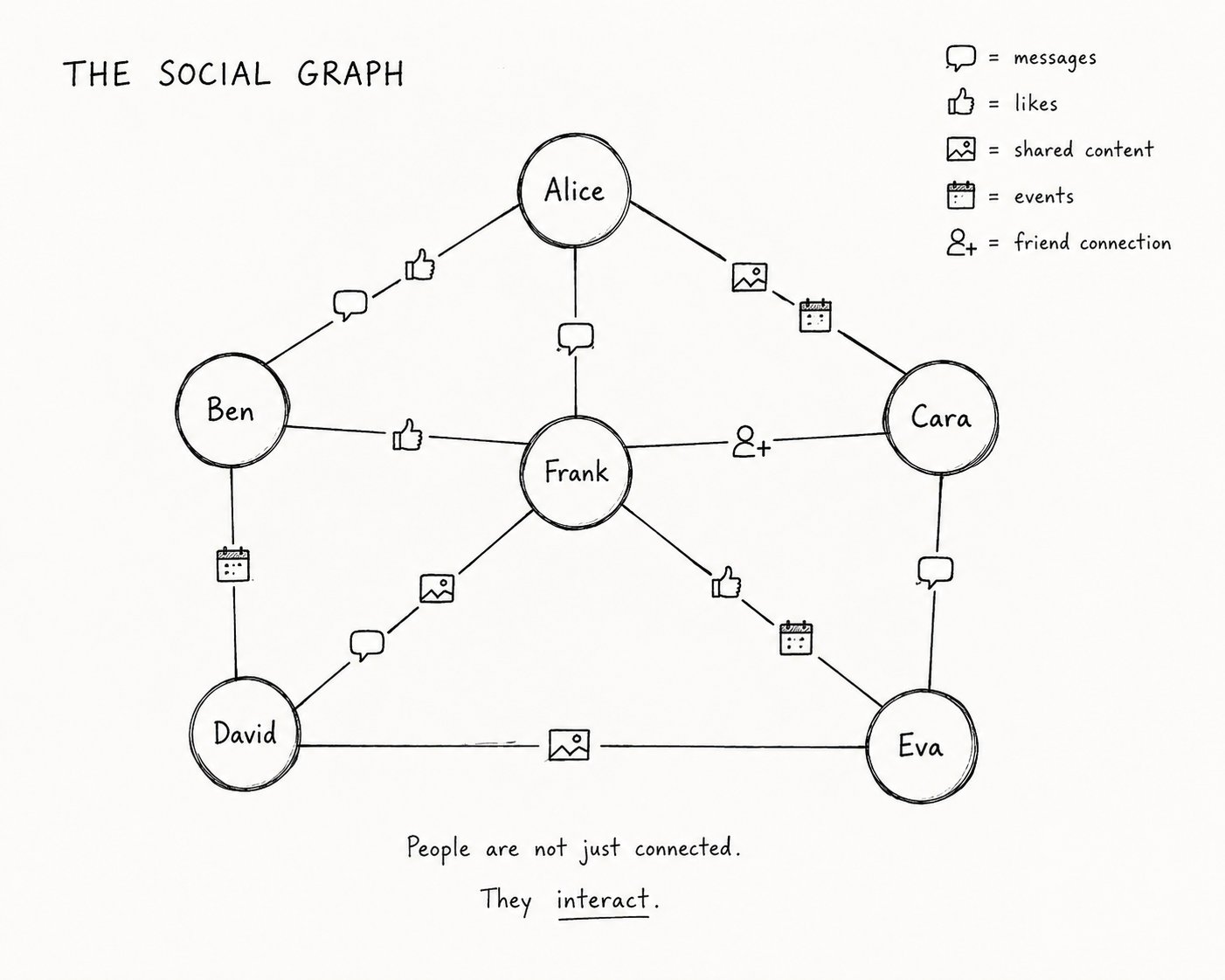
I want to stop and tell you a small fact about technology, because it is the thing that made Facebook valuable and that you should understand.
Computer scientists have a word for a network of people and the connections between them. They call it a graph. In particular, when the network represents friendships and relationships among real people, they call it a social graph.
A social graph is, in its simplest form, just a list. A list of people, and a list of which people are connected to which other people. Alice knows Bob. Bob knows Carol. Carol knows Dave. Dave knows Alice and Eve. That’s a tiny social graph. The graph of a single high school’s worth of friendships is much bigger. The graph of all of humanity’s friendships is, of course, enormous.
For most of human history, the social graph existed only in people’s heads. Each person knew, roughly, who their friends and family were, and who knew whom. There was no central place that recorded this information. There was no map of human relationships.
Facebook, by 2008 or so, had started building exactly that map. As people signed up and friended each other and listed their hometowns and schools and workplaces, an enormous social graph began to take shape inside Facebook’s computers. Within a few years, that graph contained hundreds of millions of people. Within a decade, it contained nearly three billion — close to half of the human race.
This was, by far, the largest and most detailed map of human relationships ever assembled.
You may be wondering why it was worth anything. Why does it matter that a website has a map of who your friends are?
The answer takes us back to the last chapter, where we talked about advertising.
You remember that Google had figured out something extraordinary: people, when they searched, told Google what they wanted to buy. The act of typing running shoes was a kind of confession of intent, and advertisers paid Google enormous amounts of money for the right to put a small ad in front of a person who had just confessed.
Facebook had something even better. Facebook didn’t have to wait for you to type running shoes. Facebook knew, from your profile, that you liked running. It knew, from the pages you’d liked and the photos you’d posted, that you were probably about to need new shoes. It knew, from your friends’ patterns, that people like you, with friends like yours, in cities like yours, tended to buy a certain kind of shoe. And it could show you that shoe’s ad while you were scrolling through baby pictures of your cousin’s wedding, without you having to ask for it at all.
The social graph turned out to be one of the most economically valuable maps ever made. By the late 2010s, two companies — Facebook and Google — together controlled most of the online advertising market in the world. They were earning, between them, hundreds of billions of dollars a year, mostly by knowing extraordinary amounts about the people who used their free products and selling that knowledge, in carefully packaged form, to advertisers who wanted to reach the right people.
All 24 chapters of How the World Got Wired · Library · All courses