How the World Got Wired · The First Message
Labor Day Weekend, 1969
On the Saturday of Labor Day weekend, 1969 — August 30, to be exact — a truck pulled up to a building called Boelter Hall at UCLA, and unloaded a refrigerator-sized metal box. The box was painted a battleship gray. It had cables coming out of one side. It was the first IMP.
The students and professors who had been waiting for it gathered around. They had been preparing for months. The IMP was wheeled into a room on the third floor and plugged into the wall. It was plugged, by a thick cable, into UCLA’s big mainframe computer next door. It was plugged, by a phone line, into the rest of the world.
It hummed.
And then, for almost two months, it did nothing interesting. There was nothing for it to talk to. UCLA’s IMP was the only IMP in the world.
The second IMP arrived at SRI, near Stanford, on the first of October. As soon as it was installed and the phone line between Los Angeles and the Bay Area was switched on, the two IMPs could, for the first time, exchange messages.
And on the night of October 29, 1969, Charley Kline sat down to try.
The Moment
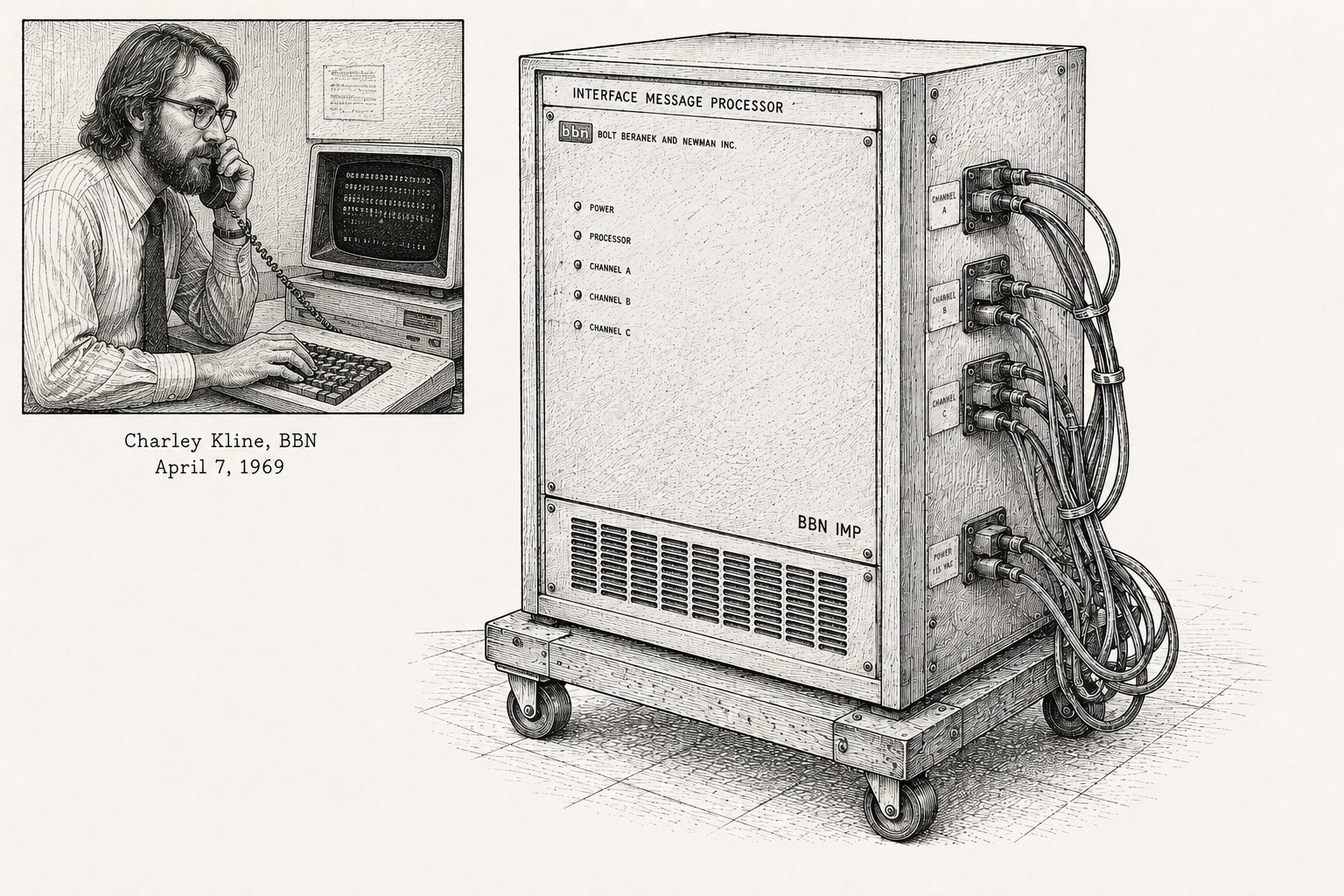
I told you what happened. Kline typed L. Duvall confirmed L. Kline typed O. Duvall confirmed O. Kline typed G. The system crashed.
It crashed because of a bug in the way SRI’s big computer handled incoming text. When Kline typed G, SRI’s computer tried to be helpful — it tried to guess that the rest of the word would be GIN (since LOGIN is what people usually typed) and finish typing for him. But the way it tried to do this overflowed a tiny part of its memory, and the whole thing froze.
Kline and Duvall fixed the bug. By midnight, login worked end to end.
A few weeks later, the third IMP was installed at the University of California in Santa Barbara. In December, the fourth one went in at the University of Utah. By the end of 1969, four computers in four states were talking to each other over a tiny new packet-switched network. The thing had a name now. It was called the ARPANET.
If you had walked into that room at UCLA on the night of October 29, 1969, you would not have seen anything dramatic. A young man typing. A phone call. A blinking light on a gray metal box. There was no party. There were no photographers. The next day’s newspapers said nothing about it. Almost nobody outside of ARPA and a few universities even knew the network existed.
This is something else I want you to remember about how the world gets built. Most of the moments that turn out to matter most do not feel like big moments when they are happening. They feel like a graduate student typing at 10:30 at night, getting a bug, and writing one boring sentence in a notebook. The bigness only comes later, when you look back.
All 24 chapters of How the World Got Wired · Library · All courses