How the World Got Wired · The Day Everything Tipped
The Delay
What was happening, in the offices of NASDAQ — the electronic stock exchange where Netscape was about to begin trading — was a problem so unusual that even the experienced traders didn’t quite know what to do with it.
Hundreds of thousands of buy orders had flooded in overnight. There were almost no sell orders. The price was supposed to be discovered by matching buyers with sellers. But there were no sellers. Almost every single person who had been allowed to buy Netscape shares at $28 the night before — the company’s employees, the bankers’ favored clients, the early investors — wanted to keep their shares. They had a feeling the price was about to go up. So nobody was selling.
You cannot have a stock market with only buyers. Somebody has to sell. So NASDAQ paused, and the bankers spent hours on the phone trying to find people willing to part with their shares — and at what price.
It took almost two hours.
At about 11:00 in the morning, New York time, Netscape’s stock finally began trading.
The first sale was not at $28.
It was at $71.
What That Number Meant
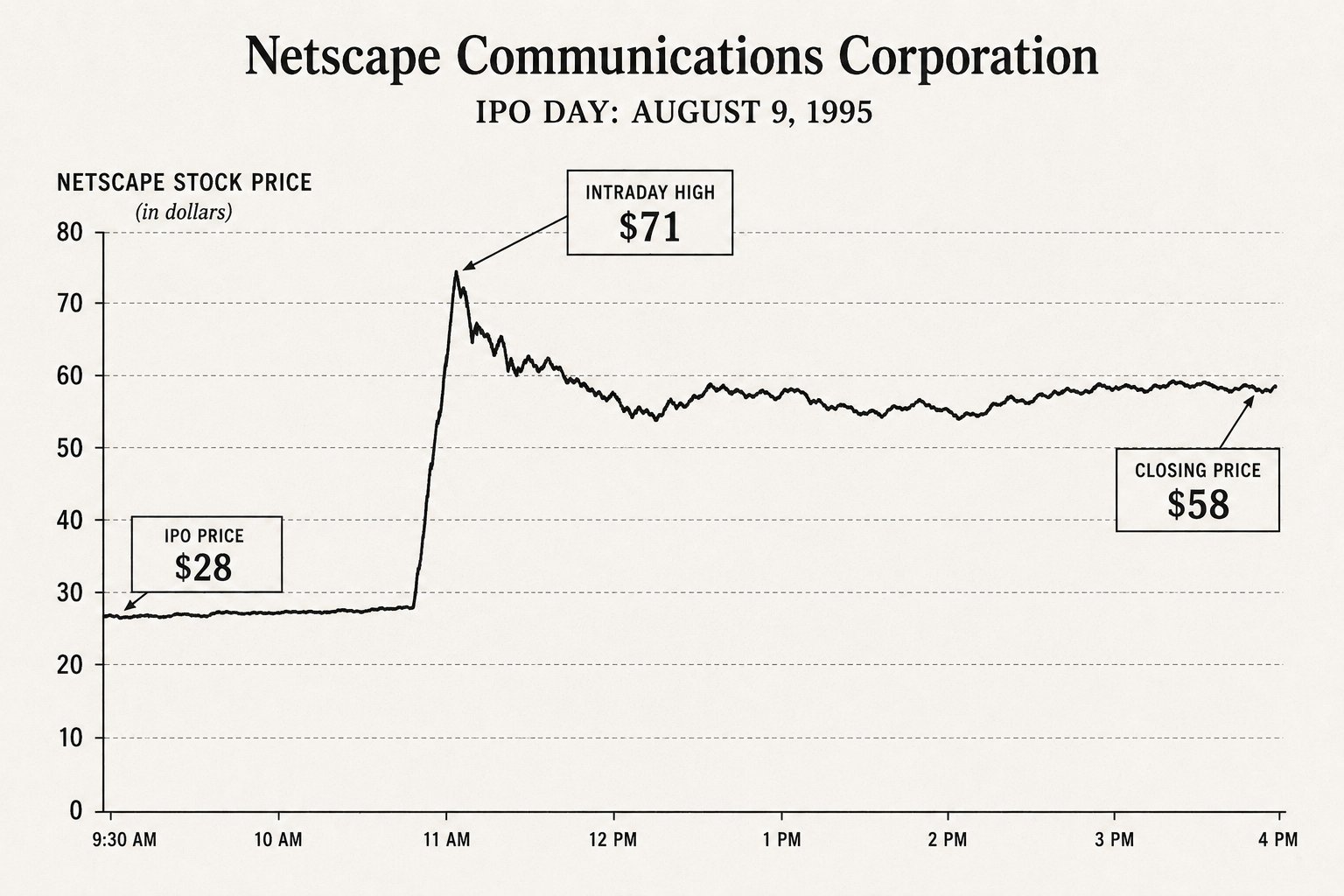
In one and a half hours, before a single share had actually changed hands, the price of Netscape had more than doubled from what insiders had paid the night before — and quintupled from what the bankers had originally planned to charge.
The stock kept rising through the morning. At one point it traded as high as $75. It bounced around, then settled down. By the end of the trading day, Netscape closed at $58.25.
Now multiply that closing price by the number of shares the company had. The math came out to about $2.9 billion.
Netscape — a company that was sixteen months old, that had never earned a profit, that sold a product almost nobody in the financial world had personally used — was now worth, in the opinion of the stock market, more than General Dynamics, which built fighter jets. It was worth more than United Airlines. It was worth more than most companies that had been operating for decades, employing thousands of people, with billions of dollars in revenue.
Marc Andreessen, twenty-four years old, owned about one percent of Netscape. On paper, by the end of the day, he was worth about fifty-eight million dollars.
His co-founder, Jim Clark — the older man who had emailed him in the coffee shop — owned about a quarter of the company. On paper, by the end of the day, he was worth almost seven hundred million dollars.
The original Mosaic engineers from Illinois, who had taken pay cuts and stock options when they moved out to California, were also, suddenly, multimillionaires. The Sequoia-style venture capitalists who had funded the company had multiplied their investment several times over in sixteen months. The bankers at Morgan Stanley earned an enormous fee.
The next morning’s Wall Street Journal called it the most extraordinary stock offering of the decade. Within a few months, Time magazine would put Andreessen on its cover — barefoot, sitting on an ornate velvet throne, with the headline The Golden Geeks. He looked, in the photograph, both like a king and like a kid who had been talked into wearing a costume. He was both.
All 24 chapters of How the World Got Wired · Library · All courses