How the World Got Wired · Mosaic, the Pivot
Mosaic
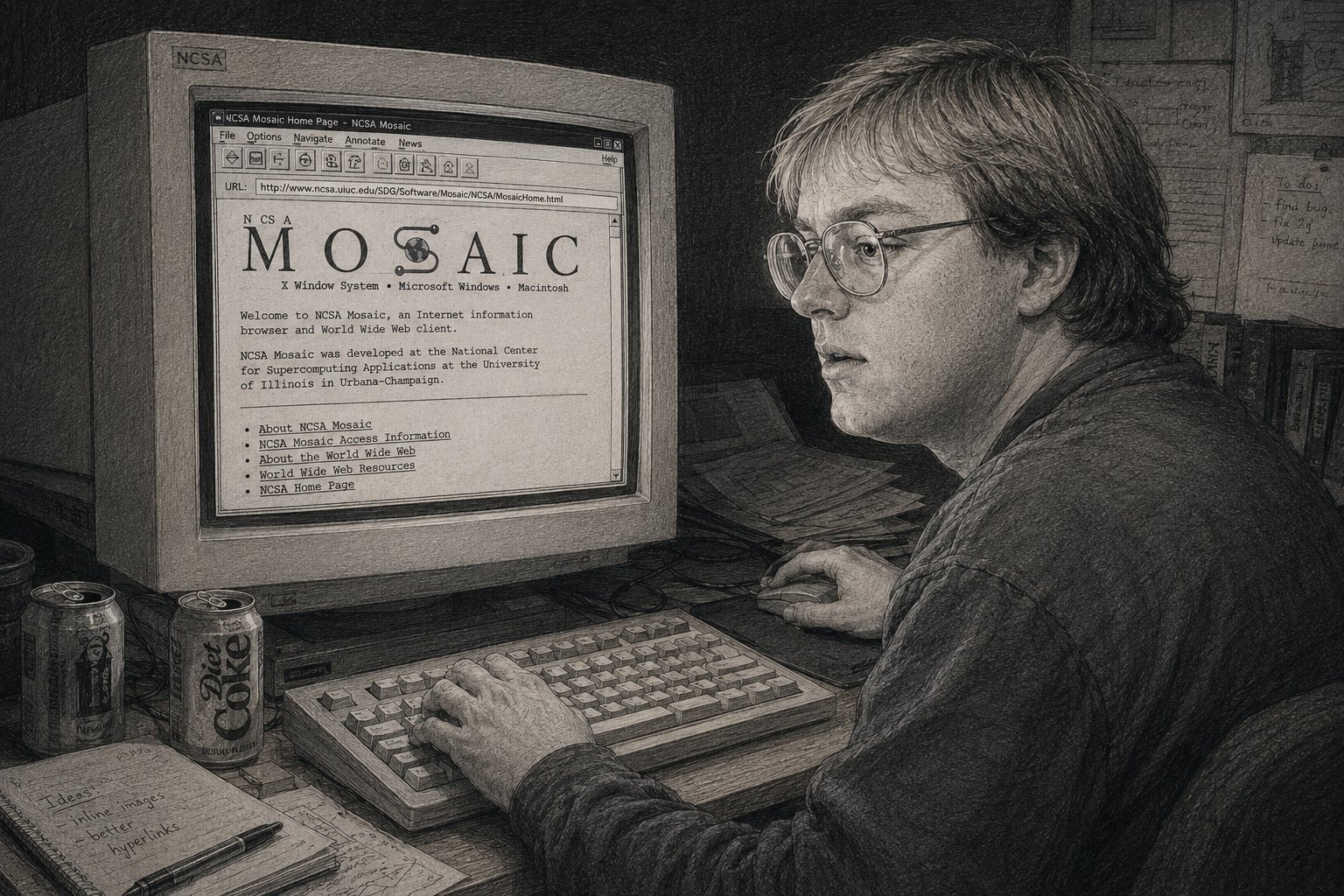
They called their browser Mosaic. The name suggested little pieces — text, images, links — fitted together into one picture. Andreessen did most of the user interface. Bina did most of the underlying engine. They worked, mostly, at night and on weekends, eating bad food and drinking enormous amounts of Coca-Cola.
The first version of Mosaic was released, free, in January of 1993. It ran on Unix. Versions for the Mac and for Windows followed later that year. The whole thing — created by undergraduate and graduate students at a public university, paid for by public money — was given away to anyone who wanted it.
You should be feeling something familiar at this point. This is the same pattern you have seen over and over in this book. The work was paid for by the public. The result was released to the public. Mosaic was free.
What happened next was not the same pattern. What happened next was something new.
Within months of its release, Mosaic was being downloaded by the thousand. By mid-1993, by the tens of thousands. By late 1993, the number of web servers in the world started to grow not by handfuls but by hundreds at a time, because suddenly there was a browser that anyone could install, that ran on any computer, and that showed beautiful pages with pictures. People who had never heard of the web were now setting up their own pages. Newspapers started writing about it. Television news started covering it. The web stopped being a thing scientists used and started being a thing anyone could use.
Andreessen had become, in less than a year, one of the most talked-about people in the small but rapidly growing world of computing. He was twenty-two years old. He had also become a problem for his employer.
The Walk Out
The University of Illinois — which technically owned Mosaic, since Andreessen and Bina had written it as part of their jobs at a public lab — started doing what universities often do when one of their employees creates something enormously valuable. They tried to take control of it.
NCSA management began to bring in more senior staff to run the Mosaic project. They started talking about commercializing it themselves, licensing it to companies for fees. Andreessen, who had created the thing, was politely pushed out of leadership. By the time he graduated, in December of 1993, the project he had started no longer really belonged to him.
He moved to California a few weeks later. He had no job. He had no specific plan. He had a degree in computer science, a small amount of fame in technology circles, and a deep frustration with the way his own university had treated him.
That’s when he got the email.
The email was from a man named Jim Clark. Clark was a Stanford professor turned entrepreneur who had founded a famous company called Silicon Graphics in the 1980s. He had recently left Silicon Graphics, after a falling-out with its board. He was looking for a new idea. He had been following the Mosaic story. He wanted to meet.
Andreessen, twenty-two years old, met Clark, who was about thirty years older, at a coffee shop in Palo Alto. They talked for hours. By the end of the meeting, Clark proposed: let’s start a company. You round up the best engineers from the NCSA Mosaic team. I’ll put up the money. We’ll build a browser that is even better than Mosaic, and we will sell it.
Andreessen said yes.
In April of 1994, Clark and Andreessen founded a company called Mosaic Communications Corporation. They flew several of the original Mosaic engineers — Bina among them — out from Illinois to California, and hired almost the entire NCSA team. The University of Illinois was furious. It sent angry lawyers. Eventually the university and the new company settled, with the company agreeing to pay Illinois several million dollars and to change its name. They renamed it Netscape.
The new browser, Netscape Navigator, was released in December of 1994. It was faster than Mosaic. It was prettier. It had more features. And, unlike Mosaic, you were going to have to pay for it — at least if you were a company. (Netscape gave it away for personal use, which was clever marketing. Almost everyone used it personally, and then the companies they worked for had to license it.)
By the spring of 1995, Netscape Navigator had something like seventy or eighty percent of the entire web-browser market. The thing that had been Mosaic — free, public, given away — had become the thing that was Netscape: a private company growing faster than almost any company in American history.
In August of 1995, less than two years after Andreessen had graduated from college, Netscape decided to sell shares of itself to the public. It was going to do an initial public offering — an IPO. The kind of event you read about in the last chapter.
Nobody knew, going into the morning of August 9, 1995, exactly what would happen. The company had been operating for sixteen months. It had never made a profit. It was selling a product — a web browser — that almost no investor really understood. The original price they planned to sell shares for was $14 each. At the last minute, the bankers running the offering doubled it to $28, because demand seemed so strong.
What happened that day became the defining moment of an entire era.
That’s the next chapter.
All 24 chapters of How the World Got Wired · Library · All courses