How the World Got Wired
Chapter 1 — A Memex and a Satellite
In the summer of 1945, an American scientist named Vannevar Bush sat down to write an essay.
The Second World War had just ended. Bush had spent the previous five years running the most important science office in the United States, called the Office of Scientific Research and Development. He had been the man who told President Franklin Roosevelt, in a famous meeting in 1940, that America needed to start a serious atomic research program — and when Roosevelt agreed, Bush helped make it happen. The bomb that ended the war was, in a sense, his bomb. Or at least, he had helped pay for it.
Now the war was over. Bush was tired. And he was worried.
He was worried about a particular problem that most people did not think was a problem at all. The problem was that science was producing too much information.
Every year, in laboratories around the world, scientists wrote tens of thousands of papers. Each paper described a small new discovery — a new chemical, a new equation, a new way of doing something. The papers were published in journals. The journals piled up in libraries. There were so many papers, in so many journals, in so many libraries, that no human being could possibly read them all. A chemist in Boston might spend years working on a problem that a chemist in Berlin had already solved, and never know it, because the Berlin chemist’s paper was sitting on a shelf in a library nobody had visited.
Bush thought this was a tragedy. So in July of 1945, he wrote an essay called As We May Think, in a magazine called The Atlantic Monthly, and in it he described a machine.
He called the machine the memex.
The Memex
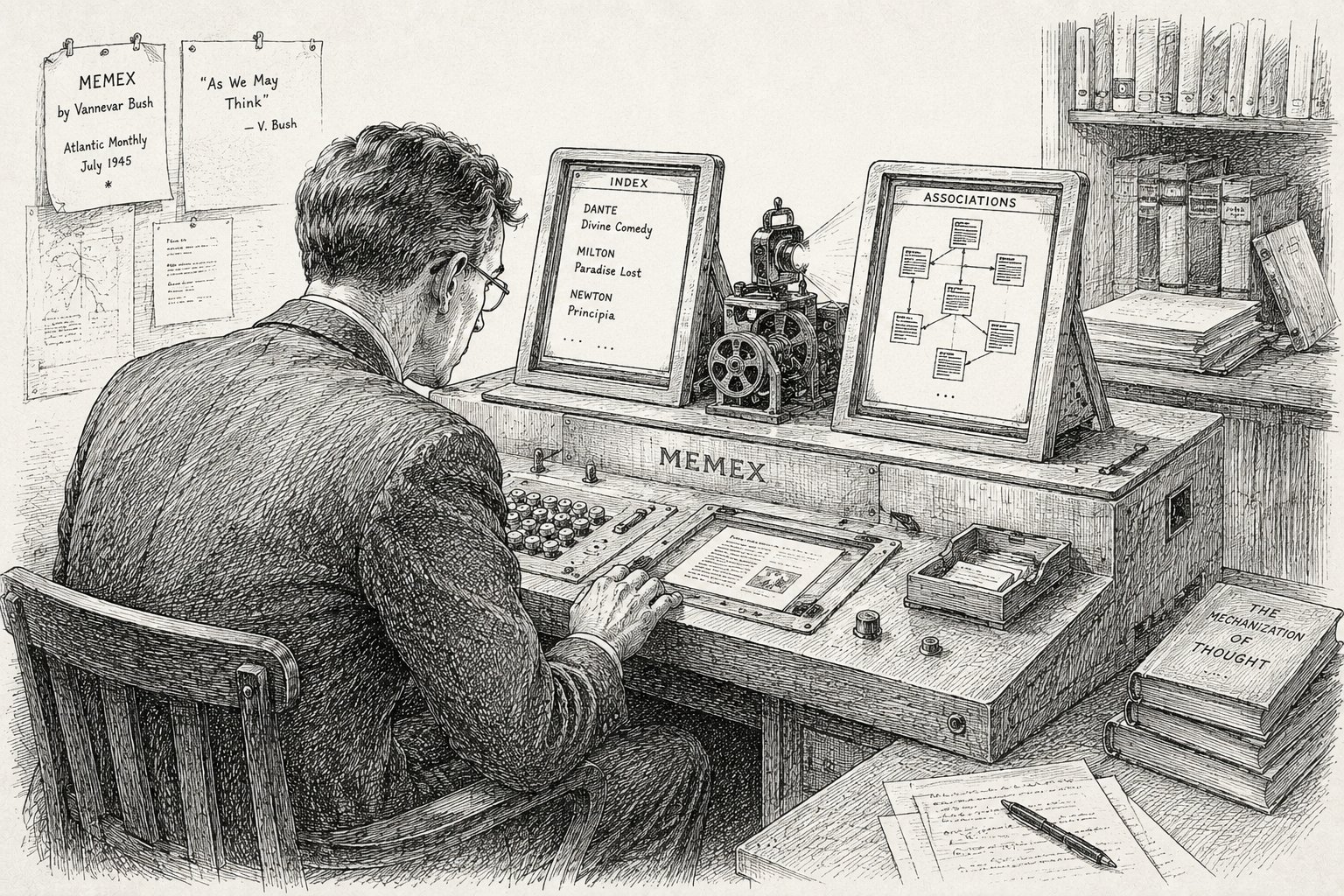
The memex would be the size of a desk. You would sit at it. Inside the desk, on tiny strips of film, would be stored every book, every article, every photograph, every letter you had ever wanted to keep. You would press a button, and the machine would find you any document in a second. That was useful — but it was not the magical part.
The magical part was that you could connect documents to each other.
If you were reading an article about birds, and the article reminded you of a poem you had read years before, you could press a button and link the article to the poem. From then on, anyone using your memex could jump from the article to the poem instantly. Then, if the poem reminded you of a painting in another book, you could link the poem to the painting. Soon you would build up trails — paths of connected ideas, running through everything you had ever read.
You could share your trails with other people. A scientist could share her trail through the chemistry of the human body. A historian could share his trail through a century of letters between two presidents. A child could share her trail through the books that had made her cry.
Knowledge, Bush wrote, would stop being a pile of separate things. It would become a web.
Vannevar Bush never built the memex. The technology of 1945 was not nearly good enough. He was describing a machine that wouldn’t really be possible for another fifty years. But he had drawn a picture of it, in words, in a magazine that a lot of curious young people read. They remembered it. They grew up. Some of them became scientists. And when the time came to build something that actually worked the way Bush had imagined, they remembered the picture.
One of the young people who read Bush’s essay was a man named J.C.R. Licklider.
You’ll meet him in the next chapter.
But before we get to Licklider, we have to talk about a beach ball.
All 24 chapters of How the World Got Wired · Library · All courses