How Cars Work · The Spark
Cutting the current
For all this to work, the current through the primary coil has to be cut off — fast — once per spark. In a 1960s car, this is done by a small mechanical switch called the points. Two metal contacts that touch each other most of the time, but get pulled apart by a small bump on a rotating shaft inside the engine. Touch, current flows, magnetic field builds. Pull apart, current stops, field collapses, twenty thousand volts springs out of the secondary coil.
The shaft that opens and closes the points is driven by the engine itself. Every time the engine rotates, the points click open at exactly the moment one of the cylinders needs a spark. The whole system stays in sync because all of it — the points, the engine, the pistons — is connected to the same rotating parts.
Modern cars use electronic switches with no moving parts. But for sixty years, every spark in every car came from two pieces of metal touching and untouching, dozens of times per second, on a moving rod inside the engine.
Sending it to the right cylinder
There is still a problem. The ignition coil makes one giant pulse of high voltage every time the points open. But the engine has multiple cylinders, each needing a spark in turn. Cylinder 1 needs a spark, then cylinder 3, then cylinder 4, then cylinder 2 (or whatever order — it varies by engine). The pulse from the coil has to be sent to the right spark plug at the right time.
This is the job of the distributor.
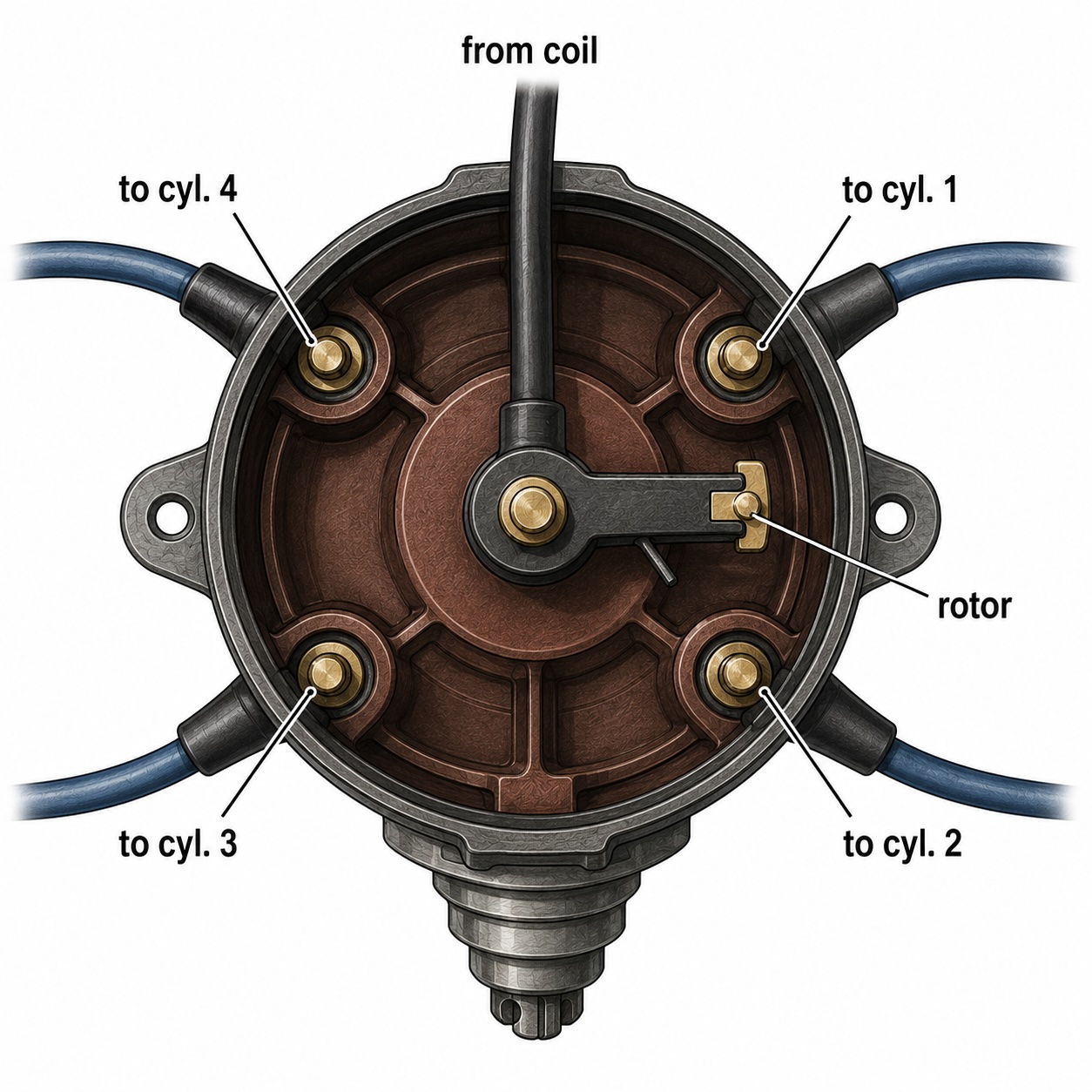
A distributor is a small cylinder that sits on top of the engine, with a rotating arm inside. The arm is called the rotor, and it spins at half the speed of the engine. (Half, because each cylinder fires once every two engine rotations — once per four-stroke cycle.) Around the inside of the cap that covers the rotor, there are little metal contacts — one for each spark plug — and a thick wire runs from each contact to the matching spark plug down in its cylinder.
In the center of the cap, a wire from the ignition coil delivers the twenty-thousand-volt pulse. The pulse comes down the center, jumps a tiny gap onto the rotor, and the rotor — wherever it happens to be pointing at that instant — passes the pulse on to the contact directly under its tip. From there, it shoots down the wire to the right spark plug.
No computer. Just a spinning metal arm, sending electricity to whichever cylinder it happens to be pointing at.