How Cars Work · Stopping and Steering
How the pedal makes it happen
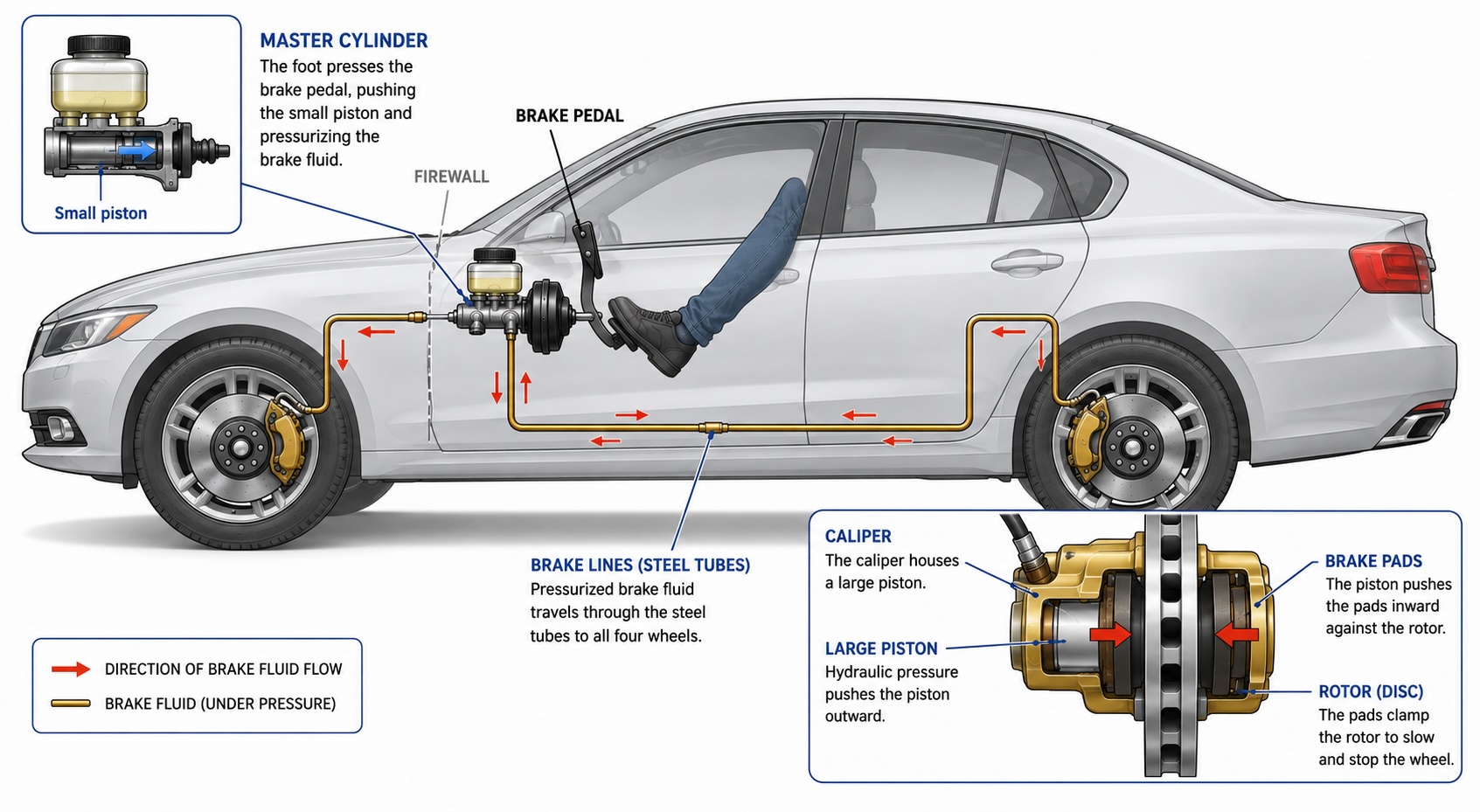
Here is something you might not expect. The brake pedal is not connected to the brakes by a metal rod or a cable. The pedal pushes a piston in a small cylinder full of liquid. The liquid does the rest.
The system is called hydraulic. (From the Greek word for water, although brake fluid isn’t water — it is a special oil that doesn’t boil even when the brakes get hot.)
Here is why the system uses fluid. A liquid sealed inside a tube is almost impossible to compress. If you push one end of the tube with some force, the same force comes out the other end, instantly. Push harder, and exactly that much harder comes out the far end.
But there is a clever trick you can play with hydraulics that you cannot easily play with rods or cables. If the tube widens at one end, the force at the wide end gets multiplied. A small piston pushing into a small cylinder, connected through a tube to a larger cylinder with a bigger piston — push the small piston with five pounds of force, and the big piston pushes out with fifty.
(There is a catch. The big piston moves a much shorter distance than the small one. Just like gears trade speed for force, hydraulics trade distance for force. You don’t get something for nothing. This rule keeps coming back.)
The brake system uses this trick. The driver presses a small piston with her foot. The pressure travels through small steel tubes to four bigger pistons, one at each wheel. Those big pistons push the pads against the rotors. A modest push from a foot becomes a serious clamping force at each wheel.
When the driver lets the pedal back up, springs in each caliper push the pads back away from the rotor. The pressure drops. The fluid retreats through the tubes. The wheels spin free again.
Steering
Stopping is about getting rid of energy. Steering is about geometry.
In a typical car, only the front wheels turn — the rear wheels just follow the path the front sets. The driver controls the front wheels through a chain of mechanical parts.
The steering wheel in the driver’s hands connects to a long shaft called the steering column, which runs down from the wheel to the bottom of the car. At the bottom, a box of gears (or, in newer cars, a clever toothed bar called rack and pinion) converts rotation of the steering wheel into side-to-side motion. From there, a pair of metal arms called tie rods push or pull each front wheel into the angle the steering wheel is asking for.
Turn the steering wheel left, the tie rods pull the front wheels left, and the car follows. Right, same thing in reverse.
There is a geometric subtlety. When a car turns a corner, both front wheels pivot — but they don’t pivot the same amount.
Picture a car making a tight left turn. The left front wheel is on the inside of the curve, taking a tight path. The right front wheel is on the outside, taking a wider path. For the wheels to roll cleanly through the turn without scrubbing sideways, the inside wheel has to pivot at a sharper angle than the outside wheel. (If they both pivoted by the same amount, one of them would be forced to skid sideways through the turn — same problem the differential solved for the rear wheels in the last chapter.)
The steering linkage handles this automatically. The arms that push each wheel are arranged at angles so that turning the steering wheel tilts the inside wheel more than the outside wheel, by exactly the right amount. The driver doesn’t think about it. She turns the wheel, and the right amount of tilt arrives at each front wheel on its own.