Will you live to 120?
Chapter 7 · The Reset
Instead of slowing the damage, what if we erased it — reset an old cell to a young one? It is the most radical idea in aging biology, the one most entangled with cancer, and, as of this writing, the subject of its very first human trial.
Companion notebook · Chapter 7. No separate notebook for this chapter — partial reprogramming rides the same hormesis curve as Chapter 4: a narrow safe window between doing nothing and triggering cancer: Open the Chapter 4 notebook →
Why we stop healing
A child’s scraped knee heals in days, leaving nothing behind. The same scrape on an eighty-year-old heals slowly, sometimes incompletely, sometimes not at all. Somewhere between those two bodies, the capacity to repair itself quietly drained away — and where it went is the subject of this final chapter, and the answer turns out to gather almost everything in the six chapters before it.
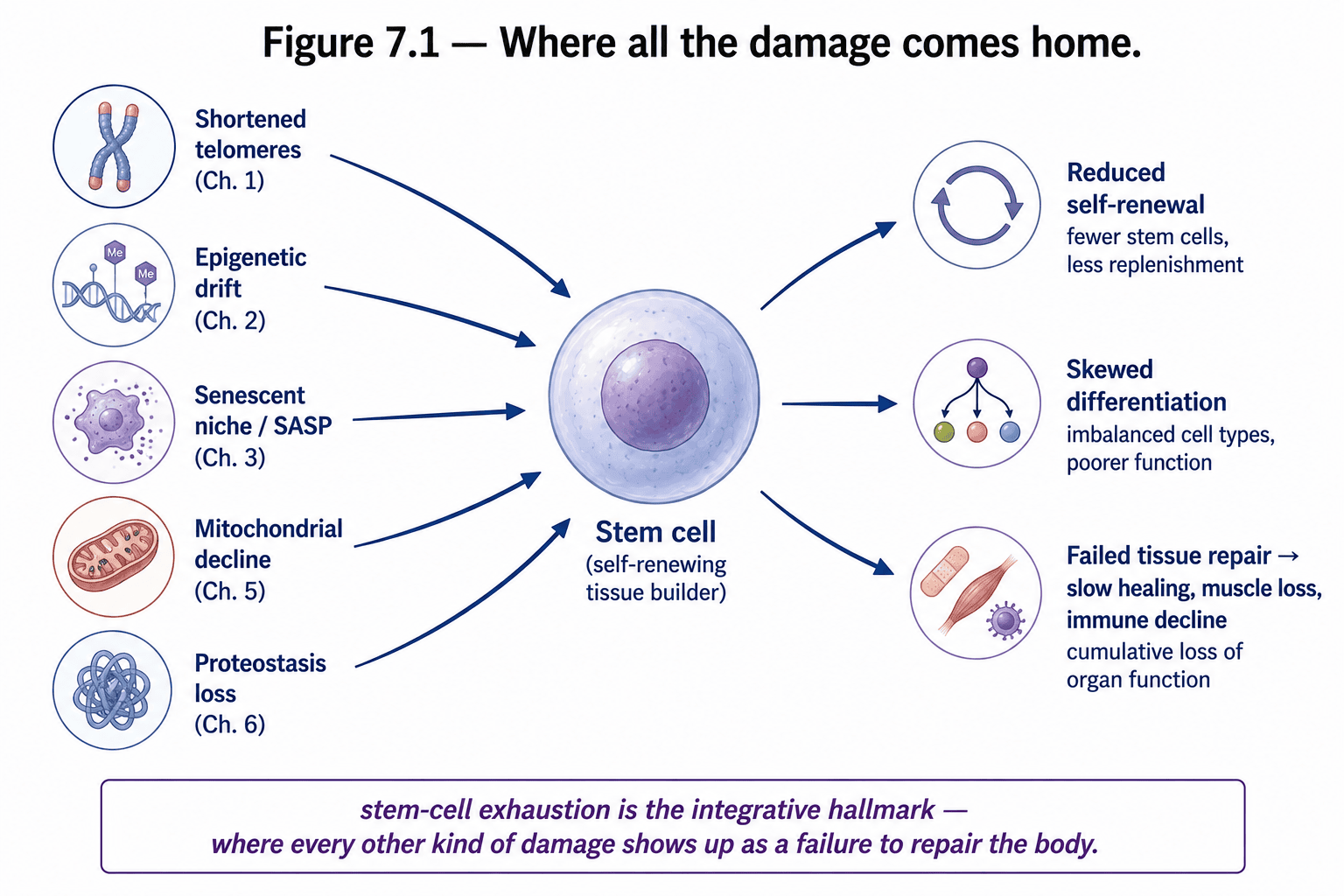
The body repairs and renews itself using stem cells — a reserve of unspecialized cells, kept in every tissue, that can do two things no ordinary cell can: copy themselves indefinitely (self-renewal), and turn into the specialized cells a tissue needs (differentiation). Your blood is completely replaced every few months from a small pool of blood-forming stem cells; the lining of your gut is rebuilt every few days; your muscle repairs itself after exercise or injury by calling on dormant muscle stem cells. Stem cells are how a body that is constantly wearing out manages, for most of a lifetime, to keep itself whole. And the hallmark of aging called stem-cell exhaustion is the slow failure of that reserve: with age, stem cells decline in function, lose self-renewal capacity, differentiate in skewed and unhelpful ways, and find themselves in a degraded local environment that no longer supports them well. The reserve runs down, and the body’s lifelong project of repairing itself falters. This is why old wounds heal slowly, why muscle is lost (sarcopenia), why the immune system renews itself less effectively, why so many tissues thin and weaken.
Here is what makes this the right place to end the tour: stem-cell exhaustion is less a separate hallmark than the place where all the others come home to roost. Why do aged stem cells fail? Because their telomeres have shortened (Chapter 1). Because their epigenome has drifted (Chapter 2). Because their niche is poisoned by senescent cells and the SASP (Chapter 3). Because their mitochondria and proteostasis have declined (Chapters 5 and 6). Every form of damage we have catalogued converges on the stem cell, and the visible result of that convergence is a body that can no longer repair itself. Stem-cell exhaustion is aging made manifest as a failure to heal.
There is a famous and slightly eerie experiment that points toward this chapter’s radical idea. If you surgically join the circulatory systems of a young mouse and an old mouse, so they share blood, the old mouse’s tissues partially rejuvenate — its muscle and liver and brain stem cells start behaving more youthfully — while the young mouse ages. The result was electrifying, because it suggested that aging is not solely locked inside each cell but is influenced by signals circulating in the blood and the cellular environment — and that an old stem cell is not necessarily broken beyond repair, but partly held down by its surroundings. This launched a wave of excitement about “young blood” as a fountain of youth. But the honest follow-up, very much in the spirit of this whole book, complicated the fairy tale: the rejuvenation appears to come less from magical youthful factors in young blood than from diluting the pro-aging factors that accumulate in old blood — with growing evidence that old blood being bad matters more than young blood being good. And the commercial young-blood-transfusion clinics that sprang up to sell the dream were selling something unproven; regulators warned against them, and they faded. The real lesson survived the hype: the aged cell is partly suppressed by its state, which means it might, in principle, be un-suppressed — reset. Which raises the most radical question in the field. If an old cell can be coaxed to behave young, how far back can we push it? All the way?
The one-way trip, reversed
To see how astonishing the answer is, you need a picture of cell identity that biologists carried, essentially unquestioned, for most of a century.
The picture is the Waddington landscape, named for the biologist who drew it in 1957, and it is the developmental cousin of the folding funnel from the last chapter. Imagine a ball at the top of a hilly landscape, poised to roll down. At the top, the ball is a fertilized egg or an embryonic cell — pluripotent, able to become anything. As it rolls down, the landscape branches into valleys, and the ball is funneled into one of them: it becomes a neuron, or a skin cell, or a muscle cell, and as it descends further into its valley it becomes more specialized, more committed, more locked in. The valley walls hold it in place; what is those walls, physically, is the epigenome from Chapter 2 — the pattern of methylation and chromatin marks that defines and maintains the cell’s identity, telling a skin cell to keep being a skin cell. And the deep, century-old assumption was that this is a one-way trip. The ball rolls downhill into its valley and stays there. A neuron is a neuron for life. You cannot, the thinking went, push the ball back up the hill.
All 10 chapters of Will you live to 120? · Foundations · All courses