Will you live to 120?
Chapter 3 · The Cells That Won’t Die
Senescent cells protect you from cancer when you’re young and poison your tissues when you’re old — which is why clearing them is the field’s most beautiful idea, and so far its most expensive disappointment.
Companion notebook · Chapter 3. When Cleanup Loses: the Senescent-Cell Tipping Point — open it in Google Colab and build it yourself: Open in Colab →
The cell that refuses to die
When Leonard Hayflick watched his fibroblasts stop dividing after fifty doublings, he assumed they were simply worn out — old cells running down like a clock with a tired spring. For a long time that is how everyone read it: senescence was passive exhaustion, the cellular equivalent of fatigue. It took decades to see that this was almost exactly backwards. A senescent cell is not a cell that has run down. It is a cell that has been deliberately, actively switched into a new state — one it cannot leave, one with a purpose, and one that turns out to be far more sinister for the tissue around it than mere exhaustion would ever be.
A senescent cell stops dividing, permanently. But it does not die. It sits in your tissue, alive and metabolically busy, often swollen to several times its normal size — and it spends its time secreting a steady cocktail of inflammatory and tissue-corroding molecules into its surroundings. It won’t divide, it won’t die, and it harms the living cells nearby. The popular name for this is the zombie cell, and for once a piece of popular-science shorthand is precise rather than misleading — but only if we are exact about what we mean. The cell is “undead” in three specific, mechanistic senses: it has been locked out of the cell cycle so it cannot proliferate; it has actively reinforced the pathways that keep it from dying, so it resists the normal cellular suicide that would clear it; and through what it secretes, it actively damages the healthy tissue it lives in. Not a tired cell. A cell that has chosen retirement over death, and makes its neighbors pay for the choice.
We met the first reason a cell does this in Chapter 1: when a telomere gets critically short and is read as DNA damage, the cell withdraws permanently from division — replicative senescence, the molecular basis of the Hayflick limit. But telomere exhaustion is only one trigger. A cell will also flip into senescence if an oncogene fires and threatens to turn it cancerous (a beautiful piece of self-defense called oncogene-induced senescence), if it suffers DNA damage it cannot repair, if it is poisoned by oxidative or metabolic stress, or if chemotherapy batters it. The common thread is danger — specifically, the danger of a damaged cell continuing to divide. And that tells you what senescence is for.
What a senescent cell actually is
Underneath the zombie metaphor is a precise piece of cell-cycle biology, and it is worth getting right, because the same machinery shows up again when we try to kill these cells.
For many proliferative tissues, dividing is the default state; senescence is an enforced, locked exit. The lock has two main bolts. The first runs through the protein p53 — the cell’s master damage sensor from Chapter 1 — which, when persistent damage is detected, switches on a small protein called p21. The second runs through a protein with the unlovely name p16^INK4a. Both p21 and p16 are cyclin-dependent kinase inhibitors: they jam the enzymes (the CDKs) that the cell normally uses to push itself through the cycle from one division to the next. With those enzymes jammed, a gatekeeper protein called Rb stays clamped down on the genes needed to copy DNA, and the cell simply cannot enter the next round of division. Throw both bolts and reinforce them — the cell even repackages the relevant stretches of its genome into dense, silent heterochromatin so the proliferation genes can’t be switched back on — and the arrest becomes effectively permanent. This is why senescence is not reversible the way a cell merely pausing between divisions is. The exit has been welded shut.
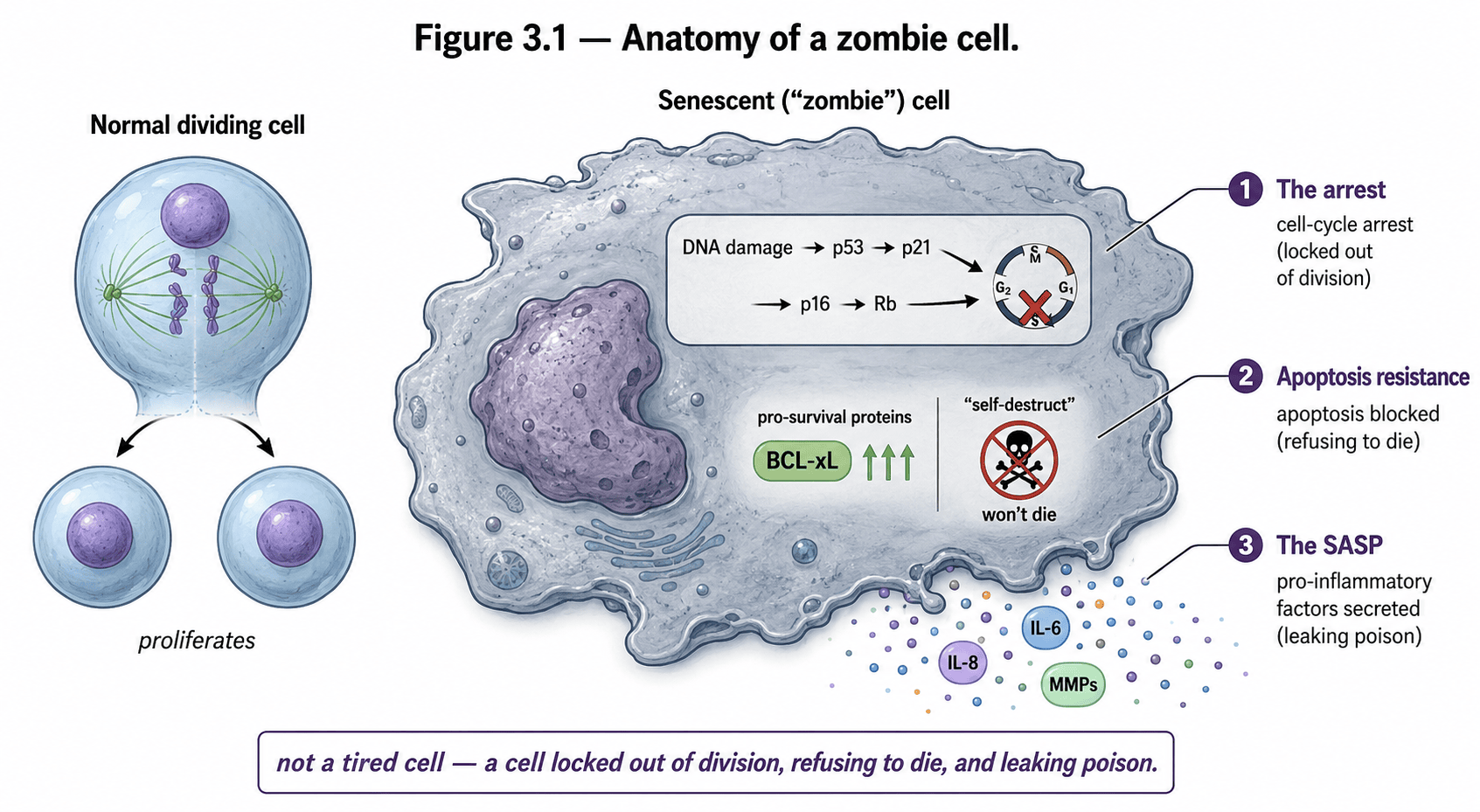
Now an honest complication that matters for everything downstream: there is no single, reliable marker that says “this cell is senescent.” The classic stain — for a lysosomal enzyme abbreviated SA-β-gal — is suggestive but not specific; p16 is a workhorse marker but not universal; the enlarged shape, the loss of a nuclear-envelope protein called Lamin B1, the persistent DNA-damage signals, the secretory profile — each is a hint, none is proof. Senescence is a heterogeneous state: a senescent liver cell, a senescent immune cell, and a senescent fibroblast can look and behave quite differently, and a cell can be partway in. Researchers identify senescence by a combination of features, not a single test. Keep this in your pocket too, because it is one of the central practical reasons the therapies are hard — if you cannot cleanly say which cells are senescent, you cannot easily confirm that a drug cleared the right ones, and (as we will see) a machine-learning problem is hiding right here.
The poison they spread
The most consequential thing about a senescent cell is not that it stopped dividing. It is what it secretes. The cocktail has a name — the senescence-associated secretory phenotype, the SASP — and it is the mechanism by which a handful of retired cells can degrade an entire tissue.
All 10 chapters of Will you live to 120? · Foundations · All courses