Calculus I · When You Can’t Solve It, Chase It
Newton’s method: replace the curve with its tangent, and repeat
We want a root of — a place where . Suppose we have a guess that is in the neighborhood but not exact. From Chapter 6 we know that near , the function is almost equal to its tangent line:
The curve is hard. The tangent line is easy — it is just a straight line, and a straight line crosses zero in exactly one obvious place. So here is the whole idea: instead of asking where the hard curve hits zero, ask where its easy tangent line hits zero, and use that as our next guess. Set the right-hand side to and call the solution :
Solve for — just rearranging:
That is Newton’s method. You did not memorize it; you built it. Geometrically: stand on the curve above your guess, slide down the tangent line until it hits the -axis, and step over to that spot. The new spot is almost always closer to the true root. Then do it again. (Figure 9.1: the curve, the tangent at sliding to the axis at , the tangent at sliding to , the guesses marching in toward the root.)
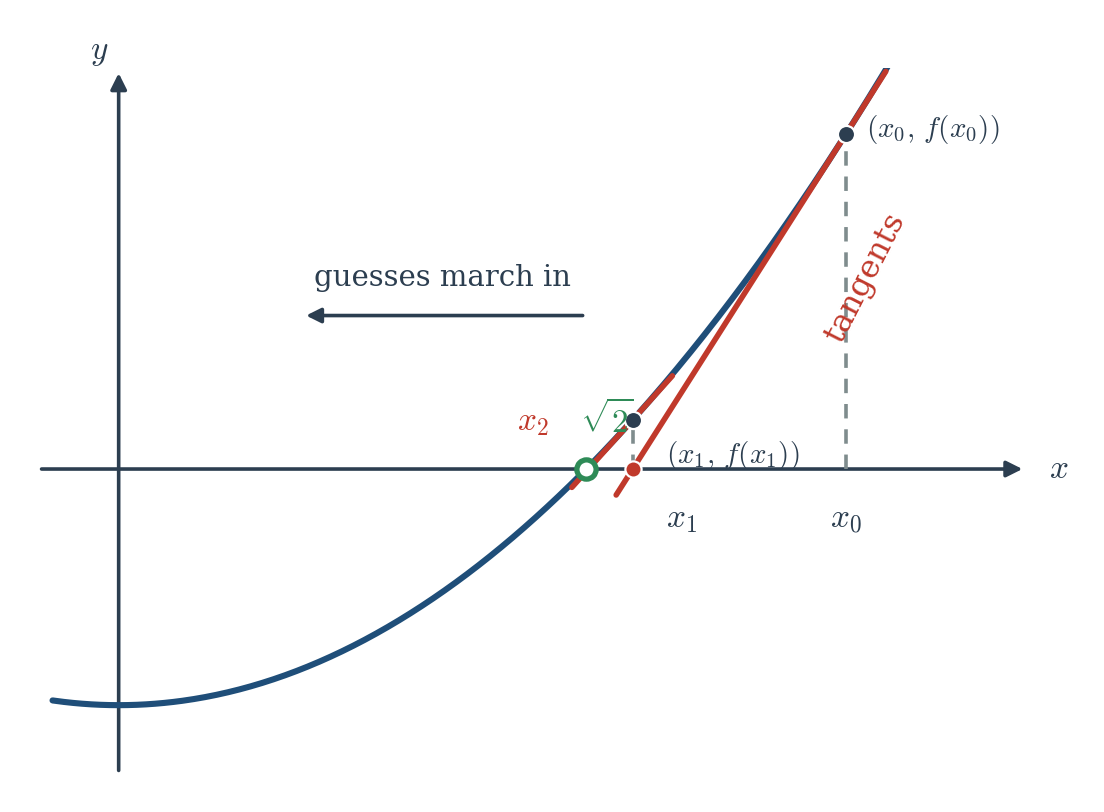
Watching it work: computing by hand
In Book 1, the very first irrational number we met was — a number with no exact fraction and no terminating decimal. We could prove it existed but we could not write it down. Now we can chase it.
Finding means finding the root of (since means ). Its derivative is . Drop these into Newton’s formula:
Start with a rough guess, , and turn the crank:
| step | value | correct digits |
|---|---|---|
| — | ||
The true value is . Look at the last column: the number of correct digits roughly doubles every step — two, then five, then eleven. After three steps from a sloppy start we have eleven correct digits. This blistering speed is called quadratic convergence, and it is Newton’s signature. (That formula , by the way, is the square-root method the Babylonians used four thousand years ago. They had no calculus; they found the rule by cleverness. You just rediscovered it from a tangent line.)
Toolkit: Newton’s method (finding a root)
To solve when no formula will: 1. Pick a starting guess somewhere near the root. 2. Repeat: . 3. Stop when the guesses stop changing (to as many digits as you need).
What it’s really doing: approximating the curve by its tangent line and jumping to where the line hits zero. Fast — digits roughly double each step — when it works. The next section is about when it doesn’t.