Calculus I · Patterns That Go Somewhere
Three fates
Not every sequence converges. There are exactly three things a sequence can do, and naming them honestly keeps you from forcing a limit where there is none.
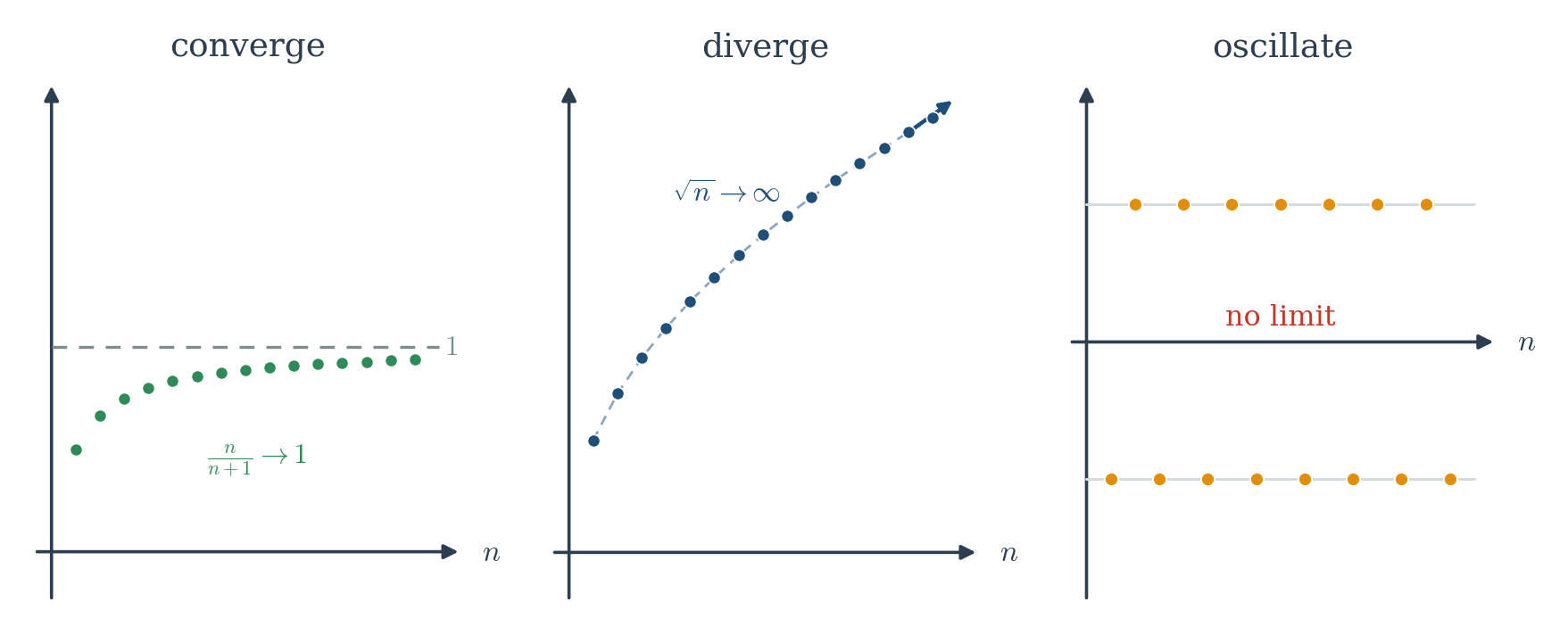
It can converge — settle to a single number , like .
It can diverge to infinity — grow without bound, like or like a geometric sequence with . There is no limit; the terms outrun every ceiling.
It can oscillate — bounce around and never settle, like , which is forever. It stays bounded but it has no limit, because it never gets and stays close to any one number. (It is near half the time and near the other half; “near half the time” is not convergence.)
That last case is the warning the rest of this section answers. Squinting at a table can fool you — a few terms can look like they’re settling when they’re not. To be sure, we need to say exactly what “gets and stays arbitrarily close” means. That is Layer 2.
◆ Layer 2 — What “approaches” really means
Here is the definition that makes calculus rigorous. It looks intimidating for about a day and then becomes the most natural thing in the world. Read it as a game between two players.
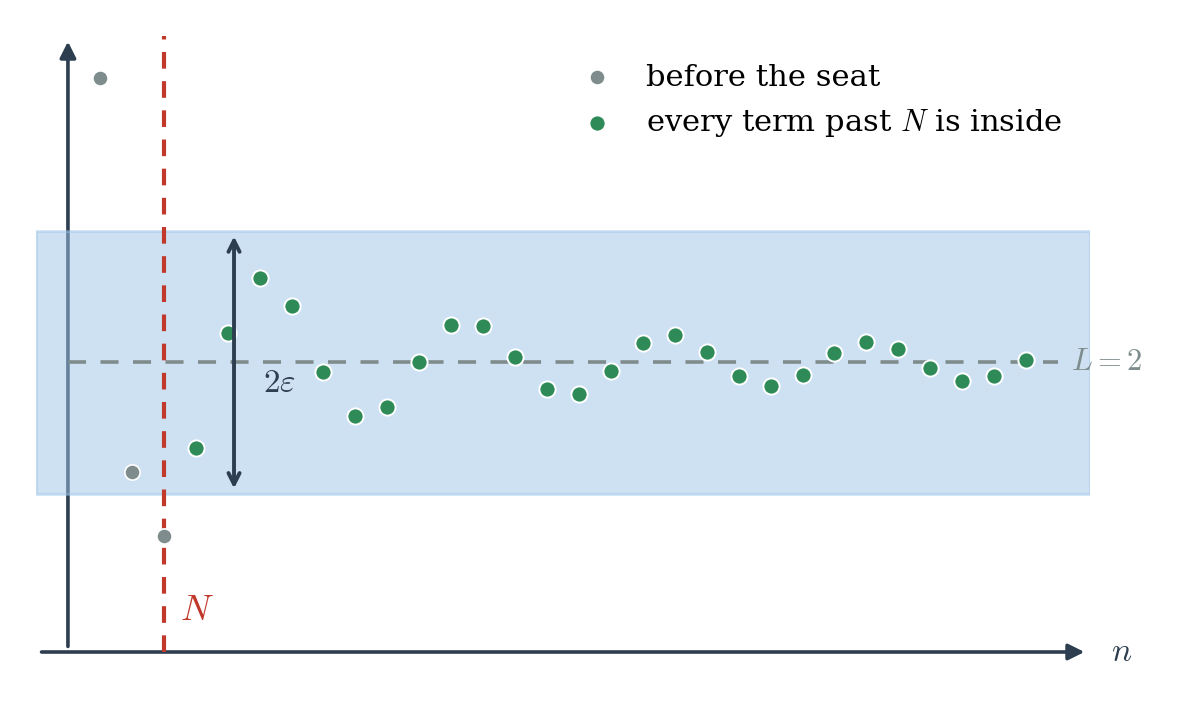
Definition. means: for every tolerance , there exists a cutoff such that for all , .
The game. A skeptic hands you a tolerance — say, “I bet your terms don’t get within of and stay there.” Your job is to answer with a cutoff — a seat number — and promise: “every term from seat onward is within of .” If you can win this game no matter how tiny a tolerance the skeptic names, then is true. The quantity is just the distance from the term to the target; says “this term is inside a window of width around .”
Why this and not “gets closer and closer”? Because “gets closer and closer” is a trap: the sequence might get closer for a while and then wander off, and the vague phrase can’t tell. The – definition forbids wandering off: past the cutoff, every term must stay in the window. That single word “every” is what your intuition was missing.
◆ Proof:
We play the game. Let a tolerance be handed to us. We must produce a cutoff so that for all , the distance is less than .
We want . Rearranging, that is the same as . So we simply choose to be any whole number with . (Such a whole number always exists — the number line never runs out of integers above a given value. That’s a basic property of the reals, sometimes called the Archimedean property.)
Now check it works: if , then , which rearranges back to . So every term past seat is within of . Since we won the game for an arbitrary , the limit is .
Sit with this one. It is the first real – proof in the book, and almost every other convergence proof is this same three-move dance: let be given → solve the inequality for → choose accordingly and verify.
◆ Proof: when
This is the fact the whole of Chapter 8 will lean on, so it deserves a real proof. Assume (the case is trivially ).
Since , its reciprocal is bigger than , so we can write for some . Then . Now use Bernoulli’s inequality, (proved in problem 30), to push the denominator up and the whole fraction down:
Now play the game. Given , we want , i.e. . Choose . Then for every we have . So .
The engine is the same as before — the only cleverness was rewriting as so that Bernoulli’s inequality could turn the shrinking power into an honest -style bound we already know how to beat.
◆ Layer 2 — Sequences that must arrive (and the birth of )
Sometimes you can see a sequence climbing steadily but you cannot compute its limit directly — exactly the situation with . There is a beautiful principle that rescues us, and it comes straight from the property of the real number line you met in Book 1: the line has no gaps.
The Monotone Convergence principle. A sequence that is increasing and bounded above (never climbs past some ceiling) must converge to a limit. (Likewise: decreasing and bounded below must converge.)
The picture is honest and the gaplessness is doing the work: an increasing sequence trapped under a ceiling has nowhere to escape to, and because the real line has no holes for it to pile up against, there is a genuine number it closes in on. (On a number line with gaps — like the rationals alone — this can fail, which is precisely the defect Book 1’s irrational numbers fixed.)
Now point it at our mystery sequence. The sequence turns out to be increasing (each term beats the last — take this on faith here; it’s true and provable) and bounded above by (it never reaches — you’ll prove this yourself in problem 31, and the proof reuses the geometric sequence from this very chapter). Increasing and bounded above: by the principle, it must converge. Its limit is a real, specific number, and since it doesn’t equal anything we’ve already named, we give it a new name:
Notice what just happened: we proved exists without ever computing it exactly — the principle guarantees a limit is there to be found. That is a new kind of power. We will discover in Chapter 5 that this same is the one base whose exponential curve is its own slope, and we’ll prove the two descriptions match in Chapter 10. Born here, fully understood three chapters from now.