Calculus I · Patterns That Go Somewhere
The many faces of
The sequence is the most important fight in all of mathematics, and it has a whole family. What if we replace that in the numerator with some other number ?
This single fact is the bridge from this chapter to Chapter 5. It says is not a one-off curiosity: it spawns an entire function , and that function is born from compounding. Set and recover the original . Set : . Set : . Try a few on a calculator and watch them land on powers of .
◆ Layer 2 — Why (one honest loan)
Take the logarithm, which turns the frightening exponent into a product (Chapter 5 makes rigorous; here we borrow only that pulls a power down into a multiplier): Let , so , and the right side becomes . One more famous limit closes it: as (this is the slope of at , proven in Chapter 5 — the loan). So the logarithm of our sequence , which means the sequence itself . Notice it is the same shape that turned up in Fight one. The limits that fight back are almost always derivatives wearing a costume — you’ll see this confirmed in Chapters 2 and 3.
The race decides everything: three sequences, three fates
The form is indeterminate precisely because the answer hinges on a race — how fast the base sinks toward versus how fast the exponent climbs to . Watch three sequences that all look like “” land in three different worlds:
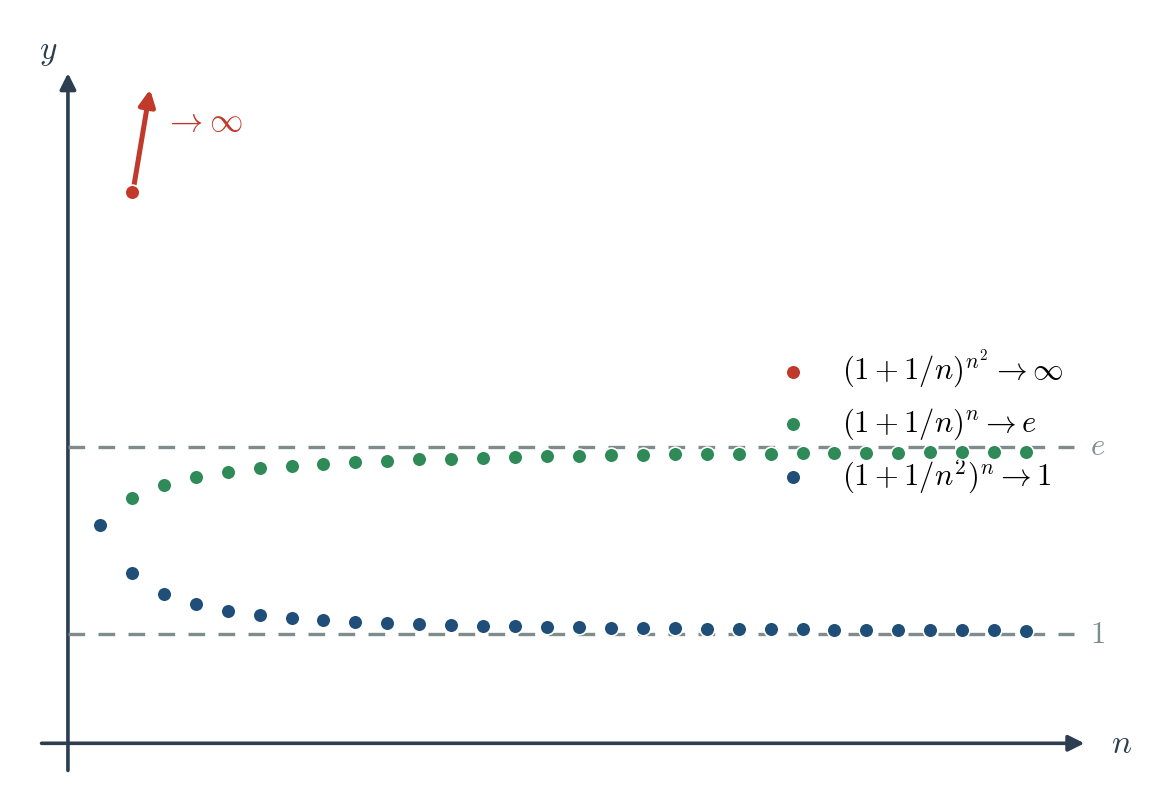
In the first, base and exponent are matched and balance at . In the second, the base rushes to too fast (like ) for a mere in the exponent to matter — its logarithm runs like , so the limit is . In the third, the exponent is too strong for the base’s gentle approach — its logarithm runs like , so it explodes.
Same form, three answers, decided entirely by who wins. Here’s the gauge that settles any of them at a glance: for a base near , look at ; whatever number that approaches, the limit is . Run the three cases through it and out pop , then , then . That is the entire secret of forms, and you now hold it.