Calculus I · Building a Function From Its Derivatives
The other flagships: sine and cosine
Two functions belong beside in any honest account of Taylor series, and now that you can differentiate them (Chapter 4), they fall out just as cleanly. Center both at .
For , the derivatives cycle: , repeating every four. Evaluated at they read — every even derivative is , every odd one is . So only odd powers survive, with alternating signs:
For , the same cycle evaluated at reads — only even powers survive:
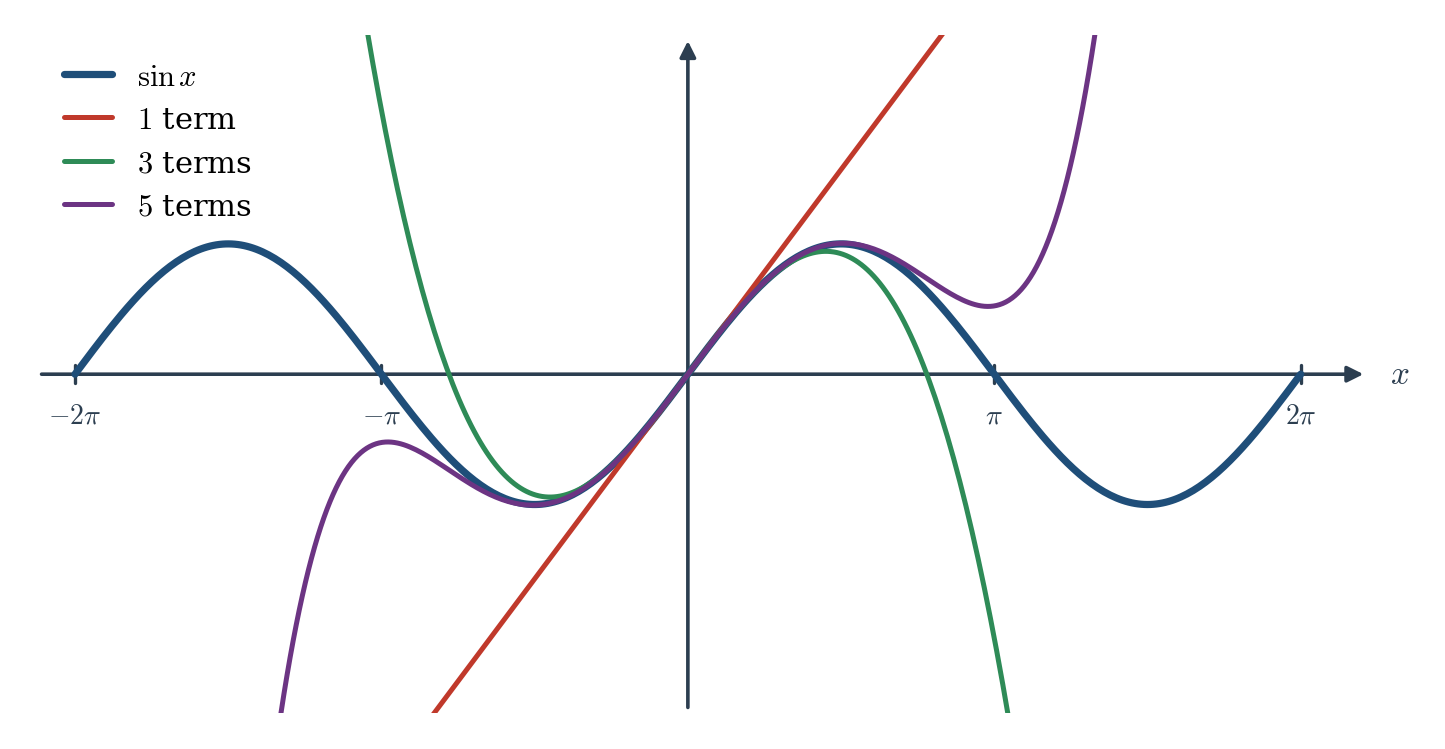
Two things to notice. First, keeps only odd powers and only even ones — which is exactly the statement that is an odd function (symmetric through the origin) and is even (mirror-symmetric across the -axis). The symmetry of the function and the parity of its surviving powers are the same fact. Second, the leading term of is just — so , which is the famous limit from Chapter 2, now visible as nothing more than “the first Taylor term is .” (Figure 7.6: overlaid with its -, -, -term Taylor polynomials, each tracking the wave over more humps before peeling off.)
◆ Layer 2 — Euler’s formula: where exponential meets trigonometry (and Book 1 pays off)
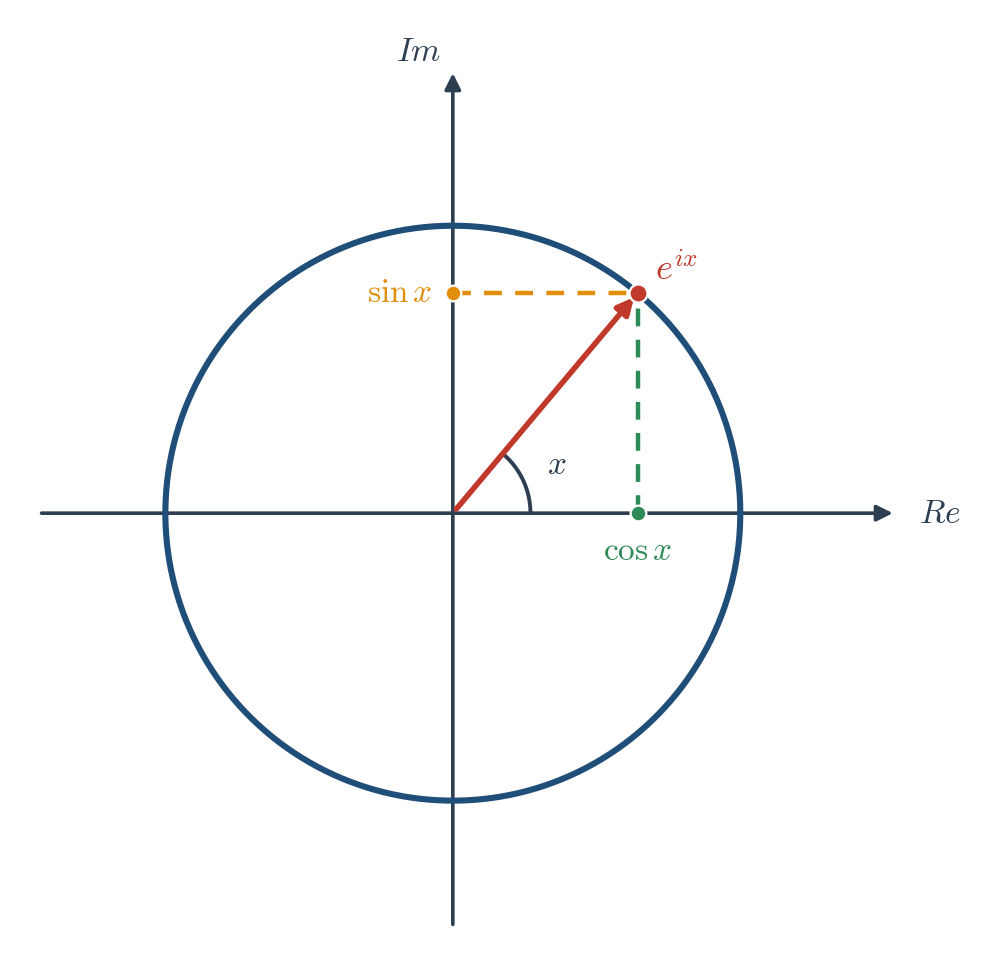
Lay the three series side by side and something extraordinary appears. We have Now feed in an imaginary input — replace with , where (the number you built in Book 1). The powers of cycle , so the terms split into a real group and an imaginary group: The real part is exactly the cosine series; the imaginary part is exactly the sine series. So This is Euler’s formula, and it is one of the deepest sentences in mathematics: the exponential that governs growth and decay, the circular functions that govern waves and rotation, and the imaginary unit from Book 1 are the same object seen from three sides. Set and, since and , it collapses to Euler’s identity, — the single equation tying together , , , , and . The complex numbers you met in Book 1, which had no payoff in single-variable real calculus, were waiting for exactly this moment.
A door left ajar. A Taylor series builds a function out of powers of — — and is at its best near a single point. But there is a second great expansion, just as important, that builds a repeating function out of waves — — and is at its best across a whole interval. It is called a Fourier series, and through Euler’s formula those waves are exactly the complex exponentials you just met. Where Taylor asks “what polynomial matches this curve right here?”, Fourier asks “what mixture of pure tones makes up this signal?” — which is why it underlies music, images, data compression, and the analysis of anything that vibrates or repeats. The tools to build it (and to make sense of infinitely many waves added together) belong to Book 3; for now, just notice that powers are not the only basis a function can be written in, and file the word away.