Calculus I · Adding Up Forever
Principle 1 — Comparison: trap it between sums you know
The first principle is exactly what you’d do by instinct: if your series is term-by-term smaller than one you know converges, it must converge too; if it’s larger than one you know diverges, it must diverge.
Comparison. Suppose for all . If converges, then converges. If diverges, then diverges.
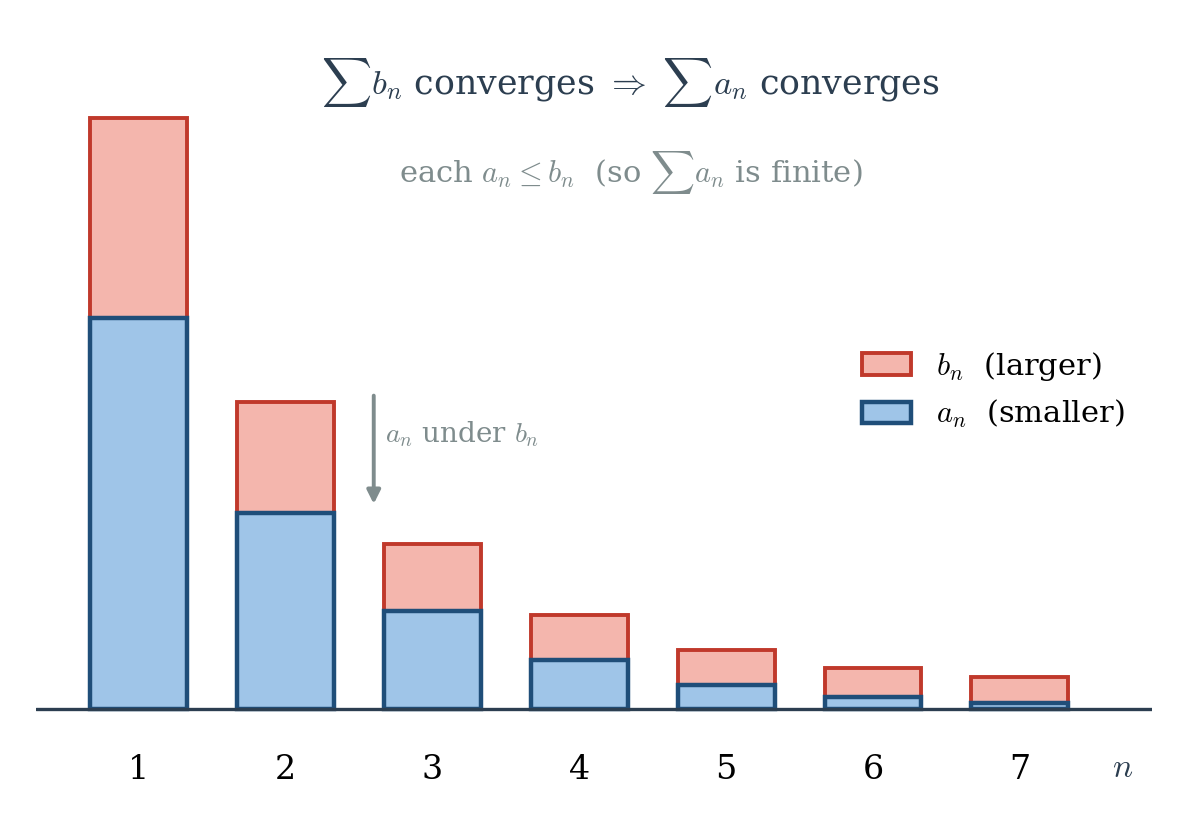
The geometric series is usually the thing you compare against. For instance, has every term smaller than , and is a convergent geometric series — so by comparison, converges. The whole skill is recognizing what to compare to: bound your complicated series above by a simple convergent one (to prove convergence), or below by a simple divergent one (to prove divergence). (Figure 12.2: two stacks of bars, the bars sitting entirely under the bars, with the total marked finite — so the total is trapped finite beneath it.)
Principle 2 — The integral test: weigh the sum against an area
The second principle is the one that earns this chapter its place at the end of a calculus book, because it connects a sum to an integral — and it does so with the very rectangle-and-curve picture you built in Chapters 10 and 11.
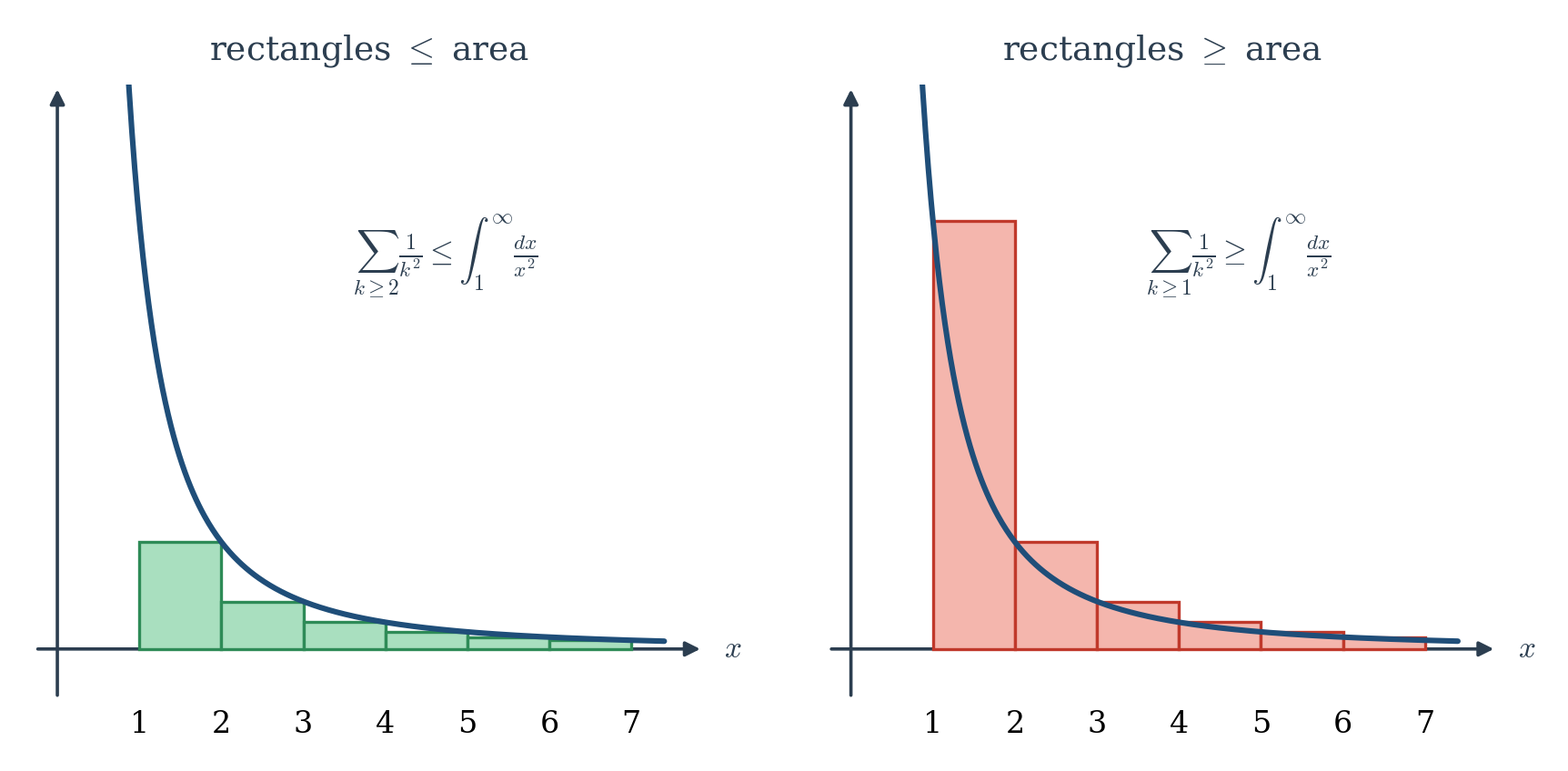
Take a series whose terms come from a function that is positive, decreasing, and continuous. Draw the terms as rectangles of width and height , and lay them against the graph of . Because is decreasing, each rectangle is trapped between the area just under and just over the curve — and summing across all of them traps the whole sum between two copies of the same integral:
The sum and the integral differ by at most the single term , so they are finite together or infinite together. That is the test:
The integral test. For positive, decreasing, continuous , the series and the integral either both converge or both diverge.
Look at what just happened: the integral you learned to compute with the Fundamental Theorem now decides infinite sums. The rectangles that defined the integral in Chapter 10 reappear here as the terms of a series, and the area they approximate settles whether the sum is finite. Adding up infinitely many numbers and measuring the area under a curve are, once again, the same question. (Figure 12.3: the curve with the series’ rectangles drawn against it — one set tucked under the curve, one rising above — visibly squeezing the sum to the area.)
The p-series, settled at last — and a debt from Chapter 11 repaid
Apply the integral test to the family . Convergence hinges on — which we computed in Chapter 11: it is finite exactly when . Therefore:
converges if and only if .
This resolves the cliffhanger Chapter 11 left you with. There, was infinite while was finite — and you were asked to predict which of and converges. Now you know, and you know why they match: the harmonic series () diverges because its integral does; () converges because its integral does. (That sum, remarkably, equals — a fact whose proof waits for the Fourier methods of Book 3.) The sum and the area live or die together, exactly as Chapter 11 promised.