Now that we have the product and chain rules, the quotient rule is almost free. Write a quotient as a product with a negative power: . The derivative of is, by power-rule-plus-chain, . So the product rule gives , and combining over :
The Quotient Rule.
In words: bottom times derivative of top, minus top times derivative of bottom, all over the bottom squared. (The order matters — the minus sign makes it non-symmetric.) Example: .
The trigonometric derivatives (where Chapter 2 finally pays off)
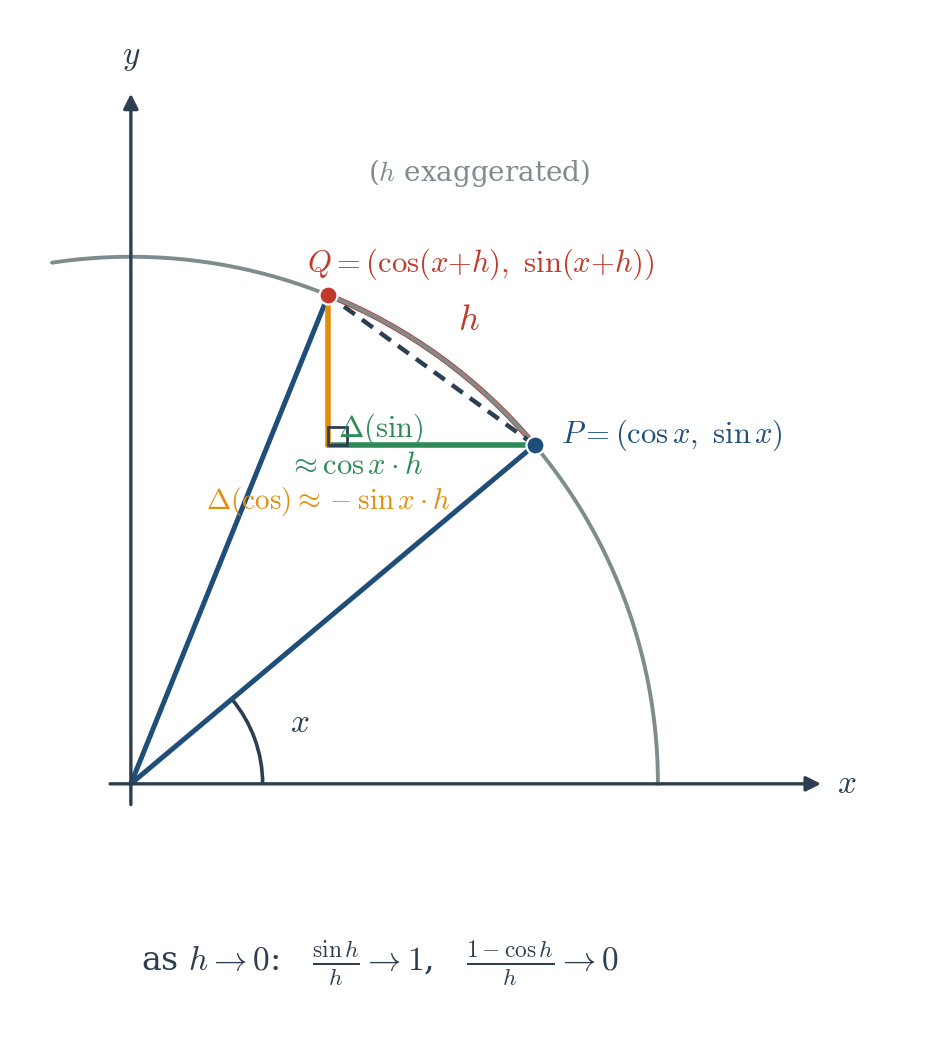
We promised, back in Chapter 2, that the two strange limits we proved there — and — were the tools that would unlock the derivatives of sine and cosine. Here is that promise kept, and it’s worth savoring because it’s the whole reason those limits earned a place in the book.
Figure 4.4
Differentiate from the definition. The key is the angle-addition formula :
Now let . The first fraction goes to and the second goes to — exactly the two Chapter 2 limits — so the whole thing becomes :
The identical computation with gives
(the minus sign because cosine is falling as it leaves ). And now yields to the quotient rule: . These are the derivatives that Chapter 7 used to build the Taylor series of and (and, through them, Euler’s formula) — now derived from the ground up.